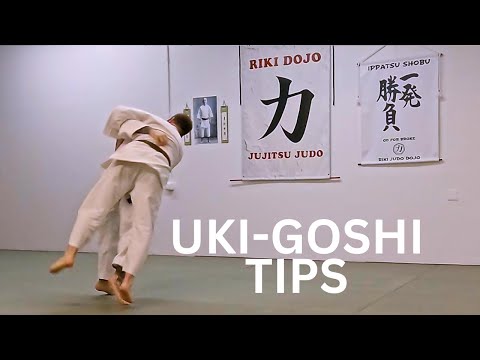
Uki-Goshi Tips | Riki Judo Dojo
0
Standard Uki Goshi·Riki Judo Dojo·Added by Admin
Riki sensei explained uki-goshi (浮腰 - floating hip throw) during judo class on 11-10-2022. 0:00 definition 0:16 uki-go…
Translation: floating hip throw
Standard Uki Goshi executes the classical floating hip throw where the thrower turns partially to the side, places the hip against the opponent's front hip, and uses a sweeping hip motion combined with arm pulling to float the opponent over the hip to the mat. [1] The partial turn means the thrower faces more sideways than in o-goshi, with the hip acting as a glancing fulcrum rather than a direct loading platform. [1],[2] The technique produces a smooth, flowing throw that relies on timing and redirection rather than raw lifting power. [2],[3]
Uki goshi (floating hip throw) is effective as a transitional throw, frequently used to enter into more powerful techniques like o goshi or harai goshi when the initial float fails to complete the throw. [1] Its lighter hip contact makes it less powerful than o goshi but more adaptable to different situations. [2]
The standard uki goshi is occasionally scored in IJF competition. [1]
No images yet for this technique.
Sign in to suggest an image.
Riki sensei explained uki-goshi (浮腰 - floating hip throw) during judo class on 11-10-2022. 0:00 definition 0:16 uki-go…
No instructional courses yet for this technique.
Sign in to suggest a course.
Risk of injury to the person this technique is applied to
O-Goshi and variants; high amplitude hip throw with significant impact (Kano 1986)
Skill level needed to execute this technique reliably
Whether this technique is allowed under major competition rule sets
Kodokan Judo — Official Nage-waza Classification
Traditional Judo throwing technique terminology (Kodokan Institute)
Official Kodokan ground technique classification system
Standard Japanese martial arts terminology (kanji/hiragana)
Established Japanese martial arts naming convention — native Japanese term (和語/漢語)
Traditional Judo throwing technique terminology (Kodokan Institute)
hip rotation speed, core strength, lower back stability
strong hips and core, good flexibility for turning entry
hip rotators, core, quadriceps, latissimus dorsi
Shoulder contact and rotation are essential—your shoulder must impact and turn your opponent's shoulders to generate the throw. If your opponent's shoulders remain straight, the technique won't work effectively.
Instead of trying to push through a stiff arm, come up and use your shoulder to get inside. You can use a quarter turn and continue pulling rather than committing to a full rotation, similar to the entry mechanics shown in nagana kata.
Standard Uki Goshi executes the classical floating hip throw where the thrower turns partially to the side, places the hip against the opponent's front hip, and uses a sweeping hip motion combined with arm pulling to float the opponent over the hip to the mat. The partial turn means the thrower faces more sideways than in o-goshi, with the hip acting as a glancing fulcrum rather than a direct loading platform.
The standard form of uki goshi has been part of the Kodokan curriculum since the art's founding and holds special significance as one of the techniques personally developed by Jigoro Kano. It is taught in the Nage no Kata as one of the representative koshi-waza techniques.
IJF: legal — Legal throwing technique; IBJJF: legal — Legal at all belt levels; UWW: legal — Legal in both freestyle and Greco-Roman; Unified MMA: legal — Legal throwing technique; ADCC: legal — Legal; FIAS Sport Sambo: legal — Legal; FIAS Combat Sambo: legal — Legal
Danger rating 6/10. High — O-Goshi and variants; high amplitude hip throw with significant impact (Kano 1986)
The standard setup chain: Grip Setup (Kumi-kata) → Off-Balance (Kuzushi) → Entry (Tsukuri) → Execution (Kake).
Standard counters include: Lower Centre of Gravity — bend knees and drop hips to make the throw harder to execute / Block the Hip — post hand on the thrower's hip to prevent loading / Step Around — circle away from the throw direction to avoid being loaded / Grip Break — deny the thrower their preferred gripping configuration.
Common variants: Standard hip throw (full turn-in with hip below the opponent's centre of gravity); No-gi hip throw (adapted without gi grips, using overhook and collar tie); Drop hip throw (dropping to one knee to lower the fulcrum point); Combination hip throw (chaining from a failed foot technique or hand technique).
The standard uki goshi is occasionally scored in IJF competition.
Top errors to watch for: Entering square-on like o goshi instead of at an angle — removes the floating quality of the throw / Over-committing to the lift and stalling when uke resists / Not timing the hip bump with uke's forward momentum — throwing against a stationary opponent is much harder / Pulling uke sideways instead of forward-and-over the hip.
The Standard Uki Goshi is also known as Uki Goshi, Classical Floating Hip Throw, Standard Floating Hip, Kihon Uki Goshi.