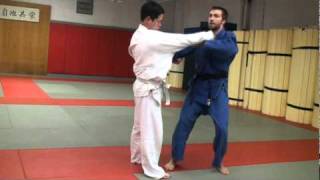
Understanding O Goshi Fundamentals
O goshi, meaning "big hip," is a fundamental throw often misunderstood as a beginner technique. Rather than classifying throws by skill level, instructors should recognize that fundamental techniques evolve into competitive and self-defense applications through proper execution and refinement.
Mechanics: Entry and Body Rotation
The critical advantage of o goshi lies in body rotation rather than arm strength. By entering and turning the opponent's body first, the practitioner eliminates shoulder strain and creates mechanical efficiency that makes the technique accessible to all body types and sizes.
Positioning Below Center of Gravity
Proper positioning requires the practitioner to maintain a lower center of gravity than the opponent, positioning the hip below the opponent's komamusubi (seam of the hips). Head position is equally important—turning the head creates the circular motion necessary for effective hip placement and rotation.
Hand Placement and Grip Mechanics
Rather than gripping with a closed fist, practitioners should use fingertips to secure a tight grip on the opponent's back. This open-hand approach allows for precise control and the ability to bend the fingers inward, ensuring proper engagement before executing the lift and rotation.
Hip Extension and Directional Lean
The hip must extend into the throw rather than remain vertical. The practitioner's body weight and lean should direct toward the intended throwing direction, with the elbow positioning itself to facilitate the turning motion rather than relying on upward pulling force.
Foot Placement and Shoulder Contact
Foot placement must cross the line of the opponent's big toe during entry, not step directly in front. The shoulder contact (katazuki) functions as a strike to initiate the turn, creating the momentum needed for effective hip positioning and throw execution.
Preventing Common Errors
Stepping over the opponent's stance, rather than stepping in, prevents jamming and maintains throwing effectiveness. This seemingly minor detail significantly impacts whether the practitioner successfully executes the throw or becomes vulnerable to being thrown themselves.
The Role of Kata in Technical Development
Kata, structured routines with specific patterns, emphasizes continuous improvement through attention to detail. Breaking down techniques into these precise elements allows practitioners to identify and refine the subtleties that distinguish successful execution from failure.
Commitment and Partner Respect
Hesitation during technique execution disrespects both the practitioner and their partner, who prepares to receive proper ukemi (breakfalling). Practitioners must commit fully to the throw once entry begins, following through to completion without overthinking or second-guessing.
O-Goshi Tips | Riki Judo Dojo
Key Takeaways
- •Understanding O Goshi Fundamentals
- •Mechanics: Entry and Body Rotation
- •Positioning Below Center of Gravity
- •Hand Placement and Grip Mechanics
Riki sensei explained o-goshi (大腰 - big/major hip throw) during judo class on 3-9-2023. 0:00 definition 0:10 relieving shoulder strain 0:23 a beginner's throw? 0:40 get below uke's center of gravity 0:55 the fundamental way of doing o-goshi 1:10 get your hip over 1:38 tsurite details 2:01 hikite details 2:21 the target 2:41 shoulder strike 2:56 how to practice 3:07 what is kata? 3:28 commit to the throw Riki sensei began Judo in Okinawa and is a Shichidan with over 56 years of study, practice, competition and teaching. He competed for 25 years at the local, national and international levels. A few of the great Judoka Riki sensei has studied and practiced with include: Kotani, Daigo, Ito, Inokuma, Okano, Kimura, Kaminaga and Nakatani. See Riki sensei teach every Monday, Wednesday, Thursday and Friday evening at 535 W. Iron Ave, Mesa, AZ 85210. Youth classes are 6 - 6:55 PM, adult classes are 7:00 - 8:30 PM. For more info, please visit rikidojousa.com The purpose of this YouTube channel is to pass on the original, traditional, authentic Kodokan Judo that Riki sensei loves so much. Riki sensei's students maintain this YouTube channel (and are responsible for any errors), but you can find more of his thoughts at the Riki Judo Dojo Facebook page: https://www.facebook.com/Riki-Judo-Dojo-USA-194351210607759 14
Frequently Asked Questions
What does this video teach about standard o goshi?
This video covers understanding o goshi fundamentals, mechanics: entry and body rotation, positioning below center of gravity. It provides detailed instruction from Riki Judo Dojo.
How long does it take to learn standard o goshi?
The basic mechanics can be understood in a single session, but developing reliable execution requires consistent drilling over weeks of practice. This 9-part breakdown helps structure your training by isolating each phase of the technique.
What are the key details for finishing standard o goshi?
Kata, structured routines with specific patterns, emphasizes continuous improvement through attention to detail. Breaking down techniques into these precise elements allows practitioners to identify and refine the subtleties that distinguish successful execution from failure.