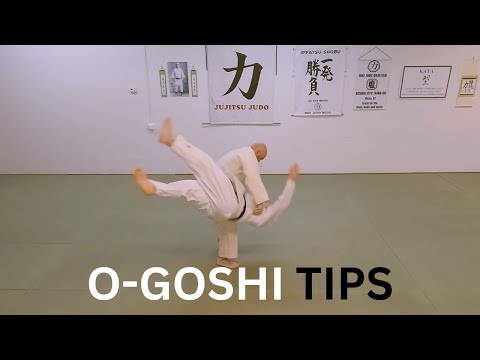
O-Goshi Tips | Riki Judo Dojo
0
Standard O Goshi·Riki Judo Dojo·Added by Admin
Riki sensei explained o-goshi (大腰 - big/major hip throw) during judo class on 3-9-2023. 0:00 definition 0:10 relieving…
Translation: major hip throw
Standard O Goshi executes the classical major hip throw where the thrower turns in with the back to the opponent, wraps the throwing arm around the opponent's waist, loads the opponent onto the hip by pulling them forward, and rotates the hip to wheel the opponent over and onto the mat. [1] The arm around the waist provides a secure connection that prevents the opponent from separating during the throw. [1],[2] The throw is completed by a combination of hip rotation, pulling arm action, and forward bending that projects the opponent over the hip. [2],[3]
O goshi is one of the most straightforward and reliable throws in judo, effective for beginners and experts alike due to its simple mechanics — the arm around the waist provides a secure connection that makes it difficult for the opponent to escape once loaded onto the hip. [1] While experienced competitors can defend against it more easily than some other hip throws, its mechanical simplicity makes it one of the most consistently executable techniques. [2]
O goshi was included in the original 1895 Kodokan gokyo no waza as a first-set technique and has been taught as one of the foundational throws in the Kodokan curriculum since. [1] Jigoro Kano personally demonstrated o goshi in his teaching, considering it the fundamental hip throw from which all others derive. [2]
The standard o goshi is scored at all levels of judo competition. [1]
No images yet for this technique.
Sign in to suggest an image.
Riki sensei explained o-goshi (大腰 - big/major hip throw) during judo class on 3-9-2023. 0:00 definition 0:10 relieving…
No instructional courses yet for this technique.
Sign in to suggest a course.
Risk of injury to the person this technique is applied to
O-Goshi and variants; high amplitude hip throw with significant impact (Kano 1986)
Skill level needed to execute this technique reliably
Whether this technique is allowed under major competition rule sets
Kodokan Judo — Official Nage-waza Classification
Traditional Judo throwing technique terminology (Kodokan Institute)
Official Kodokan ground technique classification system
Standard Japanese martial arts terminology (kanji/hiragana)
Established Japanese martial arts naming convention — native Japanese term (和語/漢語)
Traditional Judo throwing technique terminology (Kodokan Institute)
hip rotation speed, core strength, lower back stability
strong hips and core, good flexibility for turning entry
hip rotators, core, quadriceps, latissimus dorsi
Rather than lifting them up and over, focus on turning their body instead. Riki Judo Dojo emphasizes that this rotational approach reduces strain on your shoulder and is far more effective than pure lifting mechanics.
You must always position yourself below your opponent's center of gravity, below the komamusubi. Riki Judo Dojo stresses that you should turn your head to make a circular movement rather than looking at your partner, and step across their big toe line as you turn in.
Keep your hand open rather than closed, using your fingertips to bend in and secure a tight grip around your opponent's waist. Riki Judo Dojo explains that you should lean in the direction you want to throw and bring your elbow in as you use your turn to complete the technique.
Shoulder rotation is critical—Riki Judo Dojo describes the shoulder strike (katazuki) as a powerful turning motion that allows you to get your hips over for the throw. Without proper shoulder turn, you won't generate the necessary power to complete the technique successfully.
Standard O Goshi executes the classical major hip throw where the thrower turns in with the back to the opponent, wraps the throwing arm around the opponent's waist, loads the opponent onto the hip by pulling them forward, and rotates the hip to wheel the opponent over and onto the mat. The arm around the waist provides a secure connection that prevents the opponent from separating during the throw.
The standard form of o goshi has been taught in the Kodokan curriculum since 1895 as one of the first techniques introduced to beginning judo students. Its fundamental mechanics make it the template for understanding all other hip throws.
IJF: legal — Legal throwing technique; IBJJF: legal — Legal at all belt levels; UWW: legal — Legal in both freestyle and Greco-Roman; Unified MMA: legal — Legal throwing technique; ADCC: legal — Legal; FIAS Sport Sambo: legal — Legal; FIAS Combat Sambo: legal — Legal
Danger rating 6/10. High — O-Goshi and variants; high amplitude hip throw with significant impact (Kano 1986)
The standard setup chain: Grip Setup (Kumi-kata) → Off-Balance (Kuzushi) → Entry (Tsukuri) → Execution (Kake).
Standard counters include: Lower Centre of Gravity — bend knees and drop hips to make the throw harder to execute / Block the Hip — post hand on the thrower's hip to prevent loading / Step Around — circle away from the throw direction to avoid being loaded / Grip Break — deny the thrower their preferred gripping configuration.
Common variants: Standard hip throw (full turn-in with hip below the opponent's centre of gravity); No-gi hip throw (adapted without gi grips, using overhook and collar tie); Drop hip throw (dropping to one knee to lower the fulcrum point); Combination hip throw (chaining from a failed foot technique or hand technique).
The standard o goshi is scored at all levels of judo competition.
Top errors to watch for: Entering with the feet too close together, reducing your base and making you unstable / Not pulling uke forward before turning in — if they're upright, the throw requires excessive force / Wrapping the arm loosely so uke can create space and block the hip / Lifting with the back instead of the legs — this is the primary cause of lower-back injury in hip throws.
The Standard O Goshi is also known as O Goshi, Classical Major Hip Throw, Standard Full Hip Throw, Kihon O Goshi.