Three Essential Motions
A proper wrestling stance enables three primary directional movements: forward and backward motion, lateral movement left and right, and circular motion clockwise and counterclockwise. Mastery of these movements forms the foundation of effective wrestling positioning and offensive capability.
Identifying Your Lead Leg
Approximately 90% of wrestlers naturally assume a right-leg-forward stance. To determine one's lead leg, the practitioner should stand relaxed and have a partner apply gentle backward pressure; whichever leg steps forward naturally indicates the lead leg. The distance traveled in this instinctive response indicates optimal lead leg placement.
Hip Level and Spinal Alignment
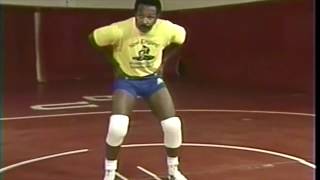
The hips must be lowered as far as individual anatomy permits, with particular accommodation for older students or those with knee limitations. The wrestler should maintain a pronounced hip hinge with the chest floating over the lead leg knee, while keeping the spine straight and the head elevated. This positioning prevents vulnerability to leg attacks and maintains readiness to initiate offense.
Hand Placement: Iowa Style Defense
The Iowa style hand positioning prioritizes defense of the lead leg, which sits closest to the opponent. The shield hand maintains disciplined placement over the lead leg while the attack hand makes initial contact, creating a defensive framework that protects vulnerable areas.
Hand Placement: Oklahoma State Style Offense
The Oklahoma State style features tight elbow positioning held close to the body, allowing the arms to extend outward aggressively from a ready position. This configuration generates offensive motion while the wrestler maintains relaxation and fluidity, avoiding unnecessary tension or tension-breaking movements.
Movement Mechanics and Footwork
Forward movement is led by the lead leg, while backward retreat is initiated by the back leg. Circular motion is led by whichever direction the wrestler circles. All movement requires short, choppy steps that maintain the feet underneath the body rather than wide, overextended strides.
Footwork and Defensive Positioning
Compact footwork preserves the ability to attack immediately while maintaining defensive integrity. Overstepping or moving too wide creates vulnerability to leg attacks and removes the wrestler from optimal offensive positioning. Staying centered under the body ensures continuous readiness.
Stance Conditioning Protocol
Wrestlers should condition their legs by moving through all ranges of motion in a staggered stance for maximum duration. Upon reaching exhaustion, the wrestler should continue five additional seconds before exiting the stance, then rest and repeat this cycle three more times. This protocol should be performed for one to two weeks to develop grappling-specific leg strength.
Stance Work as Primary Conditioning
Dedicated stance work provides sufficient conditioning for wrestling without requiring supplementary exercises like squats or jump training. The strength developed through stance conditioning is directly applicable to grappling movements and creates a superior foundation compared to general leg training. This focused approach optimizes training efficiency and sport-specific development.
The Essentials of a Wrestling Stance
Key Takeaways
- •Three Essential Motions
- •Identifying Your Lead Leg
- •Hip Level and Spinal Alignment
- •Hand Placement: Iowa Style Defense
🔥 Jiu Jitsu Practitioners, Ready to Finally Feel Confident on Your Feet? 🔥 FREE COURSE: The 2 takedowns you should focus on, regardless of age or skill level, when you’re not experiencing consistent success on your feet AND a unique way to drill so you can actually hit them live. 👉 Just tell us where to send it… https://www.wrestling.university/FREECOURSE
Frequently Asked Questions
What does this video teach about standard wrestling stance?
This video covers three essential motions, identifying your lead leg, hip level and spinal alignment. It provides detailed instruction from Wrestling University - Takedowns for Jiu Jitsu.
How long does it take to learn standard wrestling stance?
The basic mechanics can be understood in a single session, but developing reliable execution requires consistent drilling over weeks of practice. This 9-part breakdown helps structure your training by isolating each phase of the technique.
What are the key details for finishing standard wrestling stance?
Wrestlers should condition their legs by moving through all ranges of motion in a staggered stance for maximum duration. Upon reaching exhaustion, the wrestler should continue five additional seconds before exiting the stance, then rest and repeat this cycle three more times. This protocol should be performed for one to two weeks to develop grappling-specific leg strength.