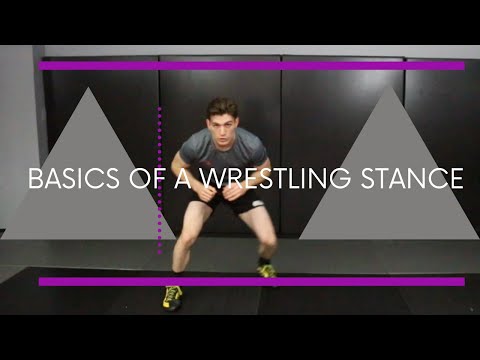
The Essentials of a Wrestling Stance
0
Standard Wrestling Stance·Wrestling University - Takedowns for Jiu Jitsu·Added by Admin
🔥 Jiu Jitsu Practitioners, Ready to Finally Feel Confident on Your Feet? 🔥 FREE COURSE: The 2 takedowns you should fo…
Translation: standard wrestling stance
The Standard Wrestling Stance positions the fighter in a low, staggered stance with the lead foot slightly forward, knees bent at approximately 90-110 degrees, hips low, back straight, and head up with hands forward at elbow level. [1] This stance provides the optimal balance between takedown offence (level change for shots), takedown defence (sprawling), and mobility (circling and angle changes). [1],[2] The standard wrestling stance is the foundation of all wrestling technique and is increasingly adopted in MMA for its grappling effectiveness. [2],[3]
The standard wrestling stance uses a staggered, slightly crouched position with hands forward, optimised for shot entries and sprawl defence. [1]
The wrestling stance is taught in all wrestling programmes worldwide. [1]
The wrestling stance is the standard position in Olympic and collegiate wrestling. [1]
No images yet for this technique.
Sign in to suggest an image.
🔥 Jiu Jitsu Practitioners, Ready to Finally Feel Confident on Your Feet? 🔥 FREE COURSE: The 2 takedowns you should fo…
No instructional courses yet for this technique.
Sign in to suggest a course.
Risk of injury to the person this technique is applied to
Standing positions are pre-engagement stances; minimal direct risk
Skill level needed to execute this technique reliably
Whether this technique is allowed under major competition rule sets
Advanced Brazilian Jiu-Jitsu Techniques (Marcelo Garcia, 2011)
Alias sources — [1] UWW Wrestling Rules [2] UWW Wrestling Rules [3] UWW Wrestling Rules
Effectiveness sources — [1] Wrestling Physical Conditioning Encyclopedia (Petrov, 1977)
Mixed Japanese-Western terminology — combines traditional Japanese terms with katakana loanwords
Alias sources — [1] UWW Wrestling Rules [2] UWW Wrestling Rules [3] UWW Wrestling Rules
Effectiveness sources — [1] Wrestling Physical Conditioning Encyclopedia (Petrov, 1977)
hook control, seatbelt grip endurance, hip connection
long legs for deep hooks, strong grip for seatbelt
hip adductors, biceps, forearms, core
You want your hips as low as your anatomy allows—if you have mobility limitations or bad knees, just get as low as you can. You don't want to stand straight up; instead, hinge at the hips with your chest floating over your lead leg knee.
Keep a straight back with no rounding, and maintain your head up. This protects you and keeps you ready to react rather than looking down or hunching over.
Use short, fast, choppy steps—never overstep or go too wide. Always keep your feet under you so you maintain an increased ability to attack and stay ready to react.
No—maintain good position but stay nice and loose and relaxed. Staying tense actually limits your ability to move and respond, so many wrestlers use small movements or brief pauses to remind themselves to stay relaxed.
The Standard Wrestling Stance positions the fighter in a low, staggered stance with the lead foot slightly forward, knees bent at approximately 90-110 degrees, hips low, back straight, and head up with hands forward at elbow level. This stance provides the optimal balance between takedown offence (level change for shots), takedown defence (sprawling), and mobility (circling and angle changes).
The standard wrestling stance is the product of centuries of wrestling development, refined through international competition and coaching at every level from youth to Olympic. It is universally taught as the fundamental wrestling position.
Unified MMA: legal — Legal; IBJJF: legal — Legal; IJF: legal — Legal; WBC/Boxing: legal — Legal — stance and footwork are fundamental; WKF: legal — Legal; UWW: legal — Legal
Danger rating 2/10. Low — standing positions are pre-engagement stances; minimal direct risk
The standard setup chain: Achieve Position → Stabilize → Maintain → Attack.
Standard counters include: Hand Fight — grip-fight the choking hand to prevent the rear naked choke / Shoulder Walk — walk shoulders to the mat to escape back control / Turn into Guard — rotate to face the attacker and recover guard position.
Common variants: Back control with hooks (both feet hooked inside the opponent's thighs); Body triangle back control (legs locked in a figure-four around the torso); Rear mount (mounted on the back with both hooks, opponent face-down); Chair sit back control (sitting behind the opponent with hooks, upright position).
The wrestling stance is the standard position in Olympic and collegiate wrestling.
Top errors to watch for: Keeping the knees straight — the deep bend is what provides explosiveness and stability / Placing the hands too high (boxing guard) — wrestling hands are lower for tie-ups and shot entry / Leaning forward excessively — the head should be over the lead knee, not past it / Not maintaining the stance during movement — the knee bend and stagger must be maintained while moving.
The Standard Wrestling Stance is also known as Sutandādo Resuringu Kamae, Classic Wrestling Stance, Standard Crouch, Basic Wrestling Position.