Barrel Roll Defined
The barrel roll is a chasing movement used when the attacker has established rotational control on the opponent's back but has not yet completed the position with full hooks. When the defending opponent begins rolling away to regain guard position, the attacker must chase quickly and explosively to maintain back control.
Defensive Back Positioning
When mounted on the back, the defender should turn their back away from the attacker as far as possible to minimize back exposure. By pointing the chest toward the attacker while rolling, the defender increases the distance the attacker must travel to re-establish chest-to-back connection.
Knee Placement and Fulcrum
As the opponent begins dropping their hip to roll, the attacker should place their knee in front of the opponent's hip to create a fulcrum. The attacker must beat the opponent to this position, planting the knee on the floor underneath the opponent's hip before the roll completes.
Hook Insertion During Motion
Inserting hooks is significantly easier while the opponent is rolling compared to static positions, as the legs become naturally disengaged from the torso during the movement. The attacker can insert the first hook during the barrel roll and add the second hook as the roll continues.
Barrel Roll Without Initial Hook
The barrel roll can be executed without an established hook provided the attacker has upper-body control such as a seat belt or motorcycle grip. The attacker jumps over the opponent as they roll, inserting the top hook into the hip while the knee fulcrum is placed underneath.
Importance of Knee Placement
With the knee positioned underneath the opponent as a fulcrum, the opponent cannot easily escape the hook because they are elevated above the mat. Without this fulcrum, the opponent's lower center of gravity allows them to scoot away and create distance from the attacker.
Modern Back Attack Methodology
The barrel roll represents contemporary high-level back attack methodology as seen in recent competition. Combined with related techniques for establishing back control, the barrel roll is considered one of the three most reliable core movements for successfully taking the opponent's back in modern Brazilian jiu-jitsu.
The Barrel Roll: When Turtle Turns Away From You
Key Takeaways
- •Barrel Roll Defined
- •Defensive Back Positioning
- •Knee Placement and Fulcrum
- •Hook Insertion During Motion
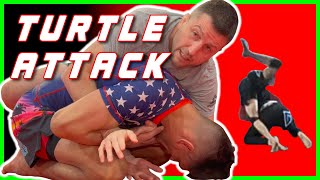
So far we have covered how to break your opponent down, and pull them towards you. However, many opponents will attempt to turn their back away from you and for good reason. The barrel roll is a technique that allows us to follow our opponent and give us the ability to attack in both directions when facing a turtling opponent. This technique takes some speed, so make sure you practice it a lot! The Barrel Roll: Intro: (00:00) How The Technique Fails: (00:25) The Barrel Roll: (02:36) The Importance Of Knee Placement: (04:27) Connecting The Turtle Attacks: (06:00) *** WANT MORE? *** Join hundreds of other BJJ athletes in our online academy led by BJJ Black Belt, Rob Biernacki. Access Rob’s constantly evolving concepts from beginner to advanced, personalized Q&A, and much more. Click here for the details – https://go.bjjconcepts.net/ytlink Use code "immunity" for a free week to try and 15% off after. Check out my Mantis Guard course, or my course for Health Care professionals (self defense and control strategies) at - https://courses.rvvbjj.ca
Related Techniques
Frequently Asked Questions
What does this video teach about standard turtle?
This video covers barrel roll defined, defensive back positioning, knee placement and fulcrum. It provides detailed instruction from RVV BJJ.
How long does it take to learn standard turtle?
The basic mechanics can be understood in a single session, but developing reliable execution requires consistent drilling over weeks of practice. This 7-part breakdown helps structure your training by isolating each phase of the technique.
What are the key details for finishing standard turtle?
With the knee positioned underneath the opponent as a fulcrum, the opponent cannot easily escape the hook because they are elevated above the mat. Without this fulcrum, the opponent's lower center of gravity allows them to scoot away and create distance from the attacker.