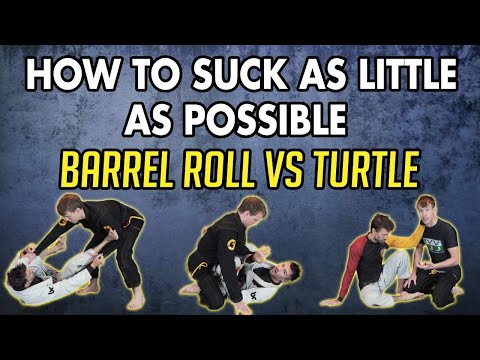
The Barrel Roll: When Turtle Turns Away From You
0
Standard Turtle·RVV BJJ
So far we have covered how to break your opponent down, and pull them towards you. However, many opponents will attempt…
Translation: standard turtle
The Standard Turtle subfamily covers the basic defensive turtle position with the fighter on hands and knees, elbows tight to the body, chin tucked, and head down to protect against chokes and submissions. [1] The standard turtle provides a stable defensive base while keeping the arms close to prevent arm attacks and the chin tucked to prevent choke entries. [1],[2] From standard turtle, the defender works to escape via sit-outs, rolls, guard pulls, or stand-ups. [2],[3]
The standard turtle is the default all-fours defensive position. [1]
The standard turtle is the fundamental turtle position in judo and BJJ. [1]
Commonly used in judo and BJJ competition. [1]
No images yet for this technique.
Sign in to suggest an image.
So far we have covered how to break your opponent down, and pull them towards you. However, many opponents will attempt…
No instructional courses yet for this technique.
Sign in to suggest a course.
Risk of injury to the person this technique is applied to
Turtle is a defensive shell position; vulnerable to back takes and chokes
Skill level needed to execute this technique reliably
Whether this technique is allowed under major competition rule sets
Jiu-Jitsu University (Saulo Ribeiro, 2008)
Alias sources — [1] IBJJF Rules (2024) [2] Kodokan Judo (Kano, 1986) [3] Jiu-Jitsu University (Ribeiro, 2008)
Effectiveness sources — [1] Jiu-Jitsu University (Ribeiro, 2008)
Official Kodokan ground technique classification system
Mixed Japanese-Western terminology — combines traditional Japanese terms with katakana loanwords
Alias sources — [1] IBJJF Rules (2024) [2] Kodokan Judo (Kano, 1986) [3] Jiu-Jitsu University (Ribeiro, 2008)
Effectiveness sources — [1] Jiu-Jitsu University (Ribeiro, 2008)
hip flexibility, active legs, grip management
long legs for distance control and guard retention
hip flexors, adductors, quadriceps, core, grip
Every move, in any martial art, shares a few universal traits. Mix and match below to pinpoint the right tool — or compare equivalents across styles.
Once you have back control with hooks and a seatbelt grip, you can add rear attacks like chokes, rear triangles, and arm submissions. RVV BJJ emphasizes that you can't go wrong with these back control offenses.
A common issue is having a hook and seatbelt grip but failing to effectively pull your opponent toward you, which can cause the attack to go wrong. Proper positioning and control are essential to make this work.
The Standard Turtle subfamily covers the basic defensive turtle position with the fighter on hands and knees, elbows tight to the body, chin tucked, and head down to protect against chokes and submissions. The standard turtle provides a stable defensive base while keeping the arms close to prevent arm attacks and the chin tucked to prevent choke entries.
The standard turtle is a fundamental defensive position in wrestling and judo, adapted for BJJ with additional emphasis on neck and arm protection against chokes and arm locks. It is one of the first defensive positions taught in grappling.
IBJJF: legal — Legal — common transitional position; IJF: restricted — Legal position but extended turtle without attacking penalized for non-combat…; ADCC: legal — Legal; Unified MMA: legal — Legal; UWW: legal — Legal — bottom position, opponent works to turn/pin; FIAS Sport Sambo: legal — Legal
Danger rating 3/10. Moderate — turtle is a defensive shell position; vulnerable to back takes and chokes
The standard setup chain: Achieve Guard Contact → Control Grips → Manage Distance → Threaten Submissions/Sweeps.
Standard counters include: Guard Pass — systematically work to clear the legs and establish a dominant position / Leg Pin — control one or both legs to neutralize guard retention / Pressure Passing — use heavy chest pressure to flatten and immobilize the guard player.
Common variants: Standard guard (primary leg and grip configuration for control and attack…); Offensive guard (configured for sweeps and submissions); Defensive guard (prioritising distance management and preventing passes); Transition guard (moving between guard types to adjust to the opponent's pa…).
Commonly used in judo and BJJ competition.
Top errors to watch for: Splaying the knees too wide — the knees should be under the hips for a compact structure / Keeping the elbows away from the body — tight elbows prevent the opponent from threading arms through / Lifting the head and exposing the neck — the chin must stay tucked at all times / Placing the hands too far forward — the hands should be close to the knees for a compact position.
The Standard Turtle is also known as Sutandādo Kame, Basic Turtle, Standard Turtle Defence, Kame no Kamae (亀の構え).