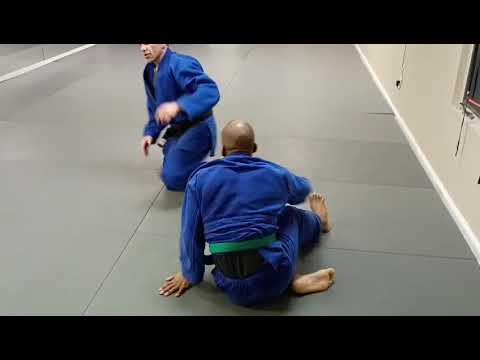
Dealing with a tight turtle in judo
0
Tight Turtle·Sakura Judo
Translation: tight turtle
The Tight Turtle subfamily covers the defensive turtle variation where the fighter compresses the body as much as possible, tucking the elbows to the knees, chin to chest, and hips low, creating the smallest possible target and maximum protection. [1] The tight turtle sacrifices escape mobility for maximum protection, used when the opponent has a strong attacking position and the defender needs to survive before creating an escape opportunity. [1],[2] The tight turtle makes it extremely difficult for the attacker to insert hooks, slide in chokes, or flatten the defender. [2],[3]
The tight turtle maximally tucks the elbows and chin, protecting against hooks and choke entries. [1]
The tight turtle is a refined defensive position in judo and BJJ. [1]
The tight turtle is used in judo and BJJ competition for defence. [1]
No images yet for this technique.
Sign in to suggest an image.
No instructional courses yet for this technique.
Sign in to suggest a course.
Risk of injury to the person this technique is applied to
Turtle is a defensive shell position; vulnerable to back takes and chokes
Skill level needed to execute this technique reliably
Whether this technique is allowed under major competition rule sets
Jiu-Jitsu University (Saulo Ribeiro, 2008)
Alias sources — [1] IBJJF Rules (2024) [2] Jiu-Jitsu University (Ribeiro, 2008) [3] Mastering Jujitsu (Gracie & Danaher, 2003)
Effectiveness sources — [1] Jiu-Jitsu University (Ribeiro, 2008)
Official Kodokan ground technique classification system
Mixed Japanese-Western terminology — combines traditional Japanese terms with katakana loanwords
Alias sources — [1] IBJJF Rules (2024) [2] Jiu-Jitsu University (Ribeiro, 2008) [3] Mastering Jujitsu (Gracie & Danaher, 2003)
Effectiveness sources — [1] Jiu-Jitsu University (Ribeiro, 2008)
core strength, tight elbow position, neck protection
compact build with strong core for stability
core stabilisers, shoulders, neck, hip flexors
Every move, in any martial art, shares a few universal traits. Mix and match below to pinpoint the right tool — or compare equivalents across styles.
A tight turtle is difficult to penetrate, but you can use the fact that it naturally wants to roll like a ball. Instead of trying to force your way in, encourage the roll by placing your thigh on top of their head and pulling them toward it, which will limit their mobility (Sakura Judo).
If you can get your knee inside the opponent's hip area, they won't be able to roll out effectively, even from a tight turtle (Sakura Judo).
Place your thigh on top of their head and gently push their head inside rather than letting them stick their head out at an unsafe angle. Pull them toward your thigh to encourage a controlled roll (Sakura Judo).
The Tight Turtle subfamily covers the defensive turtle variation where the fighter compresses the body as much as possible, tucking the elbows to the knees, chin to chest, and hips low, creating the smallest possible target and maximum protection. The tight turtle sacrifices escape mobility for maximum protection, used when the opponent has a strong attacking position and the defender needs to survive before creating an escape opportunity.
The tight turtle developed as a survival-focused defensive variation, used when the standard turtle is being attacked and the defender needs maximum protection while waiting for an escape opportunity. It is taught as the last-resort defensive turtle position.
IBJJF: legal — Legal — common transitional position; IJF: restricted — Legal position but extended turtle without attacking penalized for non-combat…; ADCC: legal — Legal; Unified MMA: legal — Legal; UWW: legal — Legal — bottom position, opponent works to turn/pin; FIAS Sport Sambo: legal — Legal
Danger rating 3/10. Moderate — turtle is a defensive shell position; vulnerable to back takes and chokes
The standard setup chain: Achieve Position → Stabilize → Maintain → Attack.
Standard counters include: Posture Control — maintain strong posture to limit the opponent's offensive options / Escape to Neutral — work back to standing or a neutral position.
Common variants: Standard turtle (hands and knees with elbows tight, head protected); Flattened turtle (driven to the mat from turtle, attempting to re-turtle); Active turtle (using sit-outs or rolls from the turtle position).
The tight turtle is used in judo and BJJ competition for defence.
Top errors to watch for: Turtling tight but not planning an escape — tight turtle buys time; use that time to plan / Leaving any gap between the elbows and thighs — every gap is an entry point for the opponent / Not tucking the chin deeply — the chin tuck must be maximal in tight turtle / Breathing shallowly due to the compact position — maintain controlled breathing despite the compression.
The Tight Turtle is also known as Taito Kame, Tight Turtle Defence, Compact Turtle, Balled-Up Turtle.