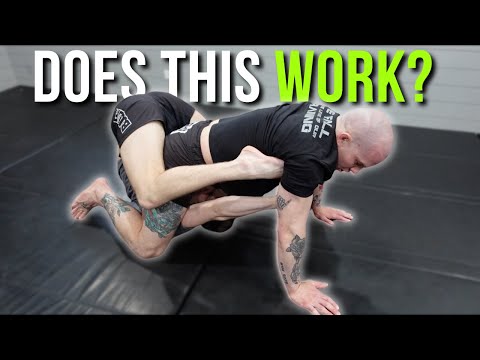
3 Ways To Escape High Mount
0
High Mount·Stay Safe Martial Arts
3 ways to escape a high mount for jiu jitsu, mma, and self defense. Check out Combat Corner for all of your fighting…
Translation: high mount
The High Mount subfamily covers the mount variation where the top fighter slides the hips up toward the opponent's chest or shoulders, creating a higher mounting position that increases submission access. [1] The high mount provides better armbar, triangle, and mounted cross-choke angles because the top fighter's hips are closer to the opponent's head and shoulders. [1],[2] The trade-off is slightly less base stability compared to full mount, as the higher position makes the mount easier to bridge. [2],[3]
The high mount (chest mount) is an advanced mount variation that provides superior submission access by positioning the hips near the opponent's chest or shoulders. [1] From high mount, the attacker can more easily isolate the arms for armbars and threaten chokes while the opponent's hip escapes are severely limited by the high body positioning. [2]
High mount positions the attacker's hips higher on the opponent's chest, increasing control and submission access; developed in BJJ as an advanced mount variant. [1]
High mount is used in BJJ and MMA competition for increased submission pressure. [1]
No images yet for this technique.
Sign in to suggest an image.
3 ways to escape a high mount for jiu jitsu, mma, and self defense. Check out Combat Corner for all of your fighting…
No instructional courses yet for this technique.
Sign in to suggest a course.
Risk of injury to the person this technique is applied to
Top positions enable pressure and striking; rib compression risk under heavy pressure
Skill level needed to execute this technique reliably
Whether this technique is allowed under major competition rule sets
Mastering Jujitsu (Renzo Gracie & John Danaher, 2003)
Alias sources — [1] IBJJF Rules (2024) [2] Jiu-Jitsu University (Ribeiro, 2008) [3] Mastering Jujitsu (Gracie & Danaher, 2003)
Effectiveness sources — [1] Jiu-Jitsu University (Ribeiro, 2008) [2] Mastering Jujitsu (Gracie & Danaher, 2003)
Standard katakana transliteration of Western martial arts terminology (外来語) — used in Japanese MMA, boxing, and BJJ communities
Alias sources — [1] IBJJF Rules (2024) [2] Jiu-Jitsu University (Ribeiro, 2008) [3] Mastering Jujitsu (Gracie & Danaher, 2003)
Effectiveness sources — [1] Jiu-Jitsu University (Ribeiro, 2008) [2] Mastering Jujitsu (Gracie & Danaher, 2003)
base stability, heavy hips, ride ability
heavier build with strong hips for pressure
hip adductors, core, glutes, quadriceps
Every move, in any martial art, shares a few universal traits. Mix and match below to pinpoint the right tool — or compare equivalents across styles.
High mount is more difficult because it eliminates your ability to use your hips effectively. According to Stay Safe Martial Arts, your first goal should be to shoulder walk your way up to bring your opponent down to a normal or low mount, then execute a standard mount escape from there.
Don't keep your arms extended or pushing outward. Instead, tuck your arms around your neck for protection and post on your opponent's hip as much as possible, as demonstrated by Stay Safe Martial Arts.
When you hip bump to escape high mount, think of the motion like taking your pants off—you're bumping your hips while simultaneously pushing on your opponent's hips to create space and give yourself a fighting chance to escape, according to Stay Safe Martial Arts.
The High Mount subfamily covers the mount variation where the top fighter slides the hips up toward the opponent's chest or shoulders, creating a higher mounting position that increases submission access. The high mount provides better armbar, triangle, and mounted cross-choke angles because the top fighter's hips are closer to the opponent's head and shoulders.
The high mount developed as a submission-focused mount variation in BJJ, used when the top fighter wants to maximise submission attack options at the cost of some positional stability. It is a standard part of the mount progression taught in BJJ.
IBJJF: legal — Legal, mount scores 4 points — highest-scoring position; IJF: legal — Legal, osaekomi (pin) — 10-19 seconds scores waza-ari, 20 seconds scores ippon; ADCC: legal — Legal, mount scores 2 points; Unified MMA: legal — Legal dominant position; UWW: legal — Legal, back exposure scores points, pin ends match by fall; FIAS Sport Sambo: legal — Legal, pin scores points
Danger rating 3/10. Moderate — top positions enable pressure and striking; rib compression risk under heavy pressure
The standard setup chain: Pass the Guard → Settle Weight → Control Arms → Threaten Submissions.
Standard counters include: Bridge (Upa) — explosive hip elevation to off-balance the top player / Elbow-Knee Escape (Shrimp) — create space by driving elbow to knee and hip-escaping / Frame — establish forearm frames to prevent the top player from settling weight.
Common variants: Low mount (hips heavy on the opponent's belly, grapevines in for sta…); High mount (knees under the armpits, arms isolated for submissions); S-mount (one knee high under the armpit, other leg across for arm …); Technical mount (one leg hooked, one knee posted, modified for back-take t…).
High mount is used in BJJ and MMA competition for increased submission pressure.
Top errors to watch for: Climbing to high mount too quickly — advance gradually, securing each position before climbing higher / Not maintaining control during the climb — each knee advance must be accompanied by upper body control / Sitting upright in high mount — lean forward with pressure to maintain the position / Staying in high mount without attacking — high mount is for finishing; attack immediately upon achieving it.
The High Mount is also known as Hai Maunto, High Mount, Technical Mount, Mounted High.