Basic Knee on Belly Choke Setup
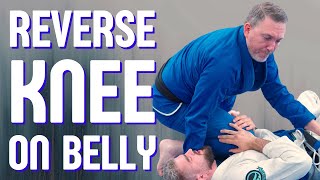
From knee on belly position with the knee placed on the opponent's sternum, the top player pulls the arm upward while controlling the head to secure a quick submission. A high collar grip is established with a flat hand rather than a closed fist, targeting the sternomastoid muscle which is pushed aside to access the neck.
Collar Choke Finish
After securing the initial grip and trapping the opponent's arm under the knee, the top player slides a flat hand up the collar, pushes the sternomastoid muscle out of the way, and brings both hands together to complete the choke. This variation remains effective even if the opponent prevents the leg from pinning the arm.
Low Collar Grip and Vertical Pressure
An alternative approach begins with a low collar grip that slides upward along the neck. The player maintains flat hand positioning while pushing the muscle aside, then grabs the opposite collar and pulls it straight downward toward the knee rather than across the body, emphasizing vertical pressure over the carotid.
Elbow Drop Finish Against Resistance
When the opponent resists the standard choke, the top player stabilizes by pulling the collar down, removes the knee, and slams the elbow to the floor with significant leverage. This variation capitalizes on the positional pressure when the opponent's defensive effort prevents traditional submission mechanics.
Loop Choke Entry
Beginning with a thumb-inside grip on one collar, the top player reaches with four fingers on the same side while lifting the opponent's head slightly off the mat. The top elbow drops to the floor while the bottom hand keeps the opponent's chest flat, creating a looping configuration that applies pressure around the neck.
Americana Armlock from Knee on Belly
When the opponent extends straight arms to push away, the top player cuts the angle by turning hips and applying body weight directly onto the opponent's elbow to immobilize it. The top player scoops underneath the arm, establishes hooks with the legs, and connects the hands to complete the Americana shoulder lock.
Back Choke with Straight Arm Control
A back choke variation from knee on belly involves establishing a thumb-inside grip with the opposite hand using four fingers, then maintaining a straight arm while walking the hips toward the opponent's head. This positioning prevents the opponent from using the standard weave defense and creates increasing pressure as the top player rotates.
Defensive Adjustment Against Arm Push
When the opponent pushes the top player's arm away to prevent submissions, the top player transitions to arm trap variations such as arm steps and pops that force the opponent's arm into submission positions. These adjustments address defensive mechanics while maintaining the fundamental knee on belly framework.
Knee on Belly Submissions
Key Takeaways
- •Basic Knee on Belly Choke Setup
- •Collar Choke Finish
- •Low Collar Grip and Vertical Pressure
- •Elbow Drop Finish Against Resistance
Mark Gilston, 4th degree judo black belt, and Sean Cooper, 3 stripe BJJ black belt, demonstrate and discuss submissions from knee on belly position (uki gatame) in BJJ or judo. This is a follow up video to Knee on Belly Hold and Escapes: https://youtu.be/WA8KnRM0qnw http://www.coopermma.com/
Related Techniques
Frequently Asked Questions
What does this video teach about standard knee on belly?
This video covers basic knee on belly choke setup, collar choke finish, low collar grip and vertical pressure. It provides detailed instruction from Seiryoku Zenyo.
How long does it take to learn standard knee on belly?
The basic mechanics can be understood in a single session, but developing reliable execution requires consistent drilling over weeks of practice. This 8-part breakdown helps structure your training by isolating each phase of the technique.
What are the key details for finishing standard knee on belly?
A back choke variation from knee on belly involves establishing a thumb-inside grip with the opposite hand using four fingers, then maintaining a straight arm while walking the hips toward the opponent's head. This positioning prevents the opponent from using the standard weave defense and creates increasing pressure as the top player rotates.