Knee on Belly Submissions
0
Standard Knee On Belly·Seiryoku Zenyo
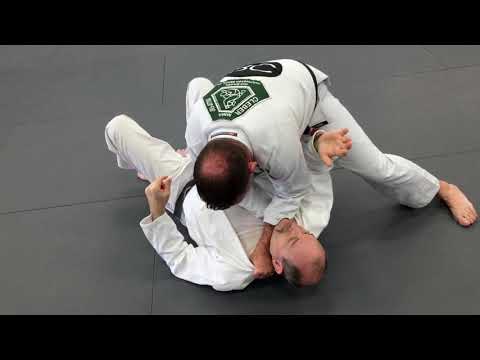
Mark Gilston, 4th degree judo black belt, and Sean Cooper, 3 stripe BJJ black belt, demonstrate and discuss submissions …
Translation: standard knee on belly
The Standard Knee On Belly subfamily covers the classic knee-on-belly position where the top fighter faces the opponent's head with one knee on the belly/midsection and the other foot posted for base. [1] Standard knee-on-belly is the primary version of this position, providing a balanced platform for pressure, submissions, and transitions. [1],[2] The position allows the top fighter to use gravity and bodyweight to create significant pressure while maintaining mobility for transitions to mount, side control, or the opposite side. [2],[3]
Knee on belly is a fundamental dominant position in BJJ, taught at all levels. [1]
Knee on belly scores 2 points in IBJJF competition. [1]
No images yet for this technique.
Sign in to suggest an image.
Mark Gilston, 4th degree judo black belt, and Sean Cooper, 3 stripe BJJ black belt, demonstrate and discuss submissions …
No instructional courses yet for this technique.
Sign in to suggest a course.
Risk of injury to the person this technique is applied to
Top positions enable pressure and striking; rib compression risk under heavy pressure
Skill level needed to execute this technique reliably
Whether this technique is allowed under major competition rule sets
Mastering Jujitsu (Renzo Gracie & John Danaher, 2003)
Alias sources — [1] IBJJF Rules (2024) [2] Jiu-Jitsu University (Ribeiro, 2008) [3] Mastering Jujitsu (Gracie & Danaher, 2003)
Effectiveness sources — [1] Jiu-Jitsu University (Ribeiro, 2008) [2] Mastering Jujitsu (Gracie & Danaher, 2003)
Standard katakana transliteration of Western martial arts terminology (外来語) — used in Japanese MMA, boxing, and BJJ communities
Alias sources — [1] IBJJF Rules (2024) [2] Jiu-Jitsu University (Ribeiro, 2008) [3] Mastering Jujitsu (Gracie & Danaher, 2003)
Effectiveness sources — [1] Jiu-Jitsu University (Ribeiro, 2008) [2] Mastering Jujitsu (Gracie & Danaher, 2003)
base stability, heavy hips, ride ability
heavier build with strong hips for pressure
hip adductors, core, glutes, quadriceps
Every move, in any martial art, shares a few universal traits. Mix and match below to pinpoint the right tool — or compare equivalents across styles.
Use a flat hand rather than a fist, and slide it up the collar without going too deep—if you're too deep, you won't catch the carotid properly. Seiryoku Zenyo emphasizes keeping the grip positioned correctly to ensure the submission works.
Come from the top and lay your weight on your shin and the crook of the opponent's elbow, rather than attacking straight at them. This positioning is key to controlling the arm and applying effective pressure.
Pull the collar down to stabilize your opponent, and make sure to keep your arm straight while walking towards their head to maintain control and prevent escape.
The Standard Knee On Belly subfamily covers the classic knee-on-belly position where the top fighter faces the opponent's head with one knee on the belly/midsection and the other foot posted for base. Standard knee-on-belly is the primary version of this position, providing a balanced platform for pressure, submissions, and transitions.
Standard knee-on-belly is the fundamental version of this position in BJJ, scored as a distinct positional achievement worth two points in IBJJF competition. It has been a core position in BJJ's positional hierarchy since the art's development.
IBJJF: legal — Legal, knee on belly scores 2 points; IJF: legal — Legal, osaekomi (pin) — 10-19 seconds scores waza-ari, 20 seconds scores ippon; ADCC: legal — Legal, knee on belly scores 2 points; Unified MMA: legal — Legal dominant position; UWW: legal — Legal, back exposure scores points, pin ends match by fall; FIAS Sport Sambo: legal — Legal, pin scores points
Danger rating 3/10. Moderate — top positions enable pressure and striking; rib compression risk under heavy pressure
The standard setup chain: Pass the Guard → Settle Weight → Control Arms → Threaten Submissions.
Standard counters include: Bridge (Upa) — explosive hip elevation to off-balance the top player / Elbow-Knee Escape (Shrimp) — create space by driving elbow to knee and hip-escaping / Frame — establish forearm frames to prevent the top player from settling weight.
Common variants: Low mount (hips heavy on the opponent's belly, grapevines in for sta…); High mount (knees under the armpits, arms isolated for submissions); S-mount (one knee high under the armpit, other leg across for arm …); Technical mount (one leg hooked, one knee posted, modified for back-take t…).
Knee on belly scores 2 points in IBJJF competition.
Top errors to watch for: Not maintaining knee pressure through movement — the knee must stay heavy even as the opponent moves / Posting the far foot too close — the foot should be wide for maximum stability / Gripping only with the hands without knee pressure — the knee is the primary control; grips are supplementary / Not attacking from knee on belly — the position forces reactions; capitalize on them.
The Standard Knee On Belly is also known as Sutandādo Nī On Berī, Standard Knee Ride, Basic Knee on Belly, Standard KOB.