Introduction and Setup
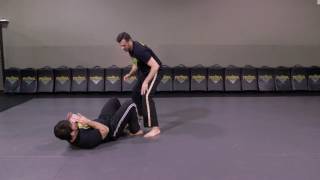
Instructor James O'Connor demonstrates knee on belly and reverse knee on belly transitions as part of a mobility series for Brazilian jiu-jitsu. The drill requires a partner positioned supine with hands kept close to the body to prevent finger injuries and to provide a surface for hand placement during transitions.
Basic Knee on Belly Transition
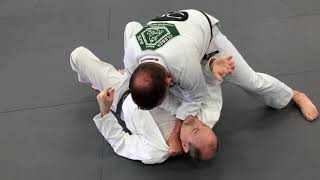
From mount position, the practitioner lifts the right heel toward the buttocks while shooting the left leg out to establish knee on belly. The hands remain on the ground for stability, and the movement is performed slowly to demonstrate proper foot mechanics and weight distribution.
Switching Between Sides
Both heels lift toward the buttocks as the practitioner leans forward, then switch positions by stepping out and transitioning to the opposite side. The movement is repeated in succession, with emphasis on keeping the feet close to the partner's body to prevent the opponent from catching the leg.
Leg Positioning and Defense Prevention
The practitioner must angle the extending leg properly to avoid it being caught by the partner's arm. If the leg travels outward rather than across the body, the opponent can trap it; maintaining proper angle and proximity to the torso prevents this defensive opportunity.
Reverse Knee on Belly Entry
From knee on belly position, one foot is brought inward while hands transfer to facilitate a spin. This rotation transitions the practitioner to reverse knee on belly, with the heel lifting to clear the partner's face during the turning motion.
Combining Forward and Reverse Transitions
The practitioner alternates between standard knee on belly and reverse knee on belly positions in sequence. Multiple switches are performed consecutively to develop coordination on both sides of the body.
Integration with Submission Attempts
The knee on belly transitions can be combined with armbar attempts from s-mount position. If the armbar is not available, the practitioner switches sides or returns to mount to reset and attempt the submission from a different angle.
Continuous Positional Drilling
The entire sequence—mount, knee on belly variations, and submission attempts—creates a continuous loop for extended drilling sessions. This approach develops balanced coordination on both sides and equalizes skill development between the practitioner's dominant and non-dominant sides.
How to do Knee on Belly and Reverse Knee on Belly
Key Takeaways
- •Introduction and Setup
- •Basic Knee on Belly Transition
- •Switching Between Sides
- •Leg Positioning and Defense Prevention
Here is a partner drill utilizing the knee on Belly position along with a more advanced reverse knee on Belly position. The knee on Belly will score you points and allow you to do different transitions while staying on top The reverse knee on belly not only looks cool but let’s you sneak in some other sneaky positions. Putting these two positions together will give you greater mobility and more options when on top of an opponent trying to escape. It also allows you to stay a step ahead. Subscribe and check out my other channels ⬇️⬇️⬇️ Instagram - https://www.instagram.com/teamjamesoconnor/ Facebook- http://bit.ly/2yuHHgn Join my FREE GROUP - http://bit.ly/2iQsE9O
Related Techniques
Frequently Asked Questions
What does this video teach about reverse knee on belly?
This video covers introduction and setup, basic knee on belly transition, switching between sides. It provides detailed instruction from James O’Connor.
How long does it take to learn reverse knee on belly?
The basic mechanics can be understood in a single session, but developing reliable execution requires consistent drilling over weeks of practice. This 8-part breakdown helps structure your training by isolating each phase of the technique.
What are the key details for finishing reverse knee on belly?
The knee on belly transitions can be combined with armbar attempts from s-mount position. If the armbar is not available, the practitioner switches sides or returns to mount to reset and attempt the submission from a different angle.