De La Riva Hook vs. De La Riva Guard
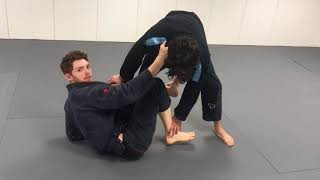
The de la riva hook describes any leg position wrapping around the outside to hook the opponent's thigh or hip, and can be combined with various upper body grips. The de la riva guard specifically refers to the outside hand controlling the ankle or pant leg, though the hook may move in and out during position transitions. Understanding this distinction clarifies that multiple grip variations can incorporate the same fundamental hook.
Functional Applications of the Hook
The de la riva hook becomes naturally accessible when opponents defend upper body submissions like triangles and armbars by positioning one leg forward with elbow defense. When pulling on an opponent from this position, they must shift from a square stance to an offset stance with one leg forward and one back to create counter-pressure. The resulting access to the de la riva hook enables off-balancing, backward takedowns, knee torque, and submission setup sequences.
Shallow vs. Deep Hook Categories
De la riva hooks divide into two broader categories: the shallow hook where the foot hooks the thigh or hip, and the deep hook which functions differently. The shallow hook further subdivides into weak and strong variations, with the weak version placing the foot on the thigh but lacking security against leg extension. The strong shallow hook places the foot on the hip, maintaining the position even when the opponent straightens their leg completely.
Distance Management for Hook Establishment
Proper distance from the opponent is the most critical factor in establishing an effective de la riva hook. When too close, the practitioner's own leg becomes jammed and cannot reach forward to the opponent's hip. Moving backward creates space allowing the foot to reach the hip with minimal leg bend, enabling off-balance control even with a completely straight leg.
Setting Distance from Classic De La Riva
From classic de la riva guard with ankle or pant control, the practitioner can establish distance by pushing off the opponent's hip or using lateral pulls to create space. A knee shield across the opponent's torso can substitute for hip pushes when they sit too close, combining rib pressure with slight hip lift. Once proper distance is achieved, the foot can transition to the hip area, enabling multiple off-balance directions for control and attack setup.
Off-Balance Applications and Takedown Entries
With a properly positioned de la riva hook at the hip, the practitioner can push the opponent backward, off-balance to the side, or pull the opponent forward to create varied directional pressure. The backward off-balance combined with collar control can transition into techniques like the barai bolo. These fundamental off-balance positions open access to subsequent attacks and positional advancement.
Understanding De La Riva Guard
Key Takeaways
- •De La Riva Hook vs. De La Riva Guard
- •Functional Applications of the Hook
- •Shallow vs. Deep Hook Categories
- •Distance Management for Hook Establishment
This is an overview of understanding the de la riva guard in modern jiu jitsu. The de la riva is one of the most useful controls in jiu jitsu but it can be used in multiple different guards. I overview the foundations of what makes this hook work and the easiest ways to apply it in different situations. My Website Here: https://www.jonthomasbjj.com/courses/modern-collar-sleeve Kimonos: https://www.vitalkimonos.com/ 0:00 Intro 0:09 DLR Hook vs DLR Guard 1:19 Why The DLR Hook is So Important 2:17 3 Types of DLR Hook 3:28 What Makes A Strong DLR Hook 4:57 Setting DLR Hook With Ankle 7:36 DLR Hook in Collar Sleeve 8:49 Leg Hug and Underhook DLR 9:40 DLR Hook in Double Sleeve 10:39 The DLR X 12:49 Outro
Related Techniques
Frequently Asked Questions
What does this video teach about de la riva guard?
This video covers de la riva hook vs. de la riva guard, functional applications of the hook, shallow vs. deep hook categories. It provides detailed instruction from JonThomasBJJ.
How long does it take to learn de la riva guard?
The basic mechanics can be understood in a single session, but developing reliable execution requires consistent drilling over weeks of practice. This 6-part breakdown helps structure your training by isolating each phase of the technique.
What are the key details for finishing de la riva guard?
From classic de la riva guard with ankle or pant control, the practitioner can establish distance by pushing off the opponent's hip or using lateral pulls to create space. A knee shield across the opponent's torso can substitute for hip pushes when they sit too close, combining rib pressure with slight hip lift. Once proper distance is achieved, the foot can transition to the hip area, enabling multiple off-balance directions for control and attack setup.