Understand the Collar Sleeve Guard In 5 Min
0
Collar-Sleeve Guard·JonThomasBJJ
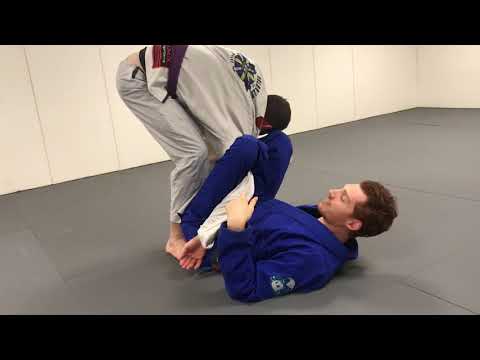
This is a general overview of the collar sleeve guard, one of the most commonly used positions in competition today. Fo…
Translation: collar-sleeve guard
The Collar-Sleeve Guard subfamily covers the open guard position where the guard player controls one collar and one sleeve while using the feet to manage distance and create attacking angles. [1] The collar-sleeve guard is one of the most versatile gi guard positions because the combination of collar and sleeve control provides push-pull capability while preventing the opponent from posting or gripping. [1],[2] The guard player typically places one foot on the hip and the other on the bicep of the controlled arm. [2],[3]
Collar-sleeve guard developed in gi BJJ competition and is one of the fundamental open guard systems. [1]
Collar-sleeve guard is widely used in gi BJJ competition at all levels. [1]
No images yet for this technique.
Sign in to suggest an image.
This is a general overview of the collar sleeve guard, one of the most commonly used positions in competition today. Fo…
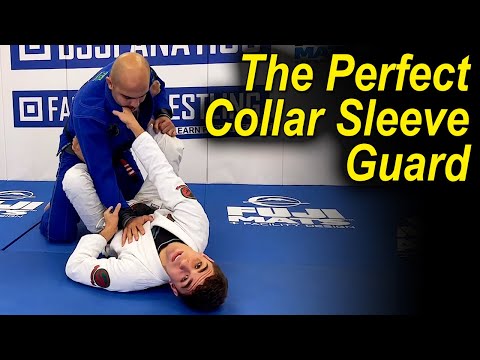
Learn here how to do the perfect Collar Sleeve Guard by Mikey Musumeci - Click Here To Check Out Mikey Musumeci's Instru…
Collar-sleeve guard is a high-level open-guard position built on the unifying principle of elbow displacement and control. Practitioners establish a collar grip (typically cross-collar) with a sleeve grip on one arm, then post a foot on the opponent's hip, ribs, or shoulder to create structural wedges that prevent the opponent from closing their elbow to their body. The strategic context centers on forcing the opponent's elbow away from spinal alignment, rendering their arm structurally weak and vulnerable to submission attacks. JonThomasBJJ emphasizes the dynamic interplay between the de la riva hook and lasso variations, noting that leg entrapment by the opponent necessitates immediate lasso transitions to maintain control and avoid passes like the X-pass or leg cuts. Bernardo Faria and Mikey Musumeci stress the conceptual foundation of wedging—systematically moving the opponent's elbow out of alignment with their shoulder by progressively placing the foot higher on the ribs or using the knee to laterally bend the elbow. Both instructors identify the ultimate position: the opponent's elbow resting in the practitioner's lap, creating irreversible structural compromise. From this control point, practitioners can fluidly transition between triangle and omoplata attacks depending on opponent head/shoulder orientation, with one attack naturally converting to the other as the opponent defends. The position adapts across positional variables (opponent on knees, one knee, standing), though the wedging principle remains constant.
Synthesized from 2 instructors
No instructional courses yet for this technique.
Sign in to suggest a course.
Risk of injury to the person this technique is applied to
Guard positions are defensive; injury risk comes from transitions, not the position itself
Skill level needed to execute this technique reliably
Whether this technique is allowed under major competition rule sets
Jiu-Jitsu University (Saulo Ribeiro, 2008)
Alias sources — [1] IBJJF Rules (2024) [2] Jiu-Jitsu University (Ribeiro, 2008) [3] Jiu-Jitsu University (Ribeiro, 2008)
Effectiveness sources — [1] Jiu-Jitsu University (Ribeiro, 2008) [2] Mastering Jujitsu (Gracie & Danaher, 2003)
Mixed Japanese-Western terminology — combines traditional Japanese terms with katakana loanwords
Alias sources — [1] IBJJF Rules (2024) [2] Jiu-Jitsu University (Ribeiro, 2008) [3] Jiu-Jitsu University (Ribeiro, 2008)
Effectiveness sources — [1] Jiu-Jitsu University (Ribeiro, 2008) [2] Mastering Jujitsu (Gracie & Danaher, 2003)
hip flexibility, active legs, grip management
long legs for distance control and guard retention
hip flexors, adductors, quadriceps, core, grip
Every move, in any martial art, shares a few universal traits. Mix and match below to pinpoint the right tool — or compare equivalents across styles.
Keep your foot in the bicep or near the shoulder area and pull tight to make it difficult for your opponent to pass. Jon Thomas BJJ emphasizes this foot placement as key to controlling the position effectively.
Many practitioners are not quick enough with their frame. Jon Thomas BJJ points out that if you hesitate on your frame while your opponent starts coming around, you'll be too late to defend properly.
According to Mikey Musumeci, focus on the alignment of your shoulder, elbow, and hand. When the opponent's arm is in a straight line they are stronger, so understanding arm geometry is crucial to controlling the guard.
Mikey Musumeci teaches that you should work between triangles and back attacks, flowing between them depending on how your opponent defends and whether they posture up or come forward.
The Collar-Sleeve Guard subfamily covers the open guard position where the guard player controls one collar and one sleeve while using the feet to manage distance and create attacking angles. The collar-sleeve guard is one of the most versatile gi guard positions because the combination of collar and sleeve control provides push-pull capability while preventing the opponent from posting or gripping.
The collar-sleeve guard was developed as one of the primary gi open guard systems, with Leandro Lo bringing it to prominence through his dominant competition career. Lo's collar-sleeve game is widely regarded as one of the most effective guard systems in gi competition history.
IBJJF: legal — Legal — guard is fundamental to BJJ, sweeps from guard score 2 points; IJF: restricted — Guard pulling penalized as non-combativity — groundwork from guard permitted …; ADCC: legal — Legal, guard pull penalized -1 point in points portion; Unified MMA: legal — Legal — no penalty for playing guard; FIAS Sport Sambo: legal — Legal
Danger rating 2/10. Low — guard positions are defensive; injury risk comes from transitions, not the position itself
The standard setup chain: Achieve Guard Contact → Control Grips → Manage Distance → Threaten Submissions/Sweeps.
Standard counters include: Guard Pass — systematically work to clear the legs and establish a dominant position / Leg Pin — control one or both legs to neutralize guard retention / Pressure Passing — use heavy chest pressure to flatten and immobilize the guard player.
Common variants: Spider guard (gripping both sleeves with feet on the biceps for distanc…); De la Riva guard (one hook behind the opponent's lead leg with opposite foo…); Lasso guard (lasso grip wrapping the leg around the opponent's arm); Collar-sleeve guard (controlling collar with one hand and sleeve with the othe…).
Collar-sleeve guard is widely used in gi BJJ competition at all levels.
Top errors to watch for: Holding the collar without actively pulling — the collar grip must constantly break the opponent's posture / Allowing the sleeve grip to be stripped without immediately re-gripping — the sleeve control is non-negotiable / Placing feet passively — the feet must actively push, pull, and reposition / Playing collar-sleeve without threatening the triangle — the triangle threat makes all other attacks available.
The Collar-Sleeve Guard is also known as Eri-sode Gādo, Collar-and-Sleeve Guard, Collar Sleeve, Manga e Gola.