Lasso Guard Sweeps
0
Lasso Guard·The Grapple Lab
Lasso Guard Sweeps. In this weeks video we look specifically at lasso sweeps when your opponent lifts their leg into com…
Translation: lasso guard
The Lasso Guard subfamily covers the open guard position where the guard player wraps one leg over the opponent's arm and threads it through, creating a 'lasso' that entangles the arm and provides powerful control. [1] The lasso guard is a gi-dependent position because the foot must grip or hook the gi material to maintain the lasso wrap. [1],[2] The lasso provides very strong one-sided control that can be used for sweeps, omoplata entries, and triangle set-ups. [2],[3]
The lasso guard provides powerful control by wrapping the leg over the opponent's arm and threading it inside the elbow crease, creating a controlling hook that restricts the passer's arm movement and generates strong sweeping angles. [1]
The lasso guard was developed in gi BJJ competition, using the sleeve grip wrapped around the attacker's arm with the shin. [1]
Lasso guard is frequently used in gi BJJ competition. [1]
No images yet for this technique.
Sign in to suggest an image.
Lasso Guard Sweeps. In this weeks video we look specifically at lasso sweeps when your opponent lifts their leg into com…
Are you tired of getting your lasso guard beat ? this video o share will help you understand the lasso guard a lot more …
No instructional courses yet for this technique.
Sign in to suggest a course.
Risk of injury to the person this technique is applied to
Guard positions are defensive; injury risk comes from transitions, not the position itself
Skill level needed to execute this technique reliably
Whether this technique is allowed under major competition rule sets
Jiu-Jitsu University (Saulo Ribeiro, 2008)
Alias sources — [1] IBJJF Rules (2024) [2] Jiu-Jitsu University (Ribeiro, 2008) [3] The Guard (Moreira & Beneville, 2003)
Effectiveness sources — [1] The Guard (Moreira & Beneville, 2003)
Standard katakana transliteration of Western martial arts terminology (外来語) — used in Japanese MMA, boxing, and BJJ communities
Alias sources — [1] IBJJF Rules (2024) [2] Jiu-Jitsu University (Ribeiro, 2008) [3] The Guard (Moreira & Beneville, 2003)
Effectiveness sources — [1] The Guard (Moreira & Beneville, 2003)
hip flexibility, active legs, grip management
long legs for distance control and guard retention
hip flexors, adductors, quadriceps, core, grip
Every move, in any martial art, shares a few universal traits. Mix and match below to pinpoint the right tool — or compare equivalents across styles.
The Double Lasso Guard uses the lasso wrap on both sides — both legs threaded over and through the opponent's arms — creating a symmetrical control that severely restricts the opponent's ability to use their arms. [1] The double lasso is extremely controlling but limits the guard player's own mobility, making it primarily a stalling or submission-setup position. [1,2] From double lasso, the guard player can attack with sweep combinations and triangle chokes. [2,3]
The Standard Lasso Guard uses a single lasso wrap on one side, with the other leg positioned as a secondary control (on the hip, bicep, or in spider guard configuration). [1] The standard single lasso provides strong one-sided control while maintaining enough mobility for the guard player to sweep, attack, and transition. [1,2] It is the most commonly used lasso guard configuration, balancing control with offensive versatility. [2,3]
When your opponent lifts their foot to counter sweeps, you can keep the lasso tight and look for a de la Riva hook on that leg instead, or transition to a different sweep by moving your hips out and bringing your foot underneath their far leg.
The Grapple Lab instructor emphasizes that letting go of the lasso grip allows your opponent to scramble up to their elbow, turning it into a scrambling battle that favors the stronger or more athletic player.
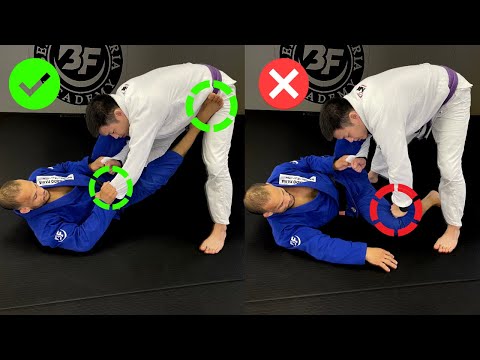
Keep your lasso leg flared out with good outside pressure and avoid collapsing your knee inward as you turn your hips, as this makes it too easy for your opponent to pass your guard.
According to BIG OSS Jiu-Jitsu, when your opponent stands up, move the lasso to their back instead of their hip to maintain leverage, since a standing opponent can deadlift you if the lasso is on the hip.
BIG OSS Jiu-Jitsu states that the priority is maintaining your primary lasso grip while always keeping secondary grips available—don't rely on a single grip or your opponent will break it and gain control.
The Lasso Guard subfamily covers the open guard position where the guard player wraps one leg over the opponent's arm and threads it through, creating a 'lasso' that entangles the arm and provides powerful control. The lasso guard is a gi-dependent position because the foot must grip or hook the gi material to maintain the lasso wrap.
The lasso guard was developed in gi BJJ as a powerful open guard control system, becoming a major competition guard in the 2000s and 2010s. It is widely used at all levels of gi competition for its strong control and submission opportunities.
IBJJF: legal — Legal — guard is fundamental to BJJ, sweeps from guard score 2 points; IJF: restricted — Guard pulling penalized as non-combativity — groundwork from guard permitted …; ADCC: legal — Legal, guard pull penalized -1 point in points portion; Unified MMA: legal — Legal — no penalty for playing guard; FIAS Sport Sambo: legal — Legal
Danger rating 2/10. Low — guard positions are defensive; injury risk comes from transitions, not the position itself
The standard setup chain: Achieve Guard Contact → Control Grips → Manage Distance → Threaten Submissions/Sweeps.
Standard counters include: Guard Pass — systematically work to clear the legs and establish a dominant position / Leg Pin — control one or both legs to neutralize guard retention / Pressure Passing — use heavy chest pressure to flatten and immobilize the guard player.
Common variants: Spider guard (gripping both sleeves with feet on the biceps for distanc…); De la Riva guard (one hook behind the opponent's lead leg with opposite foo…); Lasso guard (lasso grip wrapping the leg around the opponent's arm); Collar-sleeve guard (controlling collar with one hand and sleeve with the othe…).
Lasso guard is frequently used in gi BJJ competition.
Top errors to watch for: Playing lasso without a strong sleeve grip — the sleeve grip anchors the entire position / Using a shallow lasso when a deep lasso is available — the deeper the wrap, the more control / Staying in lasso without attacking — the lasso creates opportunities; exploit them with sweeps and submissions / Playing lasso on both sides simultaneously — one lasso combined with spider or collar-sleeve on the other side is opt….
The Lasso Guard is also known as Rassō Gādo, Lasso Guard, Guarda Laço, Spiral Guard.