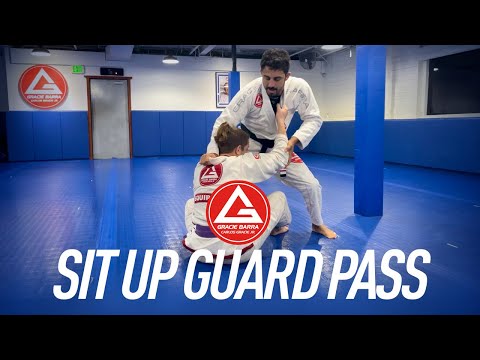
Two Sit Up Guard Passes
0
Sit-Up Guard·Gracie Barra HQ - California
Two sit up guard passes. Professor Philipe Della Monica GB2 Advanced Class | Gracie Barra HQ - Irvine, CA Feb 2021 …
Translation: sit-up guard
The Sit-Up Guard subfamily covers the open guard position where the guard player sits up with one foot on the opponent's hip and the other leg positioned for sweeps or transitions, with hands controlling grips. [1] The sit-up guard is a dynamic, upright open guard position that provides excellent transitional mobility for single leg entries, arm drags, and guard pulls. [1],[2] The upright posture allows the guard player to quickly change levels and angles, making it one of the most versatile guard entry positions. [2],[3]
Sit-up guard was popularised by Marcelo Garcia and other competitors who favoured active, upright guard play. [1]
Sit-up guard is commonly used in no-gi and gi BJJ competition. [1]
No images yet for this technique.
Sign in to suggest an image.
Two sit up guard passes. Professor Philipe Della Monica GB2 Advanced Class | Gracie Barra HQ - Irvine, CA Feb 2021 …
No instructional courses yet for this technique.
Sign in to suggest a course.
Risk of injury to the person this technique is applied to
Guard positions are defensive; injury risk comes from transitions, not the position itself
Skill level needed to execute this technique reliably
Whether this technique is allowed under major competition rule sets
Jiu-Jitsu University (Saulo Ribeiro, 2008)
Alias sources — [1] IBJJF Rules (2024) [2] Jiu-Jitsu University (Ribeiro, 2008) [3] The Guard (Moreira & Beneville, 2003)
Effectiveness sources — [1] Mastering Jujitsu (Gracie & Danaher, 2003) [2] Jiu-Jitsu University (Ribeiro, 2008)
Standard katakana transliteration of Western martial arts terminology (外来語) — used in Japanese MMA, boxing, and BJJ communities
Alias sources — [1] IBJJF Rules (2024) [2] Jiu-Jitsu University (Ribeiro, 2008) [3] The Guard (Moreira & Beneville, 2003)
Effectiveness sources — [1] Mastering Jujitsu (Gracie & Danaher, 2003) [2] Jiu-Jitsu University (Ribeiro, 2008)
hip flexibility, active legs, grip management
long legs for distance control and guard retention
hip flexors, adductors, quadriceps, core, grip
Every move, in any martial art, shares a few universal traits. Mix and match below to pinpoint the right tool — or compare equivalents across styles.
According to Gracie Barra HQ, you should underhook and drag your opponent to the side while closing the distance, then execute a knee-slice pass before they can establish their grip.
No—backing up actually helps your opponent attack with a single leg. Instead, stay close and squat down to push them back slightly, which minimizes their attacking options.
The key is to act the moment your opponent begins to sit up, before they can grab you. Don't wait for them to establish control; bring your arm and move to the side immediately.
The Sit-Up Guard subfamily covers the open guard position where the guard player sits up with one foot on the opponent's hip and the other leg positioned for sweeps or transitions, with hands controlling grips. The sit-up guard is a dynamic, upright open guard position that provides excellent transitional mobility for single leg entries, arm drags, and guard pulls.
The sit-up guard developed in modern BJJ as a dynamic open guard position, used extensively by no-gi competitors for its transitional versatility and wrestling-style entries. It is widely used as both a primary guard and a transitional position.
IBJJF: legal — Legal — guard is fundamental to BJJ, sweeps from guard score 2 points; IJF: restricted — Guard pulling penalized as non-combativity — groundwork from guard permitted …; ADCC: legal — Legal, guard pull penalized -1 point in points portion; Unified MMA: legal — Legal — no penalty for playing guard; FIAS Sport Sambo: legal — Legal
Danger rating 2/10. Low — guard positions are defensive; injury risk comes from transitions, not the position itself
The standard setup chain: Achieve Guard Contact → Control Grips → Manage Distance → Threaten Submissions/Sweeps.
Standard counters include: Guard Pass — systematically work to clear the legs and establish a dominant position / Leg Pin — control one or both legs to neutralize guard retention / Pressure Passing — use heavy chest pressure to flatten and immobilize the guard player.
Common variants: Spider guard (gripping both sleeves with feet on the biceps for distanc…); De la Riva guard (one hook behind the opponent's lead leg with opposite foo…); Lasso guard (lasso grip wrapping the leg around the opponent's arm); Collar-sleeve guard (controlling collar with one hand and sleeve with the othe…).
Sit-up guard is commonly used in no-gi and gi BJJ competition.
Top errors to watch for: Sitting passively without engaging the opponent — sit-up guard requires active grip fighting and forward pressure / Leaning back instead of sitting up — the upright posture is what makes the position effective / Not using the posting hand — the post provides stability and enables quick transitions / Staying in sit-up guard without transitioning — it is a starting position, not a destination.
The Sit-Up Guard is also known as Shitto Appu Gādo, Sit-Up Guard, Seated Open Guard, Sitting Guard.