Setup from Bump Sweep Position
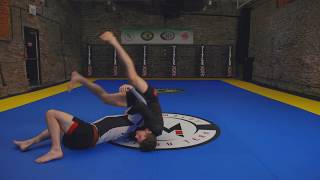
The guillotine choke begins after successfully executing a bump sweep or kimura sweep, which forces the opponent's hands to the mat. As the practitioner drives upward through the opponent's neck, the opponent's head naturally begins to separate from their body. This initial upward drive creates the opening necessary to secure the choke.
Hand Placement and Head Control
Once the opponent posts their hands to regain balance, the top arm wraps around the neck while maintaining control. Proper hand positioning is critical—the choking arm must be positioned high on the neck to prevent the head from escaping during the finish.
Angle and Hip Positioning
The most common mistake is attempting to finish straight back, which allows the opponent's head to slip out. Instead, the practitioner must cut the angle by rotating to their side hip rather than remaining flat. This hip rotation—from center to the right hip—is essential for creating the pressure needed to complete the submission.
The Finish: Rocking the Baby
From the side position, the practitioner pulls the high elbow upward while maintaining neck control, a motion referred to as 'rocking the baby.' This pulling action combined with the angled hip position creates downward pressure that forces the tap. The combination of side body positioning and high elbow pressure is what separates a successful finish from a failed attempt.
Alternative Grip: Reverse Gable
If the opponent defends by tucking their arm tight against their body, preventing a standard gable grip, the reverse gable grip provides a tighter alternative. The choking arm enters first, the practitioner grabs their own wrist, then turns their thumb downward to secure the reverse gable position.
Reverse Gable Execution
With the reverse gable grip established and the proper angle achieved, the same finishing mechanics apply—hip rotation to the side and the 'rocking the baby' motion with the elbow. This grip variation is notably tighter and more difficult for opponents to escape, making it an essential option when the standard grip fails.
Guillotine Choke from Full Guard (Every White Belt Should Know This One)
Key Takeaways
- •Setup from Bump Sweep Position
- •Hand Placement and Head Control
- •Angle and Hip Positioning
- •The Finish: Rocking the Baby
Today's BJJ technique video is a request for a Guillotine Choke from Full Guard. This is one of the earliest submissions I learned in Brazilian Jiujitsu. As I show in the video, this particular technique set up works off of the basic Kimura Sweep / Hip Bump Sweep position. If the sweep fails you come right back into the submission. Which is a valuable lesson in itself for Brazilian Jiu-jitsu. Learning to chain techniques together so that even if 1 thing fails, you can always move on to another. Also in the video I give some key points on finishing the Guillotine Choke efficiently as well as how to change your grip and finish the Arm In Guillotine Choke should the person get their arms in the way. If this is a move you were interested in then I hope this video helps! Thanks for watching. -Chewy ----------------- Free Ebook: http://www.chewjitsu.net/focused-jiu-jitsu-13-page-ebook/ Video Courses and Products: http://www.chewjitsu.net/products T shirts: http://www.chewjitsu.net/shop/ http://www.Facebook.com/Chewjitsu http://www.instagram.com/Chewjitsu http://www.twitter.com/Chewjitsu Charlotte's Web CBD. Head over to https://www.charlottesweb.com/chewjitsu and use the promo code Chewjitsu to get 15% off of your total purchase. Intro/Outtro Music : https://bknapp.bandcamp.com If you’d ever like to train with the team and I. Check out my gym Derby City MMA in Louisville,KY.
Related Techniques
Frequently Asked Questions
What does this video teach about guillotine choke from closed guard?
This video covers setup from bump sweep position, hand placement and head control, angle and hip positioning. It provides detailed instruction from Chewjitsu.
How long does it take to learn guillotine choke from closed guard?
The basic mechanics can be understood in a single session, but developing reliable execution requires consistent drilling over weeks of practice. This 6-part breakdown helps structure your training by isolating each phase of the technique.
What are the key details for finishing guillotine choke from closed guard?
If the opponent defends by tucking their arm tight against their body, preventing a standard gable grip, the reverse gable grip provides a tighter alternative. The choking arm enters first, the practitioner grabs their own wrist, then turns their thumb downward to secure the reverse gable position.