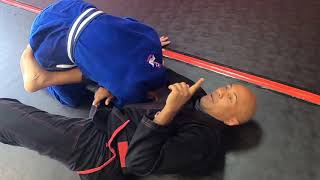
Hand Connection Timing
Hand connection should coincide with the initiation of the choke attack, not before. Connecting the hands prematurely without attacking intention allows the opponent to exploit the grip by pulling the attacker's arm in, a defensive technique called 'climbing the rope.' The correct approach is to keep hands separated during positional setup and connect only when ready to execute the finishing technique.
Initial Grip Placement
The attacking grip begins with one hand on the opponent's chin and the other on the back of the armpit or elbow. The chin hand applies direct pulling pressure, so the defending wrestler should keep their mouth closed to avoid biting their tongue during the pull. This two-point contact establishes control before transitioning to the choke itself.
Shoulder Placement on Neck Center
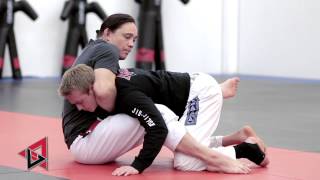
The attacking wrestler's shoulder must be positioned on the center of the opponent's neck rather than on the back or shoulder blades. Placing the shoulder on the back transforms the position into a backpack-style control that allows the opponent to generate upward pressure similar to a squat movement. Correct neck-center placement neutralizes the opponent's hip drive and prevents escape.
Elbow Control and Circling
After establishing the front headlock with proper shoulder placement, the grip transitions from the armpit to the opponent's elbow while maintaining chin pressure. The attacker then circles the opponent while pulling the extended arm forward. The opponent typically resists arm extension by pulling the elbow back toward their body, a natural defensive reaction that sets up the finishing technique.
High-Elbow Guillotine Entry
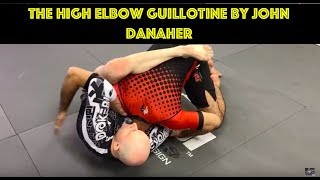
When the opponent pulls their elbow back in resistance, the attacker releases the elbow grip and allows the arm to rise high. The attacker's grip hand immediately clasps around the opponent's neck as the elbow achieves a high position. This transition exploits the opponent's defensive elbow retraction to establish the guillotine configuration.
Arm Positioning and Head Lean
In the high-elbow guillotine, the attacking arm must remain parallel to the floor while the head leans significantly forward over the opponent's body. This extreme forward lean is essential for effective pressure application; if the attacker's head remains upright, the arm alignment becomes compromised and the choke becomes easily defendable. The pronounced body angle creates a mechanical advantage that makes defense difficult.
Finishing Position
The complete high-elbow guillotine can be finished from the top position without pulling guard, though pulling guard provides additional finishing options if needed. The choke can be applied and completed while the attacker remains on their knees. Slow, controlled application is emphasized to avoid injury during training repetitions.
High Elbow Guillotine from the Front Headlock
Key Takeaways
- •Hand Connection Timing
- •Initial Grip Placement
- •Shoulder Placement on Neck Center
- •Elbow Control and Circling
Nogi BJJ technique Xtreme Couture coach Robert Follis EM5II
Related Techniques
Frequently Asked Questions
What does this video teach about guillotine choke from front-headlock sprawl high-elbow?
This video covers hand connection timing, initial grip placement, shoulder placement on neck center. It provides detailed instruction from Rich Castro.
How long does it take to learn guillotine choke from front-headlock sprawl high-elbow?
The basic mechanics can be understood in a single session, but developing reliable execution requires consistent drilling over weeks of practice. This 7-part breakdown helps structure your training by isolating each phase of the technique.
What are the key details for finishing guillotine choke from front-headlock sprawl high-elbow?
In the high-elbow guillotine, the attacking arm must remain parallel to the floor while the head leans significantly forward over the opponent's body. This extreme forward lean is essential for effective pressure application; if the attacker's head remains upright, the arm alignment becomes compromised and the choke becomes easily defendable. The pronounced body angle creates a mechanical advantage that makes defense difficult.