Arm Drag Setup and Initial Positioning
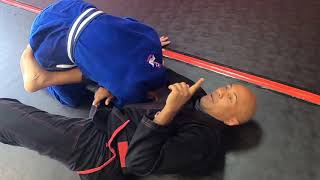
The power guillotine begins from an arm drag position with same-side wrist control and opposite-side tricep control. The instructor leans backward to engage the partner, removes their feet, and kicks the partner's leg to bring them to the floor. Once grounded, the top player clamps across the partner's lap to prevent arm escape.
First Grip Configuration and Arm Threading
With the lap clamped, the instructor threads their arm underneath the partner's neck, positioning the bicep tightly against the neck. The hands are then connected and the top player pulls themselves underneath their partner by dropping to their knees and turning their body toward the floor to execute the squeeze.
Alternative Entry from Arm Drag Posture
When the partner attempts to posture up, the top player maintains tricep control and uses this leverage to prevent the partner from securing an underhook. The same bicep-to-neck clamping technique is applied, but the top player transitions by scooping under the opponent and placing their foot on the partner's hip before squeezing from the side.
Two-on-One Tricep and Wrist Control Variation
An alternative setup uses same-side tricep grip with opposite wrist control, reducing reliance on maintaining the initial arm drag position. When the partner pulls their tricep back, this timing allows the top player to feed their arm under the partner's head more quickly, though with slightly less initial tightness than the first variation.
Hand Connection and Squeeze Mechanics
With the two-on-one grip, the instructor's hand remains positioned on the tricep, eliminating the need to reposition before connecting both hands tightly. The top player pulls underneath the partner, places their foot on the partner's head, and executes the choke by twisting the body while driving the elbow toward the knee.
Mechanical Principle: Elbow-to-Knee Compression
The choke operates by forcing the elbow toward the knee while tucking underneath the partner and squeezing the arm into the side of the head. This compression mechanism resembles a triangle or head-and-arm choke but utilizes the bicep as the primary pressure point against the neck.
Clamping as Essential Control Element
The clamping action across the partner's torso prevents arm escape and is critical to the technique's success. Without this clamp, the partner can recover their elbow and establish an underhook, negating the position.
Hip Positioning and Leg Placement for Leverage
The top player advances their hip closer to the partner and places one foot on the hip while positioning the other foot on the thigh. This leg placement stretches the partner's thigh and blocks the elbow from escaping while the entire body rotates to increase choke pressure.
Hand Deep Positioning and Thigh Block Function
The instructor threads their hand deeply under the partner's arm, and the thigh position simultaneously blocks the partner's tricep from pulling free. Depending on the partner's chest size, alternative grip points such as the inner thigh may serve as intermediate positions before connecting both hands.
Finishing Position and Opponent Responses
The top player scoots forward to further block the partner's arm, places their foot on the hip, and creates the final choking motion by twisting the neck. If the partner attempts to jump over the top player, the top player may allow the movement and continue pursuing the submission as they transition positions.
Power Guillotine
Key Takeaways
- •Arm Drag Setup and Initial Positioning
- •First Grip Configuration and Arm Threading
- •Alternative Entry from Arm Drag Posture
- •Two-on-One Tricep and Wrist Control Variation
Guillotine from an arm drag putting your opponents arm on the same side as their head. This is best from butterfly guard, half guard or off the the back with one hook in. If you like head locks and strangles try hitting this. Any issues ask your instructor for help, They be able to add detail I have missed. #stealthbjjmadrid #guillotine #powerguillotine
Frequently Asked Questions
What does this video teach about guillotine choke from top half-guard power guillotine?
This video covers arm drag setup and initial positioning, first grip configuration and arm threading, alternative entry from arm drag posture. It provides detailed instruction from Stealth BJJ Madrid.
How long does it take to learn guillotine choke from top half-guard power guillotine?
The basic mechanics can be understood in a single session, but developing reliable execution requires consistent drilling over weeks of practice. This 10-part breakdown helps structure your training by isolating each phase of the technique.
What are the key details for finishing guillotine choke from top half-guard power guillotine?
The instructor threads their hand deeply under the partner's arm, and the thigh position simultaneously blocks the partner's tricep from pulling free. Depending on the partner's chest size, alternative grip points such as the inner thigh may serve as intermediate positions before connecting both hands.
Related videos
High Elbow Guillotine from the Front Headlock
Rich Castro
Front Headlock Choke Series: Sweep to Arm In Guillotine
Robby Malof
The High Elbow Guillotine by John Danaher
Bernardo Faria BJJ Fanatics
Arm-In Guillotine: Forced Variation (Guard)
Redline Jiu-Jitsu
Snap Down to Guillotine/Clock Choke
Trillo Jiujitsu Academy