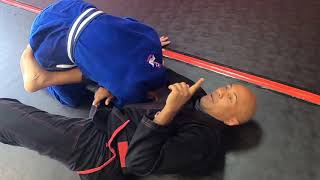
Introduction and Front Headlock vs. Guillotine Distinction
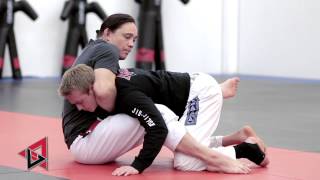
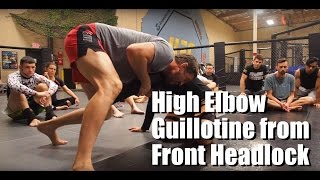
Front headlock and guillotine positions both involve head and arm control but serve different purposes. Front headlocks provide ambiguous control allowing for positional movement and multiple submission options, while guillotines represent a direct route to strangulation. The high elbow guillotine is distinguished as a particularly effective variant used successfully by elite competitors.
Critical Hand and Wrist Positioning
Success with the high elbow guillotine depends entirely on hand placement rather than flexibility. The support hand's wrist must occupy the space between the opponent's shoulder and neck, positioned inside the clavicle. If the wrist contacts the opponent's shoulder externally, the opponent can drive their shoulder to the attacker's chest, preventing the high elbow position from being achieved.
Maintaining Distance and Head Position
The attacker must keep their head forward and avoid allowing contact between their own chest and the opponent's shoulder, as this contact allows the opponent to flatten them out. Pushing the strangle-side shoulder forward onto the opponent's neck maintains the necessary distance. Head positioning directly determines elbow height rather than shoulder flexibility.
Elbow Positioning and Grip Mechanics
The attacking elbow must be kept back to prevent the opponent from covering it with their own elbow. As the attacker connects their hands, they turn their shoulder so both bodies face perpendicular to each other. The head then moves across the opponent's body from one shoulder to the opposite shoulder, creating the high elbow position.
Leg Hook and Finishing Configuration
Once hand position is secured, the attacker hooks their foot tightly in the opponent's hip area. The second leg passes high, with the foot touching the attacker's own elbow before crossing over. This leg positioning creates exceptional tightness in the stranglehold when the opponent attempts to move.
Head Movement as Primary Positioning Tool
Head movement across the opponent's body—transitioning from one shoulder to the opposite shoulder—is the fundamental mechanism for achieving the high elbow position. This movement is more critical than physical flexibility and allows the attacker to lock their elbows together in the final position. The head movement coordinates with the turning of the shoulder to prevent the opponent from flattening the attacker.
Advantages Against Standard Guillotine Defenses
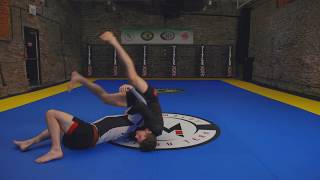
The high elbow position renders conventional guillotine defenses ineffective, including leg jumps across the attacker's body. Even if the opponent successfully jumps their legs across the attacker's side, the high elbow configuration allows the strangulation to continue. The opponent's primary recourse is to execute a forward roll escape to their side.
The High Elbow Guillotine by John Danaher
Key Takeaways
- •Introduction and Front Headlock vs. Guillotine Distinction
- •Critical Hand and Wrist Positioning
- •Maintaining Distance and Head Position
- •Elbow Positioning and Grip Mechanics
The High Elbow Guillotine by John Danaher - Click Here To Check Out John Danaher's Instructional Videos - https://bjjfanatics.com/collections/all/fighter_john-danaher - - For all your BJJ Gear and Apparel Needs Visit - https://store.bjjfanatics.com/ - Are you a BJJ Fanatics Insider? If not, you are missing out! Join now at: https://bjjfanatics.com/products/insiders-club - "Bernardo Faria is a 5x World Champion. Bernardo started training Brazilian Jiu-Jitsu in Juiz de Fora - MG, Brazil at the age of 14 in 2001. After receiving the Black Belt from his first instructor Ricardo Marques in 2008, He moved to Sao Paulo to join BJJ legend Fabio Gurgel and his Alliance team. After many years of training and winning many major titles, Bernardo moved to NYC in 2013 to train and teach at Marcelo Garcia Academy. In 2015 Bernardo achieved his dream of winning the IBJJF World Championship Open class title and his division, doing the double Gold and becoming the 1st in the IBJJF Ranking and also choosed as the best athlete of 2015. Bernardo Faria has now taken on the mission to share some of the lessons, techniques, experiences and more that he has learned along in his 16 years and counting as a BJJ student, teacher and world class competitor. Subscribe to his channel, and join him in this amazing BJJ Journey. We promise that you will also improve your BJJ with his awesome Video Lessons, Episodes of his "5 Minutes BJJ Talk" and more..." http://bernardofaria.com https://www.facebook.com/bernardofariabjj/ https://www.instagram.com/bernardofariabjj/ https://twitter.com/bernardofariajj
Related Techniques
Frequently Asked Questions
What does this video teach about guillotine choke from closed guard high-elbow?
This video covers introduction and front headlock vs. guillotine distinction, critical hand and wrist positioning, maintaining distance and head position. It provides detailed instruction from Bernardo Faria BJJ Fanatics.
How long does it take to learn guillotine choke from closed guard high-elbow?
The basic mechanics can be understood in a single session, but developing reliable execution requires consistent drilling over weeks of practice. This 7-part breakdown helps structure your training by isolating each phase of the technique.
What are the key details for finishing guillotine choke from closed guard high-elbow?
Head movement across the opponent's body—transitioning from one shoulder to the opposite shoulder—is the fundamental mechanism for achieving the high elbow position. This movement is more critical than physical flexibility and allows the attacker to lock their elbows together in the final position. The head movement coordinates with the turning of the shoulder to prevent the opponent from flattening the attacker.