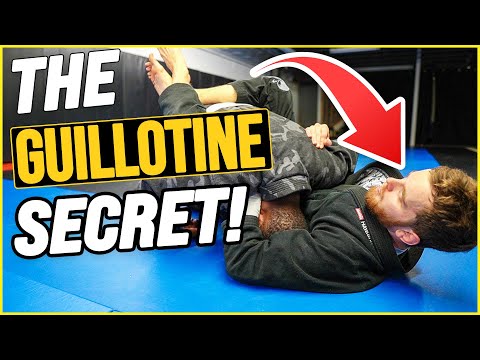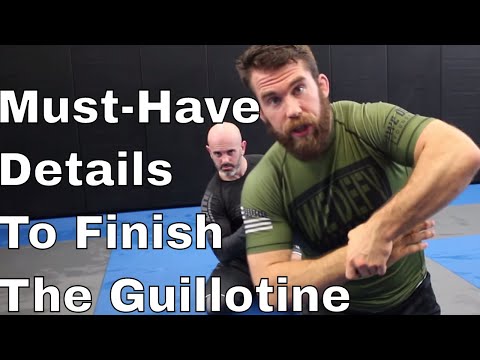
Guillotine Choke from Full Guard (Every White Belt Should Know This One)
0
Guillotine Choke From Closed Guard·Chewjitsu
Today's BJJ technique video is a request for a Guillotine Choke from Full Guard. This is one of the earliest submissions…
Translation: Guillotine Choke (katakana loanword); also フロントチョーク
The guillotine choke from closed guard is applied by wrapping one arm around the opponent's neck from the front, locking the hands together, and squeezing while using the closed guard to prevent the opponent from posturing up or pulling their head free. [1],[2] The guard player typically catches the guillotine as the opponent shoots or dives into the guard, then closes the legs to secure the position. [1] Hip elevation and a slight angle to the choking side increase leverage and direct the forearm blade more precisely into the carotid artery. [1],[2],[3]
The guillotine from closed guard is one of the earliest and most fundamental front choke applications in Brazilian Jiu-Jitsu, used by Royce Gracie in the inaugural UFC events to submit larger opponents. [1],[2] The technique derives from mae-hadaka-jime (front naked strangle) in judo but was refined through the BJJ guard system, which added leg control to prevent escape. [1],[3] It remains one of the most commonly attempted submissions in both MMA and sport grappling at all levels. [1],[2]
The guillotine from closed guard is one of the most commonly finished submissions in both MMA and BJJ. The guard provides leg control preventing escape, while multiple arm positions (arm-in, arm-out, high-elbow) create a versatile attack system. [1]
The closed guard guillotine evolved from basic front headlock chokes through Brazilian Jiu-Jitsu guard development. Marcelo Garcia's guard guillotine innovations were the most significant modern advancement. [1]
Statistically one of the top 5 submissions in MMA history. Extremely common at all levels of BJJ and submission grappling competition. [1]
No images yet for this technique.
Sign in to suggest an image.
Today's BJJ technique video is a request for a Guillotine Choke from Full Guard. This is one of the earliest submissions…
See how I choke anyone in BJJ using the guillotine. I created this guide to help you with everything needed guillotine a…
The guillotine choke from closed guard is a fundamental submission that both Tyler Spangler and Chewjitsu emphasize as highly versatile and effective. Both instructors prioritize grip mechanics, though with different emphases. Spangler stresses the shallow grip with the thumb placed directly on the carotid artery as the critical control point, arguing this positioning makes hand-fighting by the opponent counterproductive and enables the choke even with an arm trapped (arm-and-guillotine variation). Chewjitsu, working from full guard following a sweep setup, offers alternative grip options including a reverse gable grip for situations where standard wrist control fails, particularly when the opponent defends tightly. Both instructors agree on the importance of body positioning: Spangler emphasizes getting the back off the mat and maintaining height to allow adjustment space before falling, while Chewjitsu stresses switching hips to the side and "cutting the angle" rather than finishing straight back, preventing the head from popping out. Spangler demonstrates the choke from half guard and multiple follow-up sequences including mounted variations, while Chewjitsu focuses on guard-based setups following sweep mechanics. Both recommend leaning into or "rocking the baby" (compressing chest pressure) as the finishing mechanic. The instructors agree the choke requires minimal energy expenditure when executed correctly, relying on proper positioning and angle rather than brute force.
Synthesized from 2 instructors
No instructional courses yet for this technique.
Sign in to suggest a course.
Risk of injury to the person this technique is applied to
Guillotine variants compress the trachea and carotids from front headlock control
Skill level needed to execute this technique reliably
Whether this technique is allowed under major competition rule sets
柔術B (jiujitsu-b.com); gentle-world.tech; Yahoo知恵袋; Wikipedia ja (フロントチョーク)
Major Japanese BJJ publication — comprehensive technique lists
Japanese BJJ submission guide
Japanese Q&A community — BJJ technique name verification
Japanese Wikipedia — martial arts technique articles
Standard katakana transliteration of Western martial arts terminology (外来語) — used in Japanese MMA, boxing, and BJJ communities
Japanese terminology sourced from 柔術B (jiujitsu-b.com); gentle-world.tech; Yahoo知恵袋; Wikipedia ja (フロントチョーク)
forearm and grip strength, hip flexibility for guard retention
longer arms for deeper chin-strap wrap
forearm flexors, biceps, hip flexors
Every move, in any martial art, shares a few universal traits. Mix and match below to pinpoint the right tool — or compare equivalents across styles.
The arm-in guillotine from closed guard traps the opponent's arm alongside their neck inside the choking loop, creating a head-and-arm strangle rather than a pure neck choke. [1] The attacker wraps one arm around the opponent's neck and one trapped arm, locks a grip with the free hand, then closes the guard and squeezes while curling the wrist upward into the throat. [1,2] The trapped arm acts as additional compression material — it fills space on one side of the neck, so the forearm only needs to compress the opposite carotid. [2] The arm-in configuration changes the angle of attack and can be more accessible when the opponent is posturing low with both arms extended. [2,3]
The high-elbow guillotine from closed guard — often called the Marcelotine when applied from guard — positions the choking elbow high above the opponent's back, creating a steep downward angle of the forearm across the throat. [1] The attacker wraps the arm around the neck, then elevates the elbow dramatically upward so the wrist digs deep under the chin and the forearm presses at an acute angle against the trachea and carotid arteries. [1,2] The high elbow creates superior mechanical advantage compared to the flat guillotine because the angle generates more compression per unit of squeeze force. [2] From closed guard, the legs pull the opponent's torso forward into the choke while the high elbow prevents them from posturing out. [2,3]
A shallow grip prevents your opponent from hand-fighting effectively—if they try to defend your hands, they compromise their position and make the choke worse. Tyler Spangler emphasizes that keeping your opponent from reaching your hand is the most important part of the offense.
Use heavy chest pressure by puffing your chest forward while pulling up on the neck, and place your elbow on top of the head, pulling it down and compressing your chest and everything together. Tyler Spangler notes that once you execute this compression correctly, your opponent will tap no matter what.
Maintain extremely heavy chest pressure and make sure to puff your chest forward as you pull up on the neck to prevent them from bridging out, which will lead to an easy submission.
Chewjitsu recommends using a gable grip: grab your wrist with your choking arm, then take your thumb and go down to secure it. A reverse gable grip variation is also effective and described as tighter.
The guillotine choke from closed guard is applied by wrapping one arm around the opponent's neck from the front, locking the hands together, and squeezing while using the closed guard to prevent the opponent from posturing up or pulling their head free. The guard player typically catches the guillotine as the opponent shoots or dives into the guard, then closes the legs to secure the position.
The guillotine from closed guard is one of the earliest and most fundamental front choke applications in Brazilian Jiu-Jitsu, used by Royce Gracie in the inaugural UFC events to submit larger opponents. The technique derives from mae-hadaka-jime (front naked strangle) in judo but was refined through the BJJ guard system, which added leg control to prevent escape.
IBJJF: legal — Legal at all belt levels, gi and no-gi — chokes are the safest submission cat…; IJF: legal — Legal (shime-waza) — strangulation techniques are one of three permitted subm…; ADCC: legal — Legal; Unified MMA: legal — Legal — choke submissions are among the most common finishes in MMA; FIAS Sport Sambo: banned — All chokes prohibited in Sport Sambo; FIAS Combat Sambo: legal — Legal
Danger rating 9/10. Guillotine variants compress the trachea and carotids from front headlock control
The standard setup chain: Achieve Controlling Position → Isolate the Neck → Set the Grip → Apply Pressure.
Standard counters include: Tuck Chin — protect the neck by lowering the chin to prevent the choke from sinking / Two-on-One Grip Fight — use both hands to strip the choking grip before it locks / Turn Into — rotate toward the choking arm to relieve carotid pressure / Posture Up — straighten the spine and create distance to break the choking angle.
Common variants: Arm-in guillotine (traps the opponent's arm inside the choke for additional …); High-elbow guillotine (Marcelotine) (elevates the elbow above the head for stronger carotid co…); Standing guillotine (finished from the feet without pulling guard); Power guillotine (chin-strap grip with a rear-naked-choke-style finish for …).
Statistically one of the top 5 submissions in MMA history. Extremely common at all levels of BJJ and submission grappling competition.
Top errors to watch for: Not closing the guard before attempting the finish — open guard allows the opponent to pass; close the guard immediat… / Pulling the head without extending the hips — the guillotine from guard requires hip extension as the primary force; … / Lying flat on the back — angle slightly to the choking side for better forearm-to-neck contact / Not connecting the hands securely — the grip must be locked before attempting to finish; loose grips are stripped.
The Guillotine Choke From Closed Guard is also known as Girochin Chōku, Guard Guillotine, Guilhotina from Guard, Closed Guard Guillotine.