Establishing Proper Fighting Stance
The foundation of an effective straight lead begins with correct stance positioning. The practitioner should stand with feet shoulder-width apart, front foot angled 25 degrees, back foot at 45 degrees, with bent knees and engaged core. The lead hand is positioned slightly lower than traditional boxing to facilitate seamless transitions between the straight lead, hook, and uppercut without requiring hand repositioning.
Hand-First Movement Principle
The critical distinction in executing a powerful straight lead is initiating hand movement before foot movement. When stepping and punching simultaneously, the practitioner's weight remains grounded; moving the hand first allows body weight to transfer directly into the target. This sequencing also reduces telegraphing, as arm movement is less visible than body displacement and provides superior structural alignment with the rear shoulder positioned behind the lead shoulder.
Structural Advantages Over Traditional Boxing
The straight lead generates significantly more power than a conventional jab due to complete body engagement and structural integrity. Unlike the boxing jab—a quick distance-finding tool meant for point scoring—the straight lead is designed to inflict maximum damage in self-defense scenarios. The alignment of shoulders and hips creates a compressed spring effect, enabling force generation through the entire kinetic chain rather than isolated arm movement.
Range Extension and Precision
The straight lead extends 3-5 inches beyond a traditional jab, a significant advantage in combat where inches determine success or failure. By lowering the lead hand slightly, the practitioner gains an additional forearm length of distance without compromising defensive positioning. This extended reach allows practitioners to intercept opponents transitioning toward them while maintaining the ability to quickly retreat to stance.
Back Foot Drive for Power Generation
Generating force in the straight lead requires explosive drive off the rear foot to bridge distance and create kinetic energy. The practitioner should focus on driving the back foot forcefully into the ground, which propels the body forward and amplifies punch velocity. This power generation mechanism transforms the straight lead from a mere distance tool into a genuinely damaging technique.
Offensive Application and Safety
The straight lead is the safest offensive tool because recovery to fighting stance is immediate and minimal. From engagement to retreat requires only a short, linear withdrawal, allowing practitioners to maintain offensive readiness. This safety factor makes it ideal for initiating combinations and maintaining pressure without overextending or compromising defensive positioning.
Tactical Usage in Transitions
The straight lead excels as an intercepting tool during opponent transitions, particularly when an opponent steps forward or backward. Because longer tools create longer interception windows, the straight lead effectively cuts off an opponent's movement and progress. Practitioners should deploy it reactively to catch opponents in moments of vulnerability or positional disadvantage.
Counter-Fighting and Distance Adjustment
After defending against an opponent's combination, the straight lead bridges distance gaps more efficiently than power shots like the cross. When an opponent finishes a combination in a compromised position, the straight lead's shorter path and quicker execution allow immediate scoring. This adaptability makes the straight lead essential for adjusting distance during exchanges rather than committing to telegraphed power techniques.
Combination Strategies
The straight lead serves as both an opening and transitional tool in multi-strike combinations, allowing practitioners to advance while striking. Practitioners can execute double straight leads, chain them with hooks or uppercuts, or deploy them following the cross to bridge the distance created by opponent retreat. The straight lead's efficiency in advancing while maintaining damage output makes it invaluable for combinations that progress forward.
Versatility as a Core Technique
The straight lead functions as the foundational punch because it enables scoring, damage infliction, and setup for additional techniques simultaneously. Its quick execution path from point A to point B, minimal recovery distance, and seamless integration with other tools make it essential for practical fighting. Mastering the straight lead provides practitioners with a versatile, safe, and effective tool for all combat ranges and scenarios.
Straight Lead Punch Technique | Using the Straight Lead like Bruce Lee
Key Takeaways
- •Establishing Proper Fighting Stance
- •Hand-First Movement Principle
- •Structural Advantages Over Traditional Boxing
- •Range Extension and Precision
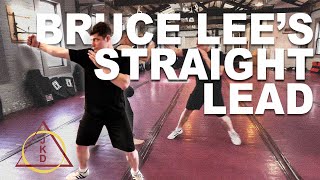
The straight lead punch is a super important technique that Bruce Lee used all the time. It involves throwing a jab with your fist remaining vertical instead of going horizontal like normal. This makes the strike much faster while still keeping it effective in a fight. You don't want to move your feet before throwing this specific strike. Moving your lead hand to throw the straight punch before your legs move, you'll find you get more power and a quicker strike. When used correctly, the straight lead punch can be thrown between your opponent's guard and set them up for a stronger punch or kick immediately after. Make sure you check out more of our technique videos by visiting our channel here: https://www.youtube.com/channel/UCbrco7wH-PWvLLqtg_NCUmg
Related Techniques
Frequently Asked Questions
What does this video teach about lead hand straight?
This video covers establishing proper fighting stance, hand-first movement principle, structural advantages over traditional boxing. It provides detailed instruction from NY Martial Arts Academy.
How long does it take to learn lead hand straight?
The basic mechanics can be understood in a single session, but developing reliable execution requires consistent drilling over weeks of practice. This 10-part breakdown helps structure your training by isolating each phase of the technique.
What are the key details for finishing lead hand straight?
The straight lead serves as both an opening and transitional tool in multi-strike combinations, allowing practitioners to advance while striking. Practitioners can execute double straight leads, chain them with hooks or uppercuts, or deploy them following the cross to bridge the distance created by opponent retreat. The straight lead's efficiency in advancing while maintaining damage output makes it invaluable for combinations that progress forward.