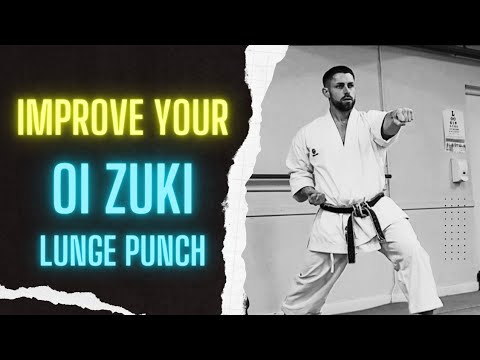
A lesson on Oi Zuki - Shotokan Karate lunge punch
0
Oi Tsuki·John Gardiner
#karate #shotokan #martialarts #training #karatetechniques
Translation: lunge punch
Oi Tsuki is the fundamental stepping punch in karate where the practitioner lunges forward with the rear foot stepping to the front while simultaneously delivering a straight punch with the arm on the same side as the stepping leg. [1] Unlike gyaku tsuki (reverse punch) where the punching arm is opposite to the lead leg, oi tsuki coordinates the punch with the forward step, using the body's forward momentum to power the strike. [1] It is typically the first punch taught in karate and appears in nearly every kata. [1]
The stepping momentum adds significant force to the punch. [1] In traditional karate competition, oi tsuki scored with good timing is one of the highest-percentage scoring techniques. Less common in full-contact fighting where the telegraph of the step is exploitable.
Okinawan karate lineage: Chinese martial arts (Fujian White Crane, Southern Shaolin) → Okinawan te (Shuri-te, Naha-te, Tomari-te) → systematized by Anko Itosu and Kanryo Higaonna → transmitted to mainland Japan by Gichin Funakoshi (Shotokan), Chojun Miyagi (Goju-Ryu), and Kenwa Mabuni (Shito-Ryu) in the 1920s–30s. [1]
The most fundamental attack in WKF karate kumite competition. Oi tsuki (stepping punch) is one of the highest-frequency techniques in point-fighting karate. Also foundational in ITF TKD patterns. [1]
No images yet for this technique.
Sign in to suggest an image.
#karate #shotokan #martialarts #training #karatetechniques
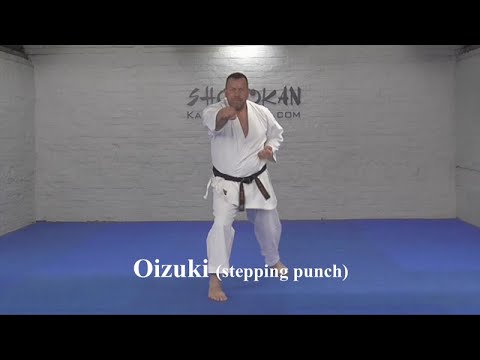
https://www.shotokankarateonline.com/blog/lesson-6-oi-zuki-stepping-punch/ Stepping forward oizuki from zenkutsu dachi,…
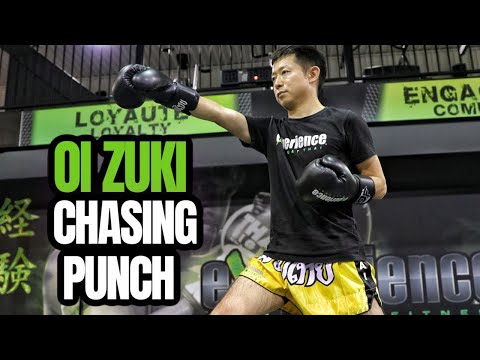
My special guest, Shintaro, from Japan is here today to show us one of his special techniques from Karate, called OI ZUK…
Oi tsuki, known as the lunge punch or chasing punch, is a fundamental straight punch technique in Shotokan karate characterized by simultaneous forward movement of the punch and same-side leg. Danny Fung emphasizes that the technique's power derives from coordinated advancement without intermediate motions, enabling unpredictable and forceful strikes. He demonstrates its application in combination, notably following kicks when an opponent's guard is lowered, and notes its adaptability to MMA and Muay Thai contexts. John Gardiner provides detailed biomechanical instruction, stressing that proper foundation begins with stance mechanics rather than arm movement. He describes a pulling action of the rear foot from the ground—not a push—with knee flexors driving the leg forward while protecting the groin through knee alignment. Gardiner emphasizes that back-foot rotation (35-45 degrees) occurs during forward weight transfer, not beforehand, to avoid knee strain. The punch lands simultaneously with the completion of the stance, driven by hip rotation and rear-leg power rather than upper-body initiation. Gardiner's resistance-band exercises isolate the hip-drive component, ensuring practitioners develop the technique from ground-force generation rather than stepping mechanics. Both instructors agree on the importance of coordinated lower-body and striking movement, though Gardiner provides more granular kinetic detail regarding stance transition and injury prevention.
Synthesized from 3 instructors
No instructional courses yet for this technique.
Sign in to suggest a course.
Risk of injury to the person this technique is applied to
Standard punching force amplified by stepping momentum.
Skill level needed to execute this technique reliably
Whether this technique is allowed under major competition rule sets
Funakoshi, G. Karate-Do Kyohan. Kodansha International.
[1] Funakoshi, Karate-Do Kyohan, Punching Techniques chapter
Official karate technique names (和語/漢語)
Established Japanese martial arts naming convention — native Japanese term (和語/漢語)
[1] Funakoshi, Karate-Do Kyohan, Punching Techniques chapter
coordination of step and punch, hip alignment
rear leg (drive), core (stability), shoulder, triceps
Oi tsuki (stepping/lunge punch) is the most fundamental forward attack in karate — the rear hand punches while the rear foot steps forward into the technique. It is the first attack taught in most karate curricula and appears in virtually every basic kata. Distinguished from gyaku-zuki (reverse punch) by the same-side hand-foot coordination. (Nakayama, Dynamic Karate; Funakoshi, Karate-Do Kyohan)
John Gardiner emphasizes that oi tsuki should start with a pulling action from your hip flexors, drawing your knees together as you bring your back foot forward, rather than bouncing or pushing off the floor. After that initial pull, you then push through your front leg into the stance.
Keep your knees close together as you move forward to protect your groin, and ensure your knees travel forward and back (not rotated outward) to avoid putting harmful pressure on the knee joint. The foot rotation happens naturally as your weight presses forward into the lunge position, not before.
John Gardiner advises against turning your foot first, as this puts the knee in a bad position; instead, let your weight press forward as if entering a lunge, and the back foot naturally turns slightly inward as a result of that forward motion.
John Gardiner stresses that everything in oi tsuki is built from the foundations of the floor—your legs and feet—which is why establishing a strong zenko stance first and understanding the pulling action from your lower body are critical before adding the punch.
Oi Tsuki is the fundamental stepping punch in karate where the practitioner lunges forward with the rear foot stepping to the front while simultaneously delivering a straight punch with the arm on the same side as the stepping leg. Unlike gyaku tsuki (reverse punch) where the punching arm is opposite to the lead leg, oi tsuki coordinates the punch with the forward step, using the body's forward momentum to power the strike.
Oi Tsuki is documented in Gichin Funakoshi's Karate-Do Kyohan as the foundational stepping punch. It is the first punch taught in virtually all traditional karate styles and forms the basis of basic combinations (kihon).
WKF Karate: Legal: legal — primary scoring technique, controlled contact required; WT Taekwondo: Legal: legal — hand techniques score 1 point; Unified MMA: Legal {src:Unified Rules of MMA, August 2025|/sources/Unified: legal — MMA-Rules-August-2025.pdf}; WAKO Kickboxing: Legal {src:WAKO Full Contact Rules|/sources/WAKO: legal — Full-Contact-Rules.pdf}
Danger rating 4/10. Moderate — standard punching force amplified by stepping momentum.
The standard setup chain: From distance → After a front kick → In kata sequence.
Standard counters include: Side step — the lunge commits to one line / Tai sabaki (body shift) — evade and counter from the angle / Back leg front kick — stop the forward momentum.
Common variants: Oi tsuki jodan (lunge punch to the face (high level)); Oi tsuki chudan (lunge punch to the solar plexus (middle level)); Oi tsuki gedan (lunge punch to the groin (low level)); Sanbon tsuki (triple lunge punch in sequence); Kizami oi tsuki (short lunge punch from close range).
The most fundamental attack in WKF karate kumite competition. Oi tsuki (stepping punch) is one of the highest-frequency techniques in point-fighting karate.
Top errors to watch for: Punching before the step completes — punch and step must synchronize / Not pulling the rear hand back (no hikite) / Leaning forward instead of keeping upright posture / Stepping too wide — the step should be straight forward.
The Oi Tsuki is also known as Oi Tsuki, Oizuki, Lunge Punch, Stepping Punch, Chasing Punch.