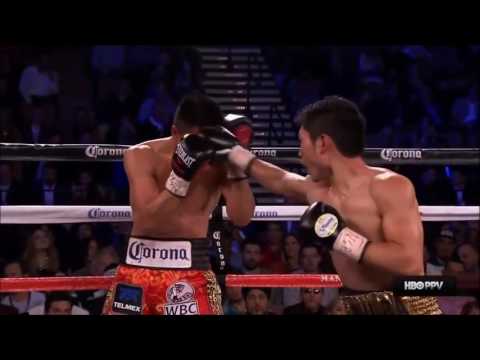
The 1 2, Jab and Cross Knockouts
0
Cross·Jack O'Connell
A collection of some sweet 1-2, jab cross knockouts and knock downs in boxing. The 1-2 is the original boxing combinati…
Translation: cross
The cross is the straight rear-hand power punch, one of the four fundamental punches in boxing. [1] The term 'cross' derives from the punch crossing over the opponent's lead hand, a concept documented in early boxing manuals. [2] The cross developed as gloved boxing matured under the Queensberry Rules, with bare-knuckle fighters having previously favoured hooks and looping punches to protect their hands. [2] Dempsey described the cross as the primary 'power line' punch, where the body's kinetic chain aligns to deliver maximum force along a straight trajectory from the rear hand. [1] Bob Fitzsimmons (1863-1917) is credited with pioneering the use of full body rotation to power the rear straight hand. [3]
The cross (also called the straight right for orthodox fighters) is one of the four fundamental boxing punches. [1]
The cross is one of the highest-power punches in boxing and a primary knockout tool. [1]
No images yet for this technique.
Sign in to suggest an image.
A collection of some sweet 1-2, jab cross knockouts and knock downs in boxing. The 1-2 is the original boxing combinati…
No instructional courses yet for this technique.
Sign in to suggest a course.
Risk of injury to the person this technique is applied to
Jab/cross; fundamental striking tool, cumulative brain trauma risk
Skill level needed to execute this technique reliably
Whether this technique is allowed under major competition rule sets
Karate-Do Kyohan: The Master Text (Gichin Funakoshi, 1935)
Alias sources — [1] Championship Fighting (Dempsey, 1950) [2] Karate-Do Kyohan (Funakoshi, 1935) [3] Boxing (Fleischer, 1958)
History sources — [1] Championship Fighting (Dempsey, 1950) [2] The Art of Boxing and Manual of Training (Price, 1867) [3] Boxing's Greatest Fighters (Sugar, 2006)
Standard katakana transliteration of Western martial arts terminology (外来語) — used in Japanese MMA, boxing, and BJJ communities
Alias sources — [1] Championship Fighting (Dempsey, 1950) [2] Karate-Do Kyohan (Funakoshi, 1935) [3] Boxing (Fleischer, 1958)
History sources — [1] Championship Fighting (Dempsey, 1950) [2] The Art of Boxing and Manual of Training (Price, 1867) [3] Boxing's Greatest Fighters (Sugar, 2006)
hip rotation power, rear foot pivot, full kinetic chain coordination
reach advantage, strong hips for power transfer
glutes, obliques, pectorals, triceps, deltoids
Every move, in any martial art, shares a few universal traits. Mix and match below to pinpoint the right tool — or compare equivalents across styles.
A rear-hand straight punch timed to land simultaneously or immediately after slipping or parrying an incoming attack, using the opponent's forward momentum against them.
A looping rear-hand punch thrown over the opponent's guard in a slight arc, dropping the body weight forward and downward on impact.
The fundamental rear-hand straight punch thrown with full hip and shoulder rotation, transferring weight from the back foot through the kinetic chain.
A powerful straight punch thrown with the rear hand, rotating the hips and shoulders fully to generate maximum force along a direct line to the target.
The cross is the straight rear-hand power punch, one of the four fundamental punches in boxing. The term 'cross' derives from the punch crossing over the opponent's lead hand, a concept documented in early boxing manuals.
Unified MMA: legal — Legal striking technique; WBC/Boxing: legal — Legal — punches are the core technique of boxing; WKF: legal — Legal, jodan/chudan punch scores 1 point (yuko) — controlled contact required; Kyokushin: restricted — Body punches legal at full power, head punches banned; WT: restricted — Punches to trunk only (1 point), punches to head banned; ITF: legal — Legal — hand techniques to head and body both permitted; WAKO: legal — Legal in Full Contact and Low Kick formats; K: legal — 1/GLORY — Legal — full power punches to head and body; IFMA: legal — Legal
Danger rating 5/10. High — jab/cross; fundamental striking tool, cumulative brain trauma risk
The standard setup chain: Fighting Stance → Weight Transfer → Extend → Snap Back.
Standard counters include: Slip — move the head off the centre line to evade the punch / Parry — deflect the incoming punch with a quick hand redirection / Counter Cross — time a straight punch over the incoming attack.
Common variants: Standard cross (rear-hand straight punch with full hip rotation); Counter cross (pull counter) (leaning back to avoid the jab, firing the cross as a counter); Step-in cross (stepping forward with the punch for added reach and power); Body cross (targeting the solar plexus or liver with the straight rea…).
The cross is one of the highest-power punches in boxing and a primary knockout tool.
Top errors to watch for: Squaring the shoulders to generate more power, which removes your bladed stance and exposes the chin / Pushing the punch rather than rotating into it — the fist should accelerate to the target, not coast / Lifting the rear heel too early, which disconnects the kinetic chain from the floor / Not returning to guard after the cross, leaving the lead side of the face open to hooks.
The Cross is also known as Kurosu, Rear Straight, Gyaku Tsuki, Right Cross.