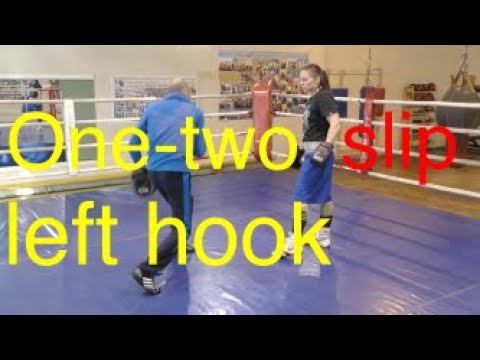
Combination: One-two, Slip, Left Hook
0
One-Two Combination·Russian School of Boxing
Alexey Frolov trains Saadat Dalgatova, the vice-world Champion.
Translation: one-two combination
The one-two combination (jab followed immediately by the cross) is the most fundamental two-punch combination in boxing and one of the first sequences taught to beginners. [1] Dempsey identified the jab-cross as the foundational combination in Championship Fighting, explaining that the jab obscures the opponent's vision and disrupts their guard, creating the opening for the more powerful cross. [1] The one-two has been the single most commonly thrown combination in professional boxing since records have been kept. [2] Haislet documented the one-two as requiring the jab to be thrown at full extension before the cross follows in a seamless transfer of weight from front foot to rear foot and back. [3]
The one-two is the first combination taught in boxing. [1]
The jab-cross is the most commonly thrown combination in boxing and MMA. [1]
No images yet for this technique.
Sign in to suggest an image.
Alexey Frolov trains Saadat Dalgatova, the vice-world Champion.
How to Come Back with the ONE TWO Punch combination! Today Tom Yankello of the @World Class Boxing Channel shows you a…
No instructional courses yet for this technique.
Sign in to suggest a course.
Risk of injury to the person this technique is applied to
Jab/cross; fundamental striking tool, cumulative brain trauma risk
Skill level needed to execute this technique reliably
Whether this technique is allowed under major competition rule sets
Karate-Do Kyohan: The Master Text (Gichin Funakoshi, 1935)
Alias sources — [1] Championship Fighting (Dempsey, 1950) [2] Boxing (Fleischer, 1958) [3] Karate-Do Kyohan (Funakoshi, 1935)
History sources — [1] Championship Fighting (Dempsey, 1950) [2] Boxing's Greatest Fighters (Sugar, 2006) [3] Boxing (Haislet, 1940)
Standard katakana transliteration of Western martial arts terminology (外来語) — used in Japanese MMA, boxing, and BJJ communities
Alias sources — [1] Championship Fighting (Dempsey, 1950) [2] Boxing (Fleischer, 1958) [3] Karate-Do Kyohan (Funakoshi, 1935)
History sources — [1] Championship Fighting (Dempsey, 1950) [2] Boxing's Greatest Fighters (Sugar, 2006) [3] Boxing (Haislet, 1940)
hand speed, shoulder endurance, quick retraction
longer reach for keeping opponents at distance
anterior deltoid, triceps, serratus anterior, core
Every move, in any martial art, shares a few universal traits. Mix and match below to pinpoint the right tool — or compare equivalents across styles.
Focus on rotating and counter-rotating your hips and shoulders together rather than using huge arm movements. The Russian School of Boxing emphasizes that you are faster when you accelerate with your shoulders while maintaining proper boxing stance.
No—accelerate yourself immediately after the one-two regardless of whether your opponent throws a counter punch. The key is continuous footwork and momentum; don't hesitate or lean forward waiting for a response.
Yes, absolutely. The World Class Boxing Channel recommends practicing the footwork and moves by yourself while watching instructional videos; this helps ingrain the technique into your muscle memory.
A fundamental two-punch combination consisting of a lead-hand jab immediately followed by a rear-hand cross, the most basic and widely taught combination in striking arts.
The one-two combination (jab followed immediately by the cross) is the most fundamental two-punch combination in boxing and one of the first sequences taught to beginners. Dempsey identified the jab-cross as the foundational combination in Championship Fighting, explaining that the jab obscures the opponent's vision and disrupts their guard, creating the opening for the more powerful cross.
Unified MMA: legal — Legal striking technique; WBC/Boxing: legal — Legal — punches are the core technique of boxing; WKF: legal — Legal, jodan/chudan punch scores 1 point (yuko) — controlled contact required; Kyokushin: restricted — Body punches legal at full power, head punches banned; WT: restricted — Punches to trunk only (1 point), punches to head banned; ITF: legal — Legal — hand techniques to head and body both permitted; WAKO: legal — Legal in Full Contact and Low Kick formats; K: legal — 1/GLORY — Legal — full power punches to head and body; IFMA: legal — Legal
Danger rating 5/10. High — jab/cross; fundamental striking tool, cumulative brain trauma risk
The standard setup chain: Assume Fighting Stance → Generate Power → Execute Strike → Recover to Guard.
Standard counters include: Block — absorb the strike with a protective guard position / Evasion — move the target out of the strike's path / Counter-Attack — time an offensive response during the recovery phase of the strike.
Common variants: Standard jab (quick, straight lead-hand punch from orthodox stance); Power jab (stepping into the jab with more body weight for increased…); Double jab (two rapid jabs to set up a follow-up power shot); Body jab (targeting the midsection instead of the head).
The jab-cross is the most commonly thrown combination in boxing and MMA.
Top errors to watch for: Pausing between the jab and the cross — the combination must flow as one continuous motion with two beats / Throwing both punches at the same power, when the jab should be a quick setup and the cross the payload / Not returning the jab hand to the chin before the cross fires, leaving the lead side open to a hook / Winding up the cross while the jab is still out, creating a readable telegraph.
The One-Two Combination is also known as Wan Tsū, Jab-Cross, One-Two, Ichi-Ni.