Prerequisites and Technique Overview
Practitioners must first master the fundamental sidekick before attempting the spinning variation. The spinning sidekick differs from a standard sidekick in that the practitioner rotates 180 degrees backward using the back leg rather than stepping forward with the front leg.
Three-Step Breakdown
The technique is divided into three distinct phases: inverting the lead leg so toes point toward the back foot, turning the head over the back shoulder to locate the target, and chambering the back leg with heel and buttocks aligned toward the target while the standing foot pivots away. After mastering these steps individually, practitioners can combine them into a single fluid motion.
Wall-Assisted Practice Method
Using a wall or bar for support helps prevent loss of balance and falling during the learning phase. Practitioners should practice both the three-step version and the combined motion while maintaining contact with the support structure before attempting the technique in open space.
Avoiding Over-Spinning
A common error involves excessive rotation that resembles spinning like a top rather than moving directionally toward the target. The practitioner should simply look over the shoulder and pick up the leg; the body will naturally rotate to the correct position without forced circular momentum.
Proper Chamber Position and Rechamber
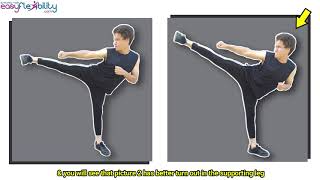
The standing heel, kicking heel, and buttocks must all point toward the target at full extension. Retracting the leg back to chest position after extension is critical to control momentum and prevent over-rotation; practitioners should practice double spinning sidekicks to ensure proper rechamber technique.
Generating Power Through Proper Knee Height
The leg must be lifted high enough to achieve a stomping motion that engages gravity and body weight. Placing an obstacle in front of the target ensures the knee clears the barrier before extension, preventing weak leg-only strikes without gravitational force.
Standing Foot Pivot and Center Protection
The standing foot must remain fully pivoted to effectively manage rebound force from impact. Over-rotation of the standing foot after achieving full pivot exposes the practitioner's center line to the opponent, creating a defensive vulnerability.
Accuracy Development with Ping Pong Ball Target
Once control and power are established, practitioners should practice striking a ping pong ball suspended by kite string, aiming for heel contact only while avoiding the string and toe strikes. This precision drill develops the targeting accuracy necessary for effective application.
Distance Management and Sliding Variation
When distance prevents reaching the target, practitioners can execute a sliding spinning sidekick by pushing off the standing foot during extension to close the gap while gaining additional power. This technique allows recovery from distance miscalculation.
Head Position and Jump Variations
The head must lead the rotation and locate the target before extension; practitioners often forget this step when increasing speed, resulting in missed strikes. The technique can be executed as a jump spinning sidekick with three variations: spinning from a chambered back leg before jumping, jumping from both feet with simultaneous spin, or jumping and landing on both feet.
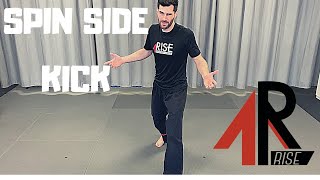
TAEKWONDO SPIN SIDE KICK TUTORIAL
Key Takeaways
- •Prerequisites and Technique Overview
- •Three-Step Breakdown
- •Wall-Assisted Practice Method
- •Avoiding Over-Spinning
Sometimes called a back kick, or reverse side kick. The spin around backward side kick can be a difficult Martial Arts kick to learn. This kick is used often in Many martial arts including Taekwondo, Karate, Kung Fu, Kick Boxing... In this video you will find instructions, and drills that will help you improve your kicking technique. If you like this vid, please share, comment like and subscribe to this channel. (These videos are intended for entertainment purposes only, the creator retains no liability should practice or application of these techniques cause injury. Utilize this information at your own risk. )
Related Techniques
Frequently Asked Questions
What does this video teach about spin-back side kick?
This video covers prerequisites and technique overview, three-step breakdown, wall-assisted practice method. It provides detailed instruction from Simon Scher.
How long does it take to learn spin-back side kick?
The basic mechanics can be understood in a single session, but developing reliable execution requires consistent drilling over weeks of practice. This 10-part breakdown helps structure your training by isolating each phase of the technique.
What are the key details for finishing spin-back side kick?
When distance prevents reaching the target, practitioners can execute a sliding spinning sidekick by pushing off the standing foot during extension to close the gap while gaining additional power. This technique allows recovery from distance miscalculation.