Side Kick Tutorial
0
Front Chamber Side Kick·TigerRockAcademy
The Side Kick is one of our most powerful kicks - follow a couple of principles to really enhance the power!
Translation: Front chamber side kick
The Front Chamber Side Kick is chambered with the knee pointing forward rather than to the side, disguising it as a potential front kick until the hip rotates and the foot drives out sideways. [1] This deception is effective because the front-facing chamber looks identical to a front kick setup, causing the opponent to defend the wrong angle. [1] The hip rotation happens explosively at the last moment, converting the apparent front kick into a powerful side kick. [1]
The Front Chamber Side Kick offers tactical advantages in specific situations where a standard side kick would be less effective. [1]
Cross-style martial arts kicking tradition. [1]
Commonly used in WT Taekwondo Olympic competition and ITF tournament sparring. Also appears in WKF karate kumite and kickboxing. [1]
No images yet for this technique.
Sign in to suggest an image.
The Side Kick is one of our most powerful kicks - follow a couple of principles to really enhance the power!
http://www.elasticsteel.net/Articles.asp?ID=185
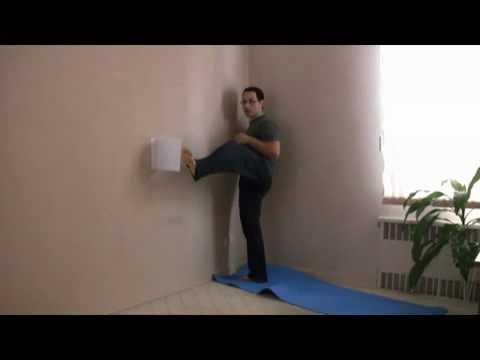
The front chamber side kick integrates foundational positioning with explosive execution. TigerRockAcademy emphasizes the critical importance of the pivot—rotating the supporting foot so toes point opposite the target direction—which resets the hips into a naturally powerful anatomical position and enables proper knee chambering. The chamber itself requires aligning heel and knee in a single line to generate direct force, achieved through hand-check drills where the kicking knee touches the back hand on retraction. TigerRockAcademy demonstrates that kicking inside the shoulder (with open shoulder positioning) produces greater penetration and power than kicking behind the shoulder, while maintaining forward-facing posture crucial for continued engagement. ElasticSteelKicking addresses the hybrid front-chamber kick's practical execution: most practitioners chamber at a moderate height and begin the strike as a snap kick before transitioning to a push motion in the final inches near contact, combining knee extension with hip extension and posterior-chain engagement. This hybrid approach reduces flexibility demands on hamstrings and hip flexors compared to pure push kicks while still accessing power from multiple muscle groups. Both instructors note that effective side kicks typically target mid-body or lower rather than high targets, and that proper chamber mechanics—whether through pivot positioning or deliberate hand-check training—form the foundation for powerful, penetrating strikes.
Synthesized from 2 instructors
No instructional courses yet for this technique.
Sign in to suggest a course.
Risk of injury to the person this technique is applied to
Side kick variants deliver significant lateral force to the target
Skill level needed to execute this technique reliably
Whether this technique is allowed under major competition rule sets
Essential Book of Martial Arts Kicks (De Bremaeker & Faige, 2010)
[1] De Bremaeker & Faige, Essential Book of Martial Arts Kicks (2010)
Requires good lateral hip flexibility
Strong core for balance
gluteus medius, hip abductors, quadriceps
Documented in De Bremaeker & Faige, Section 2.6. A side kick that begins with a front-kick-style chamber before extending laterally — the front chamber disguises the side kick trajectory. (De Bremaeker & Faige, Essential Book of Martial Arts Kicks, 2010)
The pivot allows you to turn your base foot to align your body correctly for the kick, which then enables you to chamber your knee and pull it in properly. Without the pivot, you won't be able to lift your knee correctly to set up the technique.
Without pivoting your base foot, you won't be able to lift and chamber your knee correctly, which breaks down the foundation of the entire kick.
The Front Chamber Side Kick is chambered with the knee pointing forward rather than to the side, disguising it as a potential front kick until the hip rotates and the foot drives out sideways. This deception is effective because the front-facing chamber looks identical to a front kick setup, causing the opponent to defend the wrong angle.
The Front Chamber Side Kick is a specialised variant of the side kick documented in cross-style kicking methodology. Side kick variations have been developed across karate, taekwondo, and kung fu traditions.
Unified MMA: legal — Legal striking technique; WBC/Boxing: banned — All kicks prohibited in boxing; WKF: legal — Legal, chudan (body) kick scores 2 points, jodan (head) kick scores 3 points; Kyokushin: legal — Legal at full power to body and head; WT: legal — Legal, body kick 2 points, head kick 3 points, spinning body 4 points, spinni…; WAKO: legal — Legal in Full Contact and Low Kick formats; K: legal — 1/GLORY — Legal; IFMA: legal — Legal — kicks are a core Muay Thai technique
Danger rating 6/10. Side kick variants deliver significant lateral force to the target
The standard setup chain: Feint or jab → Chamber → Front Chamber Side Kick to target → Follow-up technique.
Standard counters include: Step inside the kick range / Catch and sweep / Counter with low roundhouse.
Common variants: High front chamber side kick (targeting head level); Mid front chamber side kick (targeting body); Low front chamber side kick (targeting legs).
Commonly used in WT Taekwondo Olympic competition and ITF tournament sparring. Also appears in WKF karate kumite and kickboxing.
Top errors to watch for: Attempting the front chamber side kick without sufficient side kick foundation / Poor balance during execution / Insufficient hip rotation.
The Front Chamber Side Kick is also known as Furonto Chanbā Saido Kikku, Forward Chamber Side Kick.