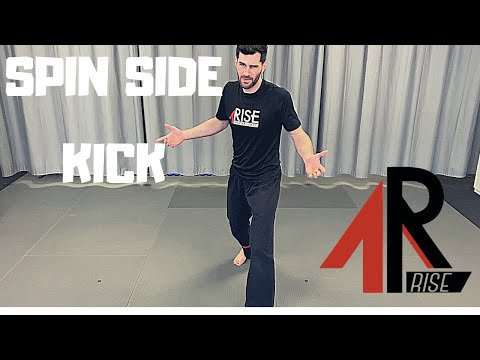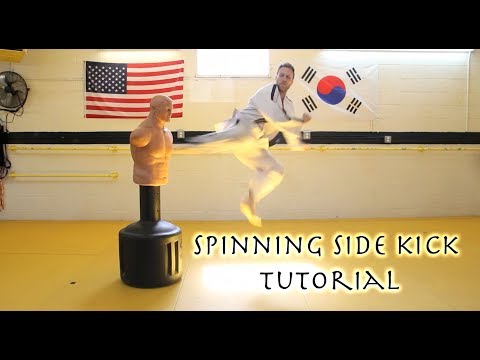
TAEKWONDO SPIN SIDE KICK TUTORIAL
0
Spin-Back Side Kick·Simon Scher
Sometimes called a back kick, or reverse side kick. The spin around backward side kick can be a difficult Martial Arts k…
Translation: Ushiro (後ろ) = behind/back, Yoko (横) = side, Geri (蹴り) = kick — a side kick preceded by a 180° spin, delivering the kick with the back toward the opponent during the rotation
The Spin-Back Side Kick combines a full 180-degree spin with a thrusting side kick, generating tremendous rotational power that makes it one of the most powerful kicks in any martial art. [1] The practitioner pivots on the front foot, spinning the rear shoulder forward until the back is momentarily facing the opponent, then chambers and thrusts the side kick at the moment the hips are squared to the target — the entire body's rotational momentum funnels through the hip and into the heel, producing impact forces significantly greater than a standard standing side kick. [1],[2] The spin is initiated by turning the lead foot inward (pivoting on the ball) while the rear shoulder drives forward and the head turns to locate the target over the shoulder — this head turn is critical because it provides visual tracking of the target during the spin, without which the kick arrives blind. [1] De Bremaeker and Faige document the Spin-Back Side Kick as one of the most powerful techniques in their 89-kick compilation, noting that it combines the linear thrust of the side kick with the rotational acceleration of a spinning technique — a combination that produces forces measured at up to 1,500 pounds of impact in laboratory testing of elite taekwondo practitioners. [1],[3] In taekwondo, where it is called dwi yop chagi, the Spinning Side Kick is one of the signature power techniques of the art and has produced numerous spectacular knockouts in both WT (Olympic) and ITF competition. [3] The technique is a staple of MMA striking: fighters such as Bas Rutten, Mirko 'Cro Cop' Filipovic, and Robert Whittaker have used the spinning side kick to devastating effect in UFC and PRIDE competition. [4] The kick's primary limitation is the momentary blind spot during the spin (approximately 0.1-0.2 seconds where the back is to the opponent), which an experienced counter-fighter can exploit. [1]
The Spin-Back Side Kick appears in multiple martial arts traditions: in Japanese karate as ushiro yoko geri (documented in Shotokan kata such as Unsu), in Korean taekwondo as dwi yop chagi (a core competition technique), and in Chinese wushu as a standard spinning technique. [1],[2],[3] The technique's development in competition was driven by the realisation that spinning adds approximately 30-50% more force to a side kick — a significant advantage in full-contact fighting where knockout power determines outcomes. [3] In taekwondo, which awards bonus points for spinning techniques under WT competition rules, the spinning side kick became one of the most commonly trained power techniques. [3] The kick achieved global fame through fighters like Mirko 'Cro Cop' Filipovic, whose spinning side kick (and the related spinning heel kick) became his signature weapon in PRIDE Fighting Championships during the 2000s — his left high kick and spinning side kick were so feared that opponents would alter their entire game plan to avoid them. [4] In the UFC, fighters such as Robert Whittaker, Yair Rodriguez, and Stephen Thompson have used the Spin-Back Side Kick as a fight-ending weapon. [4]
The Spin-Back Side Kick is one of the most powerful single techniques in martial arts. [1],[3] Laboratory force plate measurements of elite taekwondo practitioners have recorded impact forces of 1,500+ pounds — exceeding the force typically needed to fracture ribs (approximately 400 pounds) by nearly 4x. [3] The technique's effectiveness in competition is demonstrated by its frequency as a fight-ending weapon: the spinning side kick has produced knockouts in UFC, PRIDE, Kyokushin, and taekwondo competition against world-class opposition. [4] The primary limitation is the predictability and the blind spot: experienced fighters can time a counter during the 0.1-0.2 second window when the spinner's back is to them. [1] This risk-reward calculation makes the Spin-Back Side Kick most effective when used sparingly as a surprise weapon, not as a primary technique. [1],[2]
Traditional karate (ushiro yoko geri, documented in Shotokan kata) + taekwondo (dwi yop chagi, core competition technique) → refined for full-contact competition → demonstrated at highest MMA levels by Cro Cop, Whittaker, Thompson → now a standard power technique across all striking martial arts. [1],[2],[3],[4]
Mirko 'Cro Cop' Filipovic — PRIDE heavyweight champion, multiple spinning side kick KOs || Robert Whittaker — UFC middleweight champion, notable spinning side kick usage || Stephen Thompson — UFC welterweight contender, karate-based spinning kicks || Numerous WT taekwondo Olympic and World Championship knockouts via dwi yop chagi || Kyokushin World Tournament knockouts via ushiro yoko geri to the body || Laboratory measurement: 1,500+ pounds of impact force from elite TKD practitioners. [3]
No images yet for this technique.
Sign in to suggest an image.
Sometimes called a back kick, or reverse side kick. The spin around backward side kick can be a difficult Martial Arts k…
The Spin Side Kick is a powerful technique built on timing, balance, and full-body control. In this tutorial, we break d…
The spin-back side kick is executed by rotating 180 degrees on the balls of the feet to face away from the target, then extending a side kick backward. Both Simon Scher and Rise Martial Arts emphasize foundational mastery of a standard side kick before attempting the spinning variation. Scher breaks the technique into three discrete steps: inverting the lead leg with toes pointing toward the back foot, turning the head over the back shoulder to sight the target, and picking up the back leg into full chamber with heel and glute toward the target. Rise Martial Arts presents a similar progression: lifting heels to pivot on the balls of the feet while twisting, then combining this rotation with a backward side kick. Both instructors stress critical execution details: maintaining a fully pivoted standing foot, achieving proper knee height early in the chamber to enable downward force, and crucially, rechambering the leg after extension to control momentum and prevent over-rotation. Scher warns against excessive spinning (likening it to unwanted centripetal motion), emphasizing that the body naturally assumes the correct position when the head leads. Rise Martial Arts similarly cautions that the kick must travel linearly forward upon extension rather than continuing the rotational arc. Both recommend progression drills using support tools (wall, bar) before free-standing execution, and advanced variations including double spins, jump variations, and sliding applications. Scher addresses tactical application in sparring, noting the technique's telegraphic nature and recommending it primarily as a follow-up in combinations or when the opponent moves backward, never as an isolated opening attack.
Synthesized from 2 instructors
No instructional courses yet for this technique.
Sign in to suggest a course.
Risk of injury to the person this technique is applied to
The Spin-Back Side Kick is one of the most powerful kicks measurable in combat sports. Laboratory testing of elite taekwondo practitioners has recorded impact forces exceeding 1,500 pounds — more than sufficient to fracture ribs, rupture the spleen or liver, cause kidney damage, and produce one-hit knockouts when landing to the head or body. [1,3] Mirko 'Cro Cop' Filipovic's spinning side kick was feared across PRIDE and UFC for its fight-ending capability. In Kyokushin karate, the ushiro yoko geri is one of the primary body-knockout techniques. [4]
Skill level needed to execute this technique reliably
Whether this technique is allowed under major competition rule sets
Essential Book of Martial Arts Kicks (De Bremaeker & Faige, 2010)
description: [1] De Bremaeker 2010 pp.79-81, [2] Nakayama 1966, [3] Pieter 1997 force data
Official karate technique names (和語/漢語)
Established Japanese martial arts naming convention — native Japanese term (和語/漢語)
description: [1] De Bremaeker 2010 pp.79-81, [2] Nakayama 1966, [3] Pieter 1997 force data
Requires good hip flexibility for the side kick component
Strong core (obliques) for the rotational acceleration
Good balance on the pivot foot during the spin
Cervical mobility for the head turn to track the target
Explosive leg strength for the thrust at the end of the spin
Proprioception for maintaining body alignment during 180° rotation
Practitioners with martial arts backgrounds in spinning techniques (TKD, wushu) adapt faster
According to Simon Scher, the most common mistake is forgetting to rechamber—pulling the leg back to your chest after extending it. Without rechambering, you'll over-spin and lose control, since the pullback serves to cease momentum just like the kick itself does.
Simon Scher emphasizes that your butt cheek, heel, and standing heel should all be pointed toward your target for proper extension and rechamber. Make sure your standing foot stops in a fully pivoted position—if you over-spin and it continues rotating, you won't handle the rebound force effectively.
Simon Scher advises never throwing it as a solo technique since it's highly telegraphed and gives opponents time to counter. Instead, use it as part of a combination when your opponent is moving away from you, or as a fading jump spin sidekick to keep distance while they retreat.
Simon Scher identifies not turning your head with your body as one of the most common errors in the spin sidekick. You need to see your target before you throw the kick to ensure accuracy and timing.
The Spin-Back Side Kick combines a full 180-degree spin with a thrusting side kick, generating tremendous rotational power that makes it one of the most powerful kicks in any martial art. The practitioner pivots on the front foot, spinning the rear shoulder forward until the back is momentarily facing the opponent, then chambers and thrusts the side kick at the moment the hips are squared to the target — the entire body's rotational momentum funnels through the hip and into the heel, producing impact forces significantly greater than a standard standing side kick.
The Spin-Back Side Kick appears in multiple martial arts traditions: in Japanese karate as ushiro yoko geri (documented in Shotokan kata such as Unsu), in Korean taekwondo as dwi yop chagi (a core competition technique), and in Chinese wushu as a standard spinning technique. The technique's development in competition was driven by the realisation that spinning adds approximately 30-50% more force to a side kick — a significant advantage in full-contact fighting where knockout power determines outcomes.
Unified MMA: legal — Legal striking technique; WBC/Boxing: banned — All kicks prohibited in boxing; WKF: legal — Legal, chudan (body) kick scores 2 points, jodan (head) kick scores 3 points; Kyokushin: legal — Legal at full power to body and head; WT: legal — Legal, body kick 2 points, head kick 3 points, spinning body 4 points, spinni…; WAKO: legal — Legal in Full Contact and Low Kick formats; K: legal — 1/GLORY — Legal; IFMA: legal — Legal — kicks are a core Muay Thai technique
Danger rating 9/10. The Spin-Back Side Kick is one of the most powerful kicks measurable in combat sports. Laboratory testing of elite taekwondo practitioners has recorded impact forces exceeding 1,500 pounds — more than sufficient to fracture ribs, rupture the spleen or liver, cause kidney damage, and produce one-hit knockouts when landing to the head or body. Mirko 'Cro Cop' Filipovic's spinning side kick was feared across PRIDE and UFC for its fight-ending capability. In Kyokushin karate, the ushiro yoko geri is one of the primary body-knockout techniques.
The standard setup chain: Establish the jab-cross rhythm at punching range → Opponent calibrates to punching-range exchanges → Throw a jab-cross combination → Instead of resetting, continue the body's rotation from the cross into a 180° spin → Head turns to locate the target over the shoulder → Chamber the side kick as the hips approach the target line → THRUST the side kick at the moment the hips face the target → Heel impacts the opponent's midsection or head with full rotational + linear force → Immediately recover to fighting stance → Follow up if the opponent is hurt, or reset if they defended.
Standard counters include: Timing the spin — the 0.1-0.2 second window when the spinner's back is to the opponent is the primary counter-window;… / Advancing into the spin — closing distance before the spin completes jams the kick at short range where it cannot dev… / Lateral movement — stepping to the side during the spin takes the target off the kick's linear path / Low kick to the pivot leg — attacking the planted foot/leg during the spin destabilises the rotation.
Common variants: Standard Spin-Back Side Kick (the basic 180° spin to side kick); Fast spin (a shorter, tighter spin prioritising speed over power, us…); Power spin (a wider, more committed spin maximising rotational force,…); Jumping Spin-Back Side Kick (adding a jump during the spin for additional height and v…); 360° Spin Side Kick (a full rotation (360°) before the kick, adding maximum ro…); Switch Spin (switching stance before spinning, adding deceptive timing); Spin-Back Side Kick to the head (elevating the kick to head height during the spin (requir…).
Mirko 'Cro Cop' Filipovic — PRIDE heavyweight champion, multiple spinning side kick KOs || Robert Whittaker — UFC middleweight champion, notable spinning side kick usage || Stephen Thompson — UFC welterweight contender, karate-based spinning kicks || Numerous WT taekwondo Olympic and World Championship knockouts via dwi yop chagi || Kyokushin World Tournament knockouts via ushiro yoko geri to the body || Laboratory measurement: 1,500+ pounds of impact force from elite TKD practitioners.
Top errors to watch for: Not turning the head to locate the target — the most critical error: spinning blind produces inaccurate kicks that mi… / Incomplete pivot — if the lead foot doesn't rotate the full 180°, the hip angle is wrong and the side kick fires in t… / Wide, looping spin — a spin that travels a wide arc (rather than rotating on a vertical axis) is slow, telegraphed, a… / Telegraphing the spin — any preparatory movement (dropping the hands, shifting weight, looking backward) alerts the o….
The Spin-Back Side Kick is also known as Spinning Side Kick, Ushiro Yoko Geri, Dwi Yop Chagi (Taekwondo), Reverse Side Kick, Back Spinning Side Kick.