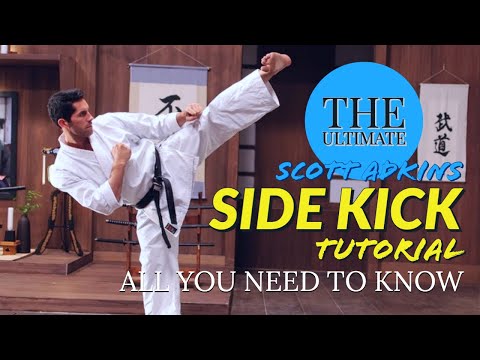
Scott Adkins Side Kick Tutorial
0
Back Side Kick·Scott Adkins
This Side Kick Tutorial is brought to you by World renowned martial artist Scott Adkins. This kick is a staple of martia…
Translation: Back side kick
The Back Side Kick is a side kick delivered toward the rear, targeting an opponent who has moved behind or to the side of the practitioner. [1] Without fully turning to face the opponent, the kicker chambers and extends the side kick backward, using peripheral vision or feeling to guide the strike. [1] This technique is particularly effective in multiple-attacker scenarios or when an opponent has circled to the flank. [1]
The Back Side Kick offers tactical advantages in specific situations where a standard side kick would be less effective. [1]
Cross-style martial arts kicking tradition. [1]
Primarily a training, demonstration, and point-fighting technique. Rarely seen in full-contact MMA or kickboxing due to acrobatic risk and telegraphing. Appears occasionally in TKD and point-fighting karate tournaments. [1]
No images yet for this technique.
Sign in to suggest an image.
This Side Kick Tutorial is brought to you by World renowned martial artist Scott Adkins. This kick is a staple of martia…
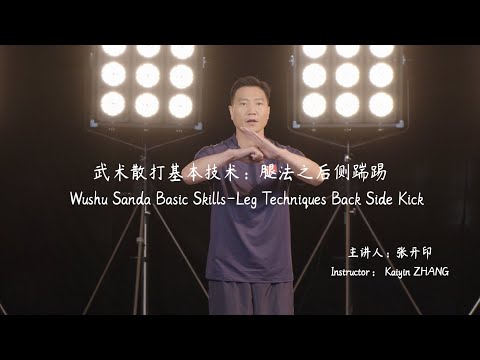
Wushu Sanda Basic Skills-Leg Techniques-Back Side Kick Instructed by Zhang Kaiyin, a World Wushu Sanda Champion
The back side kick is a defensive and offensive striking technique executed by rotating the base foot to generate hip torque, then extending the leg laterally with the heel or knife-edge of the foot as the primary striking surface. Scott Adkins emphasizes that proper end-position alignment is critical: the body should rotate nearly perpendicular to the target with the back slightly facing the opponent, the striking foot's heel elevated higher than the toes, and the shoulders squared down. He stresses avoiding the chambering of the knee in favor of a direct rotation-and-kick motion that preserves momentum generated from the floor, arguing that excessive knee lift wastes power by interrupting ground-force transfer. The heel and blade ridge deliver maximum impact due to concentrated striking surface area; hitting with a flat foot disperses force and reduces damage potential. Adkins notes that body weight shifting into the kick amplifies power significantly, and practitioners should drill the fundamental technique repeatedly to internalize correct positioning. He also identifies the back side kick as an effective follow-up after a missed round kick, as the rotation already positions the hips advantageously for the lateral strike. The WUSHU TV transcript provides no usable English-language instruction for synthesis.
Synthesized from 2 instructors
No instructional courses yet for this technique.
Sign in to suggest a course.
Risk of injury to the person this technique is applied to
Side kick variants deliver significant lateral force to the target
Skill level needed to execute this technique reliably
Whether this technique is allowed under major competition rule sets
Essential Book of Martial Arts Kicks (De Bremaeker & Faige, 2010)
[1] De Bremaeker & Faige, Essential Book of Martial Arts Kicks (2010)
Requires good lateral hip flexibility
Strong core for balance
gluteus medius, hip abductors, quadriceps
Documented in De Bremaeker & Faige, Section 2.7. A side kick directed backward — the kicker turns away from the opponent and delivers a side kick behind them. Useful when retreating. Appears in 31 passages across 2 books. (De Bremaeker & Faige, Essential Book of Martial Arts Kicks, 2010)
According to Scott Adkins, what matters most is what you do with your hips before you throw the side kick. You need to turn your back foot outward so your toes point one direction and your heels point the opposite way to generate proper power and technique.
Scott Adkins explains that knowing the correct end position makes it easier to transition to that position from whatever stance you're in. If you know what the end position should be, you'll reach it more efficiently and consistently.
Your toes should be pulled back and positioned lower than your heel, with the ridge of the foot (knife's edge) and heel being the striking surfaces, not the flat of the foot or toes. Scott Adkins emphasizes that hitting with just the heel concentrates force into a smaller area, making the kick more devastating.
Scott Adkins advises pushing off the floor and going straight into the kick without pausing, rather than bringing your knee up first and then extending. This keeps the momentum from your initial push going through the entire technique instead of losing power by changing direction mid-motion.
The Back Side Kick is a side kick delivered toward the rear, targeting an opponent who has moved behind or to the side of the practitioner. Without fully turning to face the opponent, the kicker chambers and extends the side kick backward, using peripheral vision or feeling to guide the strike.
The Back Side Kick is a specialised variant of the side kick documented in cross-style kicking methodology. Side kick variations have been developed across karate, taekwondo, and kung fu traditions.
Unified MMA: legal — Legal striking technique; WBC/Boxing: banned — All kicks prohibited in boxing; WKF: legal — Legal, chudan (body) kick scores 2 points, jodan (head) kick scores 3 points; Kyokushin: legal — Legal at full power to body and head; WT: legal — Legal, body kick 2 points, head kick 3 points, spinning body 4 points, spinni…; WAKO: legal — Legal in Full Contact and Low Kick formats; K: legal — 1/GLORY — Legal; IFMA: legal — Legal — kicks are a core Muay Thai technique
Danger rating 6/10. Side kick variants deliver significant lateral force to the target
The standard setup chain: Feint or jab → Chamber → Back Side Kick to target → Follow-up technique.
Standard counters include: Step inside the kick range / Catch and sweep / Counter with low roundhouse.
Common variants: High back side kick (targeting head level); Mid back side kick (targeting body); Low back side kick (targeting legs).
Primarily a training, demonstration, and point-fighting technique. Rarely seen in full-contact MMA or kickboxing due to acrobatic risk and telegraphing.
Top errors to watch for: Attempting the back side kick without sufficient side kick foundation / Poor balance during execution / Insufficient hip rotation.
The Back Side Kick is also known as Bakku Saido Kikku, Reverse Side Kick.