Knee Positioning for Height Variation
The angle and position of the knee before extension is critical to sidekick effectiveness. For mid-level kicks, the knee should remain parallel to the floor before driving straight outward, while higher kicks require angling the knee upward first. The knee must remain positioned within the hip alignment to maximize power generation rather than moving away from the body's centerline.
Hip Engagement and Injury Prevention
Hip positioning determines both power output and injury risk in sidekick execution. Practitioners must actively push the hips forward into the kick rather than allowing the leg to shoot upward independently, which can cause the leg to collapse under body weight. Adequate flexibility in front splits and side splits enables proper hip extension without strain or injury to the hip joint.
Supporting Leg Timing and Coordination
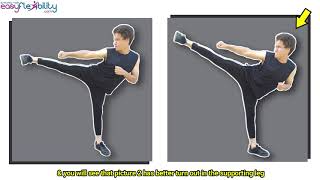
Maximum force is generated by rotating the supporting leg and extending the kick simultaneously rather than executing these movements sequentially. The supporting foot should complete its turn at the same moment the kicking leg reaches full extension. Breaking these actions into separate phases significantly reduces the overall force of the technique.
Knee Safety and Hyperextension Prevention
The sidekick carries inherent risk of knee and ACL injury, particularly when executing the technique against air without target contact. Hyperextension occurs when the leg drives too forcefully beyond its natural range, commonly happening in repetitive air kicks. Practitioners should focus on generating force through hip and glute engagement rather than excessive leg extension.
Foot Position and Contact Surface
The striking surface utilizes a blade foot (palle) configuration where the ankle is pulled upward and toes point sideways. This foot shape presents the top edge of the foot as the primary striking zone. Proper ankle flexion and toe positioning are essential for effective target contact and technique aesthetics.
Practice Drills for Height and Power
Two primary conditioning drills develop sidekick capacity: sustained height holds using wall support to build hip muscular endurance, performed for one minute across three sets, and rapid repetitions from starting to finished position for explosive power development. The first drill increases kicking height and flexibility while the second develops velocity and force generation.
Common Technical Errors
Practitioners frequently bend or curve the upper body during execution when maintaining an upright torso is required. The knee should not point downward as this creates a back kick appearance rather than a proper sidekick. The body and leg should descend simultaneously to create maximum effort, and the return path must mirror the outgoing path rather than deviating to a different trajectory.
(How to) Side Kick Tutorial - Taekwondo
Key Takeaways
- •Knee Positioning for Height Variation
- •Hip Engagement and Injury Prevention
- •Supporting Leg Timing and Coordination
- •Knee Safety and Hyperextension Prevention
(How to) Side Kick Tutorial - Taekwondo Please Subscribe! Side kick (WTF) Taekwondo is one of Taekwondo's representative kick. It is a very difficult kick to perfect and requires good flexibility along with muscular strength. Hong Kong Taekwondo School HKU Station is now open so its more convenient to get to us!! http://instagram.com/wootaekwon http://www.hongkongtaekwondo.com
Related Techniques
Frequently Asked Questions
What does this video teach about snapping side kick?
This video covers knee positioning for height variation, hip engagement and injury prevention, supporting leg timing and coordination. It provides detailed instruction from wootaekwon.
How long does it take to learn snapping side kick?
The basic mechanics can be understood in a single session, but developing reliable execution requires consistent drilling over weeks of practice. This 7-part breakdown helps structure your training by isolating each phase of the technique.
What are the key details for finishing snapping side kick?
Two primary conditioning drills develop sidekick capacity: sustained height holds using wall support to build hip muscular endurance, performed for one minute across three sets, and rapid repetitions from starting to finished position for explosive power development. The first drill increases kicking height and flexibility while the second develops velocity and force generation.