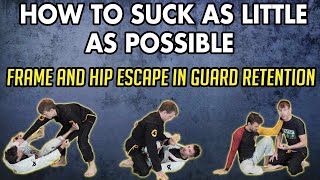
Safety Position Foundation
The foundational safety position in mounted bottom involves placing the triceps flat on the mat with elbows tight against the body to maintain hip-to-hip connection with the top player. This positioning prevents the mounted opponent from achieving a high mount position, which allows unrestricted striking. The defender maintains this frame while preparing to initiate an escape.
Hip Frame and Edge Control
The escape begins by framing the opponent's hips with one arm while establishing an edge—shifting body weight to one side. The bottom player straightens the leg on the same side as the frame, keeping that foot planted on the mat to create stability and leverage for the subsequent movement.
Knee-Elbow Connection
The core technique involves bringing the knee of the straightened leg into contact with the elbow of the framing arm. The bottom player points the toes downward to create an optimal angle for the knee to work under the opponent's ankle, then crunches the body to achieve tight knee-elbow connection, which is difficult for the top player to control.
Hip Escape and Underhook
Using a shrimping motion, the bottom player drives their hips into open space while simultaneously securing an underhook on the opponent's arm. Without the underhook, the top player can prevent hip movement and halt the escape, making this arm position essential for progression.
Second Side Execution
The bottom player repeats the knee-elbow crunch on the opposite side, using hip pressure to drive that knee outward. Once both sides are executed with proper underhook control, the escape transitions the bottom player into closed guard position.
Preventing High Mount
A critical defensive principle is preventing the top player from achieving high mount—where the knees move into the bottom player's armpits. This position is particularly dangerous in self-defense contexts as it allows unrestricted striking, making immediate hip framing the highest priority upon being mounted.
Underhook Grip Options
After establishing the knee-elbow connection and initial hip escape, the bottom player can secure the underhook by reaching to the opponent's waist or alternatively gripping their shoulder. This underhook prevents the top player from re-establishing control as the bottom player extracts their hips to reach closed guard.
Transitional Position and Follow-up
Once the escape reaches closed guard, the bottom player can continue developing the technique through drill work. If the top player attempts to improve their position by moving backward, the bottom player follows with hip movement and executes a bump sweep to reverse position, allowing continuous drilling of the fundamental escape sequence.
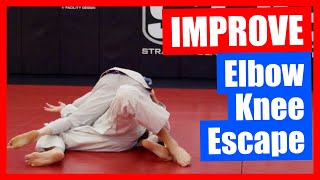
Mount Escapes - Knee Elbow Escape
Key Takeaways
- •Safety Position Foundation
- •Hip Frame and Edge Control
- •Knee-Elbow Connection
- •Hip Escape and Underhook
In my opinion the knee elbow escape is the most fundamental and reliable way to escape the mount. The key is framing the hips with quality connection across their hips. This prevents them from advancing to high mount and allows you to feel their pressures and intent. I teach students to progress the escape to closed guard because it reinforces good movement habits. The reality is that once your hips are free you’ve achieved the objective. I love drilling with the objective of getting to your feet because you really feel when you have escaped the pin. Whether we’re talking pure grappling or self-defense (street), you must have a plan to efficiently escape the mount. #bjj #jiujitsu
Related Techniques
Frequently Asked Questions
What does this video teach about knee-elbow frame?
This video covers safety position foundation, hip frame and edge control, knee-elbow connection. It provides detailed instruction from Honu BJJ Reno.
How long does it take to learn knee-elbow frame?
The basic mechanics can be understood in a single session, but developing reliable execution requires consistent drilling over weeks of practice. This 8-part breakdown helps structure your training by isolating each phase of the technique.
What are the key details for finishing knee-elbow frame?
After establishing the knee-elbow connection and initial hip escape, the bottom player can secure the underhook by reaching to the opponent's waist or alternatively gripping their shoulder. This underhook prevents the top player from re-establishing control as the bottom player extracts their hips to reach closed guard.