Low Mount Position Setup
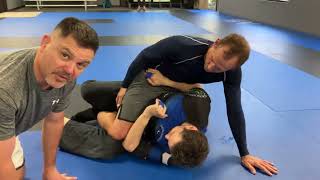
The elbow-knee escape is most effective when the opponent establishes a low mount with weight distributed across the defender's belly rather than on the hips. In this position, the opponent's legs become relatively light, creating an opportunity for the escape. The instructor demonstrates this common tournament position where the opponent's feet remain down but not crossed.
Leg Placement and Frame Mechanics
The defender begins by stepping one leg out flat in the middle of the opponent's legs while keeping the hand across the belly. The leg placement must be heavy and extended to prevent the opponent from shifting weight back underneath the knee. Maintaining the kneecap and toes down ensures the escape line remains open.
Working the Knee Underneath
Once the leg is flat in the middle, the defender brings the knee up and under the opponent's leg rather than attempting to drive through it. This sliding motion under the leg opens up space and allows the escape to progress. The elbow and opposite knee remain grounded throughout the movement.
Countering Crossed Ankle Defense
When the opponent crosses their ankles to prevent leg insertion, the defender must first untie the feet. This requires extending both legs while lifting the hips and applying downward pressure with body weight to make the position uncomfortable for the opponent. The defender must maintain heavy leg pressure throughout to prevent the opponent from re-establishing the crossed ankle position.
Identifying Top Foot Position
The defender closes their eyes to tactilely determine which of the opponent's legs is on top through pressure feedback. This sensory awareness is essential before executing the foot-clearing motion. Once identified, the defender can target the correct leg for the escape sequence.
Clearing Crossed Ankles with Hip Pressure
The defender extends both legs while keeping them heavy and swings them to one side, using hip pressure to untie the opponent's ankles. This weighted, lateral leg movement creates enough discomfort to force the opponent's feet apart. Once the ankles are separated, one leg can be inserted flat in the middle of the opponent's legs.
Progression and Drilling
The basic progression begins with both feet down and untouched, then advances to the opponent's feet touching but uncrossed, and finally to fully crossed ankles. Each stage requires the same fundamental mechanics: heavy leg pressure, flat foot insertion, and knee elevation underneath rather than through the opponent's legs. Repetition builds the tactile sensitivity and timing necessary for consistent execution.
IMPROVE your Elbow Knee Escape with this ONE simple method
Key Takeaways
- •Low Mount Position Setup
- •Leg Placement and Frame Mechanics
- •Working the Knee Underneath
- •Countering Crossed Ankle Defense
Try out SBG University for a month for free. Use the code: YOUTUBEFREE https://sbgu.samcart.com/referral/OD1DNOAi/vUiYFZg8SxVUHRex For more SBG International BJJ and MMA instructional videos check: www.sbguniversity.com Also, check the BJJ Q&A with founder of SBG Matt Thornton here: https://youtu.be/pghir7WyisY Learn more about SBG here: https://sbgi-pdx.com/ #bjj #brazilianjiujitsu #SBG
Related Techniques
Frequently Asked Questions
What does this video teach about knee-elbow frame?
This video covers low mount position setup, leg placement and frame mechanics, working the knee underneath. It provides detailed instruction from SBG PDX & Vancouver BJJ and MMA Videos.
How long does it take to learn knee-elbow frame?
The basic mechanics can be understood in a single session, but developing reliable execution requires consistent drilling over weeks of practice. This 7-part breakdown helps structure your training by isolating each phase of the technique.
What are the key details for finishing knee-elbow frame?
The defender extends both legs while keeping them heavy and swings them to one side, using hip pressure to untie the opponent's ankles. This weighted, lateral leg movement creates enough discomfort to force the opponent's feet apart. Once the ankles are separated, one leg can be inserted flat in the middle of the opponent's legs.