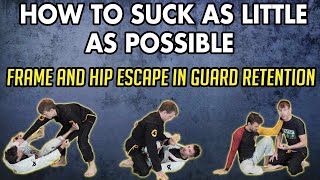
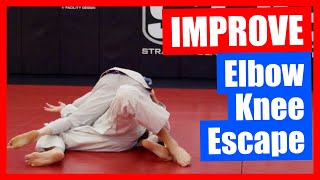
Introduction to Frame and Hip Escape
The frame and hip escape is presented as the most versatile guard retention method available against diverse passing styles. It provides the greatest range of applicable outcomes and serves as a foundational concept rather than a fixed sequence of movements.
Failure Without Frame Against Knee Cut Pass
Without establishing a frame, the defender loses positional control once the passer's knee contacts the mat during a knee cut pass. The passer slides through the guard and completes the pass due to the absence of defensive framing structures.
Arm Frame and Grip Battle
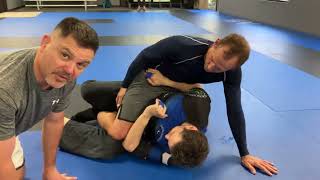
The defender establishes an upper-body frame by gripping the passer's collar with the top arm. If the passer secures a sleeve grip, the defender must engage in a grip battle to maintain the framing arm, as it serves dual purposes for both frame and base.
Frame Mechanics in the Gi
In gi grappling, the frame is created by establishing a thumb-down collar grip and driving the hand into the throat to create distance. This collar frame is more practical than no-gi alternatives and prevents the passer from advancing through the guard.
Early Recognition and Base Building
The defender can recognize the knee cut pass early and establish base before the passer fully commits, rather than waiting until the knee drops completely. Once in base with hips withdrawn, the defender reorients to face the passer and resume guard engagement from a more favorable position.
Frame as Flexible Concept
The frame is fundamentally a conceptual principle rather than a technique requiring exact replication. The defender achieves successful guard retention by establishing a frame using available tools—arm, knee, or both—depending on situational variables.
Frame and Hip Escape Against Kneefold Pass
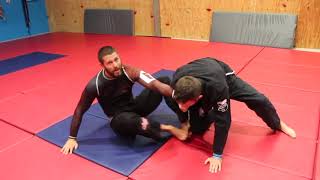
Against the kneefold pass in butterfly guard, the defender uses either a collar tie or punch grip to create a frame. The defender then abducts the hips backward to reset the guard or, if the passer moves closer, uses a classical collar tie position before re-establishing hip angle.
Application Against Standing X Pass
In open guard against a standing X pass, the defender establishes a hand frame to block the passer's advance. As the passer increases proximity, the defender may transition to an elbow frame while maintaining base, then withdraws the hips to recompose the guard.
Guard Retention 1: The Frame and Hip Escape
Key Takeaways
- •Introduction to Frame and Hip Escape
- •Failure Without Frame Against Knee Cut Pass
- •Arm Frame and Grip Battle
- •Frame Mechanics in the Gi
Guard retention: how to use the 'Frame and Hip Escape' to stop the guard pass in BJJ. From The BJJ Guard and Bottom Game Formula, http://www.grapplearts.com/bottomgame. Or for Apple iPhones and iPads: https://itunes.apple.com/ca/app/bjj-guard-game/id1106105141?mt=8 For Android phones and tablets: https://play.google.com/store/apps/details?id=com.grapplearts.bjjformula2 For Kindle devices: https://www.amazon.com/BJJ-Guard-Bottom-Game-Formula/dp/B01F6FDPF0/
Related Techniques
Frequently Asked Questions
What does this video teach about hip frame?
This video covers introduction to frame and hip escape, failure without frame against knee cut pass, arm frame and grip battle. It provides detailed instruction from Stephan Kesting.
How long does it take to learn hip frame?
The basic mechanics can be understood in a single session, but developing reliable execution requires consistent drilling over weeks of practice. This 8-part breakdown helps structure your training by isolating each phase of the technique.
What are the key details for finishing hip frame?
Against the kneefold pass in butterfly guard, the defender uses either a collar tie or punch grip to create a frame. The defender then abducts the hips backward to reset the guard or, if the passer moves closer, uses a classical collar tie position before re-establishing hip angle.