Breaking the Stiff Arm
0
Stiff Arm Frame·Alec Baulding
Jiu Jitsu X Course https://jiujitsux.com/profile/abaulding/ The Short Guy Guard: https://shortguyguard.com Reverse De …
Translation: stiff arm frame
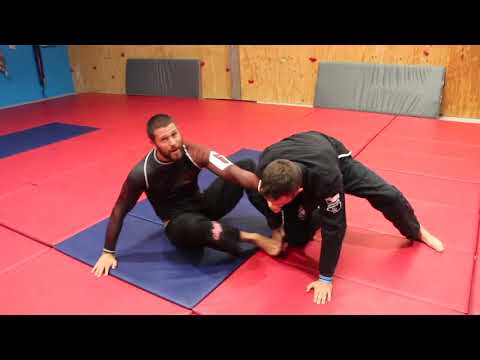
The Stiff Arm Frame subfamily covers defensive techniques where the fighter extends one or both arms to create maximum distance between themselves and the opponent, using the locked arm as a push-frame to prevent the opponent from closing distance or establishing pressure. [1] The stiff arm frame is most effective when the opponent is attempting to drive forward with heavy pressure, as the extended arm acts as a strut that transfers the opponent's forward force into the ground through the defender's body. [1],[2] In MMA, the stiff arm frame on the ground is also used to create space for standing up. [2],[3]
The stiff arm frame uses a straight arm against the opponent's shoulder or hip to maintain distance. [1]
A fundamental BJJ and wrestling defensive technique. [1]
Used in BJJ and MMA competition. [1]
No images yet for this technique.
Sign in to suggest an image.
Jiu Jitsu X Course https://jiujitsux.com/profile/abaulding/ The Short Guy Guard: https://shortguyguard.com Reverse De …
SALE SALE SALE OVER 50% OFF – BOX SET – ALL 4 COURSES 50% OFF CLICK HERE – https://bit.ly/2lAOHmp • The Blue Belt Sup…
The stiff-arm frame in guard retention and its defensive counterpart form a tactical stalemate in Brazilian Jiu-Jitsu competition. The Grappling Academy emphasizes the stiff-arm frame as a guard-retention tool: when an opponent passes the guard by controlling the legs, the defending player uses a fully locked-out arm (typically gripping the collar or body) to create distance and prevent further advancement. By maintaining a rigid, extended arm while moving hips away, the defender buys time to recover guard position without relying on leg strength alone. This technique's power derives not from arm strength but from skeletal rigidity and hip movement working in concert. Alec Baulding addresses the inverse problem: when an opponent uses the stiff arm as a stalling tactic during standup exchanges, they maintain collar and sleeve control while keeping hips away, making takedowns nearly impossible. Unlike Judo (which imposes time limits on dominant grips), Jiu-Jitsu permits indefinite stalling, making grip-breaking and positional counters essential. Baulding presents multiple solutions—preemptive collar control, structured grip breaks (wrist-shelf technique, bone-on-bone pressure), and footwork entries (underhook transitions, elbow-pin takedowns, wrist locks)—that exploit the extended-arm position's structural vulnerabilities. Both instructors frame the stiff arm as contextually powerful but ultimately one tool in a larger positional chess match.
Synthesized from 2 instructors
No instructional courses yet for this technique.
Sign in to suggest a course.
Risk of injury to the person this technique is applied to
Guard retention uses frames and hip movement; minimal direct injury risk
Skill level needed to execute this technique reliably
Whether this technique is allowed under major competition rule sets
Boxing (Edwin Haislet, 1940)
Effectiveness sources — [1] Jiu-Jitsu University (Ribeiro, 2008)
Alias sources — [1] Jiu-Jitsu University (Ribeiro, 2008) [2] Fundamentals of Brazilian Jiu-Jitsu (Danaher, 2012) [3] Brazilian Jiu-Jitsu: Theory and Technique (Gracie, 2001)
Standard katakana transliteration of Western martial arts terminology (外来語) — used in Japanese MMA, boxing, and BJJ communities
Alias sources — [1] Jiu-Jitsu University (Ribeiro, 2008) [2] Fundamentals of Brazilian Jiu-Jitsu (Danaher, 2012) [3] Brazilian Jiu-Jitsu: Theory and Technique (Gracie, 2001)
Effectiveness sources — [1] Jiu-Jitsu University (Ribeiro, 2008)
structural arm strength, forearm density, timing
strong arms and elbows for load-bearing frames
triceps, deltoids, forearms, core
Every move, in any martial art, shares a few universal traits. Mix and match below to pinpoint the right tool — or compare equivalents across styles.
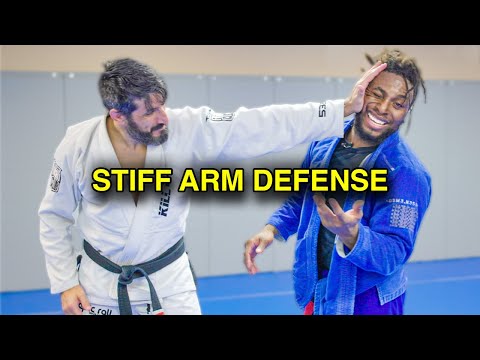
According to Alec Baulding, double up on the sleeve so your opponent can't put their thumb inside, keeping the grip around the perimeter. Then bend the wrist up and pop the arm off.
Alec Baulding emphasizes not to just let go after popping the arm off, as your opponent will regrip immediately. Instead, keep the sleeve on your outside hand while grabbing the collar with your other hand to maintain control.
In Jiu Jitsu, the stiff arm frame is used as a stalling tactic where your opponent pushes you back and keeps their hips away from you while maintaining the grip.
The Stiff Arm Frame subfamily covers defensive techniques where the fighter extends one or both arms to create maximum distance between themselves and the opponent, using the locked arm as a push-frame to prevent the opponent from closing distance or establishing pressure. The stiff arm frame is most effective when the opponent is attempting to drive forward with heavy pressure, as the extended arm acts as a strut that transfers the opponent's forward force into the ground through the defender's body.
Stiff arm frames have been used in wrestling and grappling for centuries as a basic defensive tool for creating distance. BJJ formalised stiff arm framing as a specific guard retention and escape technique, particularly for addressing heavy pressure passing styles.
Unified MMA: legal — Legal defensive technique; IBJJF: legal — Legal — defensive techniques are fundamental to grappling; IJF: legal — Legal defensive action; ADCC: legal — Legal; UWW: legal — Legal defensive technique; FIAS Sport Sambo: legal — Legal
Danger rating 2/10. Low — guard retention uses frames and hip movement; minimal direct injury risk
The standard setup chain: Anticipate the Attack → Execute Defence → Recover Stance → Counter or Disengage.
Standard counters include: Timing — attack when the defence is recovering or between movements / Feint — use deception to create openings in the defensive structure / Angle Change — attack from an unexpected angle that the defence does not cover.
Common variants: Standard defence (primary defensive technique from the most common position); Reactive defence (triggered by the opponent's attack, minimal movement for …); Proactive defence (anticipating the attack and positioning to neutralise it …); Counter defence (using the defensive movement to create an immediate count…).
Used in BJJ and MMA competition.
Top errors to watch for: Holding a fully extended arm statically — the stiff arm is vulnerable to arm attacks; use it briefly then retract / Pushing on the face or throat — frame on the shoulder, chest, or hip / Using only the arm without hip engagement — push off your hips while extending the arm for maximum force / Letting the opponent grab the extended arm — retract it before they can secure a grip.
The Stiff Arm Frame is also known as Sutifu Āmu Furēmu, Straight Arm Frame, Post Frame, Long Frame.