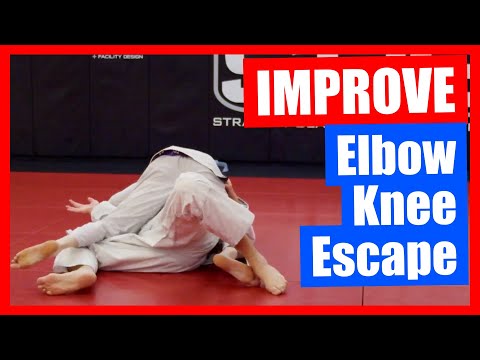
Mount Escapes - Knee Elbow Escape
0
Knee-Elbow Frame·Honu BJJ Reno
In my opinion the knee elbow escape is the most fundamental and reliable way to escape the mount. The key is framing the…
Translation: knee-elbow frame
The Knee-Elbow Frame subfamily covers the defensive position where the fighter brings the knee and elbow on the same side together, creating a compact barrier that blocks the opponent from establishing cross-body pressure or advancing through the guard. [1] The knee-elbow connection is one of the most important defensive principles in BJJ because it eliminates the space between the upper and lower body that the passer needs to exploit. [1],[2] When the knee and elbow are connected, there is no gap for the opponent to thread through, forcing them to address the frame before continuing the pass. [2],[3]
The knee-elbow frame became a central defensive concept in modern BJJ guard retention, emphasised by instructors worldwide as the fundamental principle of preventing guard passes. [1] The 'knee-elbow connection' concept was popularised through BJJ competition analysis and has become a universally taught defensive principle. [2],[3]
The knee-elbow frame connects the knee and elbow as a structure to prevent the opponent from closing distance. [1]
A fundamental BJJ defensive concept. [1]
Used in BJJ competition. [1]
No images yet for this technique.
Sign in to suggest an image.
In my opinion the knee elbow escape is the most fundamental and reliable way to escape the mount. The key is framing the…
Try out SBG University for a month for free. Use the code: YOUTUBEFREE https://sbgu.samcart.com/referral/OD1DNOAi/vUiYFZ…
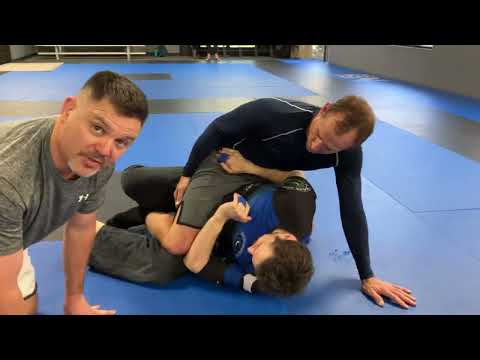
The knee-elbow frame represents a foundational defensive principle in guard retention, particularly against mounted positions. Both instructors identify this as a structural constraint technique where the defender uses the geometric relationship between their knee and elbow to create a mechanical barrier that disrupts the top player's base and control. The frame operates across a continuum: Honu BJJ Reno's Ben Brown categorizes it within an early-to-late escape progression, emphasizing that framing the hips and establishing the knee-elbow contact prevents the top player from settling into a consolidated mount position. SBG PDX & Vancouver frames the technique around the specific mechanical advantage gained when the mounted player has a low mount with feet together versus crossed—each configuration requiring distinct leg positioning and body weight sequencing. Both instructors stress that the frame initiates hip escape opportunity: the knee-elbow contact allows the defender to generate space and access underhooks, transitioning to half guard or closed guard. A critical distinction emerges in execution timing: maintaining pressure through the frame while actively crashing the body creates the mechanical disruption, whereas lifting the knee or losing contact collapses the escape opportunity. The frame's effectiveness depends on denying the top player high knee positioning (which negates escapes) and preventing them from settling their full weight distribution—making early recognition and immediate response essential.
Synthesized from 2 instructors
No instructional courses yet for this technique.
Sign in to suggest a course.
Risk of injury to the person this technique is applied to
Guard retention uses frames and hip movement; minimal direct injury risk
Skill level needed to execute this technique reliably
Whether this technique is allowed under major competition rule sets
Karate-Do Kyohan: The Master Text (Gichin Funakoshi, 1935)
Alias sources — [1] Jiu-Jitsu University (Ribeiro, 2008) [2] Fundamentals of Brazilian Jiu-Jitsu (Danaher, 2012) [3] Brazilian Jiu-Jitsu: Theory and Technique (Gracie, 2001)
Effectiveness sources — [1] Jiu-Jitsu University (Ribeiro, 2008)
Standard katakana transliteration of Western martial arts terminology (外来語) — used in Japanese MMA, boxing, and BJJ communities
Alias sources — [1] Jiu-Jitsu University (Ribeiro, 2008) [2] Fundamentals of Brazilian Jiu-Jitsu (Danaher, 2012) [3] Brazilian Jiu-Jitsu: Theory and Technique (Gracie, 2001)
Effectiveness sources — [1] Jiu-Jitsu University (Ribeiro, 2008)
forearm conditioning, reaction speed, structural stability
dense bone structure, strong forearms
forearm flexors/extensors, deltoids, biceps, core (absorbing impact)
Every move, in any martial art, shares a few universal traits. Mix and match below to pinpoint the right tool — or compare equivalents across styles.
The knee-elbow escape is most effective against a low mount position. In a high mount, the opponent gets their knees up in your armpits, which makes this escape less suitable, so you need to prevent them from settling into that high mount position.
As you execute the escape, make sure your opponent cannot get back underneath your knee. Keep your elbow and knee engaged on the ground and maintain pressure to prevent them from re-establishing control underneath.
Start by stepping out with one leg flat in the middle with your toe down and kneecap down. You should be able to identify which of the opponent's legs is on top, then extend your legs while keeping them heavy before throwing your leg out to the side to create space.
Framing the hips is the first step to staying safe and creating the proper position to start your escape. A solid hip frame prevents your opponent from settling into a high mount and gives you control before you execute the escape mechanics.
The Knee-Elbow Frame subfamily covers the defensive position where the fighter brings the knee and elbow on the same side together, creating a compact barrier that blocks the opponent from establishing cross-body pressure or advancing through the guard. The knee-elbow connection is one of the most important defensive principles in BJJ because it eliminates the space between the upper and lower body that the passer needs to exploit.
The knee-elbow frame became a central defensive concept in modern BJJ guard retention, emphasised by instructors worldwide as the fundamental principle of preventing guard passes. The 'knee-elbow connection' concept was popularised through BJJ competition analysis and has become a universally taught defensive principle.
Unified MMA: legal — Legal defensive technique; IBJJF: legal — Legal — defensive techniques are fundamental to grappling; IJF: legal — Legal defensive action; ADCC: legal — Legal; UWW: legal — Legal defensive technique; FIAS Sport Sambo: legal — Legal
Danger rating 2/10. Low — guard retention uses frames and hip movement; minimal direct injury risk
The standard setup chain: Anticipate the Attack → Execute Defence → Recover Stance → Counter or Disengage.
Standard counters include: Timing — attack when the defence is recovering or between movements / Feint — use deception to create openings in the defensive structure / Angle Change — attack from an unexpected angle that the defence does not cover.
Common variants: High block (forearm raised above the head to protect against overhead…); Low block (forearm driven downward to deflect kicks or body strikes); Cross block (forearm crosses the body to protect the opposite side); Double forearm block (both forearms together for maximum coverage).
Used in BJJ competition.
Top errors to watch for: Lying flat on your back with knee and elbow separated — turn to your side and close the gap / Connecting only briefly then letting the gap open — maintain the connection until you've recovered guard / Using the knee-elbow frame without hip movement — the frame defends the position; hip movement recovers it / Connecting the wrong knee and elbow — connect on the side the opponent is passing to.
The Knee-Elbow Frame is also known as Nī Erubō Furēmu, Knee Shield Frame, Knee-Elbow Connection, Inside Frame.