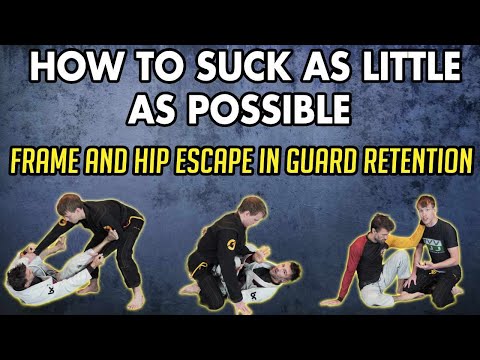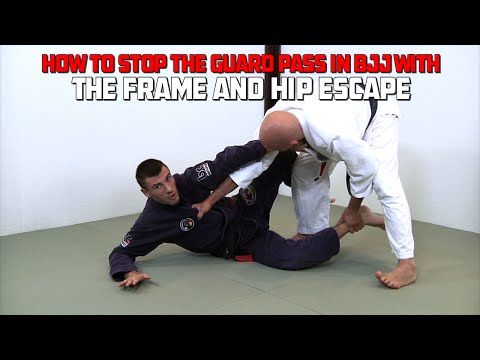
Guard Retention 1: The Frame and Hip Escape
0
Hip Frame·Stephan Kesting
Guard retention: how to use the 'Frame and Hip Escape' to stop the guard pass in BJJ. From The BJJ Guard and Bottom Gam…
Translation: hip frame
The Hip Frame subfamily covers defensive framing techniques where the fighter uses their forearm or hand placed against the opponent's hip as a primary barrier, preventing the opponent from closing distance and establishing cross-body pressure. [1] The hip frame is one of the most effective guard retention tools because controlling the opponent's hip directly controls their ability to advance — the hip is the engine of passing, and blocking it stops the pass at its source. [1],[2] The hip frame is typically combined with a knee shield or foot on hip to create layered defensive barriers. [2],[3]
Hip framing is a fundamental BJJ guard retention concept developed through decades of competitive grappling, where controlling the opponent's hip became recognised as the most important element of preventing guard passes. [1] It is now taught as a core defensive skill at all levels of BJJ instruction. [2],[3]
The hip frame uses a hand on the opponent's hip to maintain distance and prevent guard passes. [1]
A fundamental BJJ guard retention technique. [1]
Used in BJJ competition. [1]
No images yet for this technique.
Sign in to suggest an image.
Guard retention: how to use the 'Frame and Hip Escape' to stop the guard pass in BJJ. From The BJJ Guard and Bottom Gam…
The frame and hip escape has a role in guard retention, and guard recovery. We prefer to keep our legs in the air and m…
The Hip Frame is a foundational guard-retention mechanism that functions as a proactive barrier against passing leverage by establishing contact between the defender's upper body and the passer's leading edge—typically the knee or chest. Rather than a single fixed technique, it represents a conceptual framework adaptable across multiple passing scenarios, where the defender uses arm, knee, or elbow positioning to block the passer's advance while simultaneously executing a hip escape (scooting the hips backward) to reset guard engagement. RVV BJJ emphasizes that framing must precede hip escape; without an effective frame, backward hip movement merely creates space for the passer to occupy. Stephan Kesting highlights the frame's versatility across different pass types—knee cut, kneefold, standing X—noting that the frame can be executed with various limbs (arm, knee, elbow) depending on spatial constraints, with the unifying principle being the need to block forward progress and create sufficient distance. Both instructors stress the strategic timing of this tool: deployed early in the passing sequence when the passer accesses a lever, it prevents deep positional entrenchment. RVV BJJ contextualizes the frame-and-hip-escape as part of a broader guard-retention hierarchy, noting that earlier interventions (maintaining guard engagement, preventing leg pinning) are preferable, but this movement becomes critical once passing threats materialize. The technique also enables downstream options including guard recovery from collar ties, technical stand-ups, and tactical repositioning to increase offensive complexity.
Synthesized from 2 instructors
No instructional courses yet for this technique.
Sign in to suggest a course.
Risk of injury to the person this technique is applied to
Guard retention uses frames and hip movement; minimal direct injury risk
Skill level needed to execute this technique reliably
Whether this technique is allowed under major competition rule sets
Karate-Do Kyohan: The Master Text (Gichin Funakoshi, 1935)
Alias sources — [1] Jiu-Jitsu University (Ribeiro, 2008) [2] Fundamentals of Brazilian Jiu-Jitsu (Danaher, 2012) [3] Brazilian Jiu-Jitsu: Theory and Technique (Gracie, 2001)
Effectiveness sources — [1] Jiu-Jitsu University (Ribeiro, 2008)
Standard katakana transliteration of Western martial arts terminology (外来語) — used in Japanese MMA, boxing, and BJJ communities
Alias sources — [1] Jiu-Jitsu University (Ribeiro, 2008) [2] Fundamentals of Brazilian Jiu-Jitsu (Danaher, 2012) [3] Brazilian Jiu-Jitsu: Theory and Technique (Gracie, 2001)
Effectiveness sources — [1] Jiu-Jitsu University (Ribeiro, 2008)
forearm conditioning, reaction speed, structural stability
dense bone structure, strong forearms
forearm flexors/extensors, deltoids, biceps, core (absorbing impact)
Every move, in any martial art, shares a few universal traits. Mix and match below to pinpoint the right tool — or compare equivalents across styles.
The frame is the top arm grabbing the collar to create distance and control posture, while the hip escape is the movement of scooting your hips back to recompose your guard. According to RVV BJJ, a hip escape is completely useless without a frame in place—if your opponent doesn't have pressure on you, advancing becomes their goal instead.
The hip escape is most critical when you're playing guard off your back and your opponent is trying to pass. RVV BJJ emphasizes that you need redundant frames (ideally built up to your elbows) to create enough space for the hip escape to work, and that it becomes your primary tool once your opponent has already passed your guard.
Make sure your elbow is in base, keep your head strong to control posture, then scoop your hips back and drive your knee to your chest to recompose your guard. Stephan Kesting notes that building up to your elbows allows you to create more distance and increases the likelihood of establishing frames.
The frame and hip escape are similar in concept but have slightly different technical execution depending on the guard type you're playing. RVV BJJ explains this is why understanding these tools as concepts—rather than rigid individual techniques—is important for adapting to different passing styles.
The Hip Frame subfamily covers defensive framing techniques where the fighter uses their forearm or hand placed against the opponent's hip as a primary barrier, preventing the opponent from closing distance and establishing cross-body pressure. The hip frame is one of the most effective guard retention tools because controlling the opponent's hip directly controls their ability to advance — the hip is the engine of passing, and blocking it stops the pass at its source.
Hip framing is a fundamental BJJ guard retention concept developed through decades of competitive grappling, where controlling the opponent's hip became recognised as the most important element of preventing guard passes. It is now taught as a core defensive skill at all levels of BJJ instruction.
Unified MMA: legal — Legal defensive technique; IBJJF: legal — Legal — defensive techniques are fundamental to grappling; IJF: legal — Legal defensive action; ADCC: legal — Legal; UWW: legal — Legal defensive technique; FIAS Sport Sambo: legal — Legal
Danger rating 2/10. Low — guard retention uses frames and hip movement; minimal direct injury risk
The standard setup chain: Anticipate the Attack → Execute Defence → Recover Stance → Counter or Disengage.
Standard counters include: Timing — attack when the defence is recovering or between movements / Feint — use deception to create openings in the defensive structure / Angle Change — attack from an unexpected angle that the defence does not cover.
Common variants: High block (forearm raised above the head to protect against overhead…); Low block (forearm driven downward to deflect kicks or body strikes); Cross block (forearm crosses the body to protect the opposite side); Double forearm block (both forearms together for maximum coverage).
Used in BJJ competition.
Top errors to watch for: Framing on the hip with a straight arm — a slightly bent arm absorbs force better and is harder to collapse / Placing the hand on the thigh instead of the hip bone — the hip is the structural target / Framing the hip without moving your own hips — the frame creates space that your hip escape must use / Using the hip frame passively — actively push the opponent's hip away to create distance.
The Hip Frame is also known as Hippu Furēmu, Hip Block Frame, Stiff Hip, Cross-Hip Frame.