Frame and Hip Escape Applications
The frame and hip escape serve multiple guard retention purposes depending on the defensive scenario. These techniques are particularly valuable when playing seated guard against standing opponents or when preventing guard passage.
Blocking the Knee During Circling
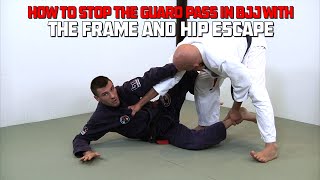
When an opponent circles to pass, the defender blocks the opponent's knee and scoops the hip away to maintain guard. This technique requires both hands to be positioned effectively; if the defender relies on only one hand, the circling movement becomes more difficult to counter.
Hip Escape Mechanics and Hip Rotation
The hip escape involves creating space by scooting backward or using the opponent's body to rotate without necessarily requiring a frame. This movement prevents the defender from needing to explicitly frame and escape in every situation.
Responding to Leg Entanglement
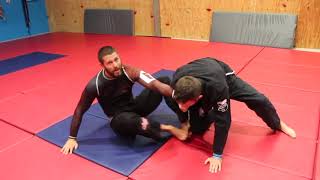
When an opponent steps between the defender's legs, the defender places a hand on the opponent's leading knee and maintains strong posture to prevent control. By framing and scooping the hip backward, the defender regains space and reestablishes guard position.
Frame Priority in Supine Guard
The frame must be established before executing a hip escape, as the escape alone is ineffective without a frame to create separation. Multiple frames provide redundancy; if one frame fails, others prevent guard passage.
Elevation from Shoulders to Elbows to Hands
Progressively building from the shoulders to the elbows to the hands increases hip mobility and escape distance. Each elevation level provides greater leverage and ability to create space against pressure.
Half Guard Leg Weave Defense
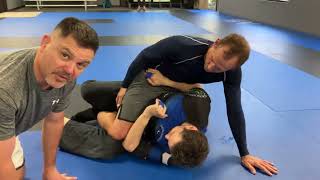
Against the leg weave pressure pass, remaining on the shoulders makes framing and hip escaping ineffective since both legs are neutralized. The defender must frame early and build to the elbows before significant pressure accumulates.
Framing Before Building Elevation
When an opponent begins pinning the legs, immediate framing maintains distance and prevents the opponent from closing the gap. Only after establishing the frame can the defender effectively build to the elbows for a powerful hip escape.
Frame and Hip Escape: Your Guard's Last Line Of Defense
Key Takeaways
- •Frame and Hip Escape Applications
- •Blocking the Knee During Circling
- •Hip Escape Mechanics and Hip Rotation
- •Responding to Leg Entanglement
The frame and hip escape has a role in guard retention, and guard recovery. We prefer to keep our legs in the air and manage the distance, but sometimes we need to create a little space. This technique is a lot more applicable in guard recovery, but look at it as a third range (the last line of defense) in the little series. Hope you find it useful! The Frame and Hip Escape Seated Position: (00:00) Understanding When To Use It: (02:19) The Risk With Hip Escapes And How To Minimize Risk: (03:33) Building Base: (04:20) Creating Space: (08:00) Watch This If Nothing Else You Lazy Piece Of Shit: (10:00) *** WANT MORE? *** Join hundreds of other BJJ athletes in our online academy led by BJJ Black Belt, Rob Biernacki. Access Rob’s constantly evolving concepts from beginner to advanced, personalized Q&A, and much more. Click here for the details – https://go.bjjconcepts.net/ytlink Use code "immunity" for a free week to try and 15% off after. Check out my Mantis Guard course, or my course for Health Care professionals (self defense and control strategies) at - https://courses.rvvbjj.ca
Related Techniques
Frequently Asked Questions
What does this video teach about hip frame?
This video covers frame and hip escape applications, blocking the knee during circling, hip escape mechanics and hip rotation. It provides detailed instruction from RVV BJJ.
How long does it take to learn hip frame?
The basic mechanics can be understood in a single session, but developing reliable execution requires consistent drilling over weeks of practice. This 8-part breakdown helps structure your training by isolating each phase of the technique.
What are the key details for finishing hip frame?
Against the leg weave pressure pass, remaining on the shoulders makes framing and hip escaping ineffective since both legs are neutralized. The defender must frame early and build to the elbows before significant pressure accumulates.