Introduction to Ground Control Positions
This lesson covers the fundamental positions that arise when a fight transitions to the ground. After mastering takedown techniques and defensive measures, practitioners must understand positional awareness and how to respond when grounded. The instructor will use standard grappling terminology to ensure clarity across all skill levels.
Closed Guard Position
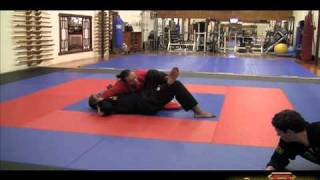
The closed guard occurs when the bottom fighter locks their legs around the top fighter's torso. This position favors the bottom fighter defensively, offering numerous submission opportunities such as armbars and triangles. The top fighter possesses striking advantages due to better leverage and hip involvement, but has limited submission options beyond basic keylock techniques.
Guard Mechanics and Control
From closed guard, the bottom fighter controls their opponent through leg pressure and posture manipulation. By pulling the knees to the chest, the bottom fighter can pull the top fighter forward; pushing backward creates distance. Twisting motions move the top fighter laterally, demonstrating the significant control advantage of the bottom position.
Open Guard and Transitioning Positions
As the closed guard opens and the legs disengage, the top fighter gains increased striking opportunities. The bottom fighter transitions to open guard variations, where ankle locks and heel hooks become available. This position requires the top fighter to be cautious of leg lock submissions while maintaining dominant striking angles.
Half Guard Position
Half guard occurs when one leg remains trapped between the fighters while the other leg is free. This intermediate position offers limited offensive opportunities for both competitors compared to closed guard or side mount. The position primarily allows for positional maneuvering rather than high-percentage submissions or strikes.
Side Mount Mechanics
Side mount provides the top fighter with significant striking advantages, including elbows and hand strikes while controlling the opponent's hips. Proper arm positioning and hip control restrict the bottom fighter's options, limiting them to defensive movements and minimal counterattacking possibilities. The bottom fighter can attempt armbars or head control but remains substantially disadvantaged.
Full Mount Position
Full mount represents the highest-percentage dominant position, with the top fighter straddling the opponent's torso. From this position, the top fighter has access to extensive striking combinations and submission techniques while the bottom fighter cannot effectively use their legs for control or escape. The bottom fighter's primary objective becomes defense and escape rather than offense.
High Mount and North-South Positions
Advancing to high mount further diminishes the bottom fighter's options and increases striking vulnerability. North-south position, achieved by rotating 180 degrees from mount, offers different submission angles including armbars. Both positions maintain the top fighter's dominance while limiting the bottom fighter to escape attempts.
Summary of Core Ground Positions
The five fundamental positions in ground fighting are closed guard, half guard, side mount, full mount, and north-south. Fighters may transition between positions or occupy intermediate states, but these five represent the complete range of established positional control. Understanding the advantages and disadvantages of each position is essential for developing effective ground fighting strategy.
Basic Ground Fight Positions - Grappling & Ground Fight
Key Takeaways
- •Introduction to Ground Control Positions
- •Closed Guard Position
- •Guard Mechanics and Control
- •Open Guard and Transitioning Positions
In this video I talk you through the basic positions that you're likely to end up in or pass through once a fight goes to the ground. To keep things simple, I use the basic terminology we hear nowadays so that nobody gets confused about what I'm referring to. -The basic positions i talk through include: -The Full Guard -The Half Guard -Side Mount -Full Mount -and North/South. Each position has it's own advantages and disadvantages and we'll explore them in more detail in later videos. Over the coming weeks you'll see basic techniques from all aspects of our Grappling & Ground Fight System including Preventing the Takedown, Getting the Takedown, Basic Control of Your Opponent and his Posture (both standing and on the ground), Transitions, Locks, Holds and Submission Techniques from all available positions just to name a few. If you have any questions, be sure to email them to [email protected] and I'll get back to you as soon as i can. If you like to view this video on our website, please visit: http://www.tytonhealth.com/ground-fight-positions/ Website: http://www.tytonhealth.com Facebook: http://www.facebook.com/tytonhealth Twitter: https://twitter.com/tytonhealth YouTube: http://www.youtube.com/user/TytonHealth Email: [email protected]
Related Techniques
Frequently Asked Questions
What does this video teach about tkd ground control?
This video covers introduction to ground control positions, closed guard position, guard mechanics and control. It provides detailed instruction from STRONGER Than Life!.
How long does it take to learn tkd ground control?
The basic mechanics can be understood in a single session, but developing reliable execution requires consistent drilling over weeks of practice. This 9-part breakdown helps structure your training by isolating each phase of the technique.
What are the key details for finishing tkd ground control?
Advancing to high mount further diminishes the bottom fighter's options and increases striking vulnerability. North-south position, achieved by rotating 180 degrees from mount, offers different submission angles including armbars. Both positions maintain the top fighter's dominance while limiting the bottom fighter to escape attempts.
Related videos
Grappling Drill F: Basic Grappling Positions.
Korean Academy of Taekwondo
JKD Ground Fighting Techniques
EliteDefenseSystems
Taekwondo Reversing Mount & Passing Guard
Maximum Martial Arts University
Brazilian Jiujitsu technique: Mount transition
fightculturevision
Cyberdojang.com: Positioning - Transitioning to Side Mounts
Hwa Rang Do