Foundational Approach: Both Hands Together
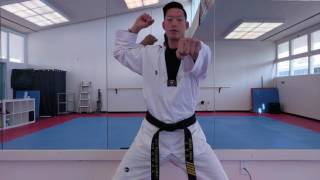
The instructor begins by teaching uchi uke with both hands simultaneously to establish the basic movement pattern. Students pull both fists to the ribs, then execute the block by driving both hands forward in a circular arc. This dual-hand repetition builds muscle memory before progressing to single-hand execution.
Single-Hand Execution
Once students master the two-handed version, training shifts to alternating single hands. One hand pulls back to the ribs while the other executes the block in a circular motion around the chambered hand. The blocking hand must travel around the opposite fist, creating the characteristic circular path essential to proper uchi uke form.
Critical Movement Path: Circular Trajectory
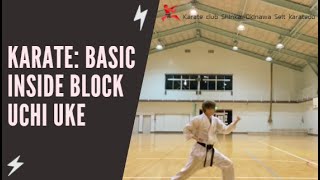
The instructor emphasizes that uchi uke must always follow a circular path around the chambered hand—never traveling directly outward. The blocking arm pulls back to prepare, then drives forward and around the opposite fist to reach the blocking position. Maintaining this curved trajectory is fundamental to the technique's defensive efficiency.
Synchronized Chamber and Extension
At the advanced level, both the chambering and extension of the blocking hand occur simultaneously rather than sequentially. This timing refinement allows for faster, more economical movement while maintaining the circular path of the block.
Footwork and Weight Distribution
The instructor demonstrates proper footwork by bringing the feet together, bending the knees, and dropping the weight downward. The blocking hand extends and chambers while the feet adjust, with weight remaining centered and forward throughout the technique. This integration of upper and lower body creates a grounded, powerful block.
Stepping Variations: Retreating and Advancing
Uchi uke is practiced with multiple stepping patterns, including stepping backward and stepping forward. Regardless of direction, the preparation, block, and weight distribution remain consistent, with weight staying forward and the block circling around the chambered hand.
Uchi Uke Gakuzuki: Integrating Reverse Punch
When combining inside block with reverse punch (uchi uke gakuzuki), the hips undergo a critical transition. The hips position back during the block execution, then rotate forward during the reverse punch. This hip rotation generates power while maintaining the forward weight position established during the block.
Sideline Analysis for Form Verification
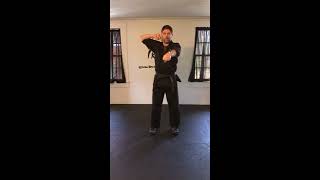
The instructor regularly demonstrates the technique from the side view to ensure proper execution of the circular path and weight distribution. This perspective clearly shows whether students are maintaining the correct trajectory and not pulling the block inward or performing straight-line movements.
Beginning Karate: Inside block (Uchi-uke)
Key Takeaways
- •Foundational Approach: Both Hands Together
- •Single-Hand Execution
- •Critical Movement Path: Circular Trajectory
- •Synchronized Chamber and Extension
For new students to karate: How to learn to do a basic inside block (uchi-uke).
Related Techniques
Frequently Asked Questions
What does this video teach about inside defence against straight punch?
This video covers foundational approach: both hands together, single-hand execution, critical movement path: circular trajectory. It provides detailed instruction from Seamus O'Dowd.
How long does it take to learn inside defence against straight punch?
The basic mechanics can be understood in a single session, but developing reliable execution requires consistent drilling over weeks of practice. This 8-part breakdown helps structure your training by isolating each phase of the technique.
What are the key details for finishing inside defence against straight punch?
When combining inside block with reverse punch (uchi uke gakuzuki), the hips undergo a critical transition. The hips position back during the block execution, then rotate forward during the reverse punch. This hip rotation generates power while maintaining the forward weight position established during the block.