Foundation and Guard Structure
The collar-sleeve guard begins with the opponent on their knees, establishing the foundational position from which all variations derive. Two primary control types exist: outside control and inside control, with outside control being the focus of initial instruction. The core strategic objective involves separating the opponent's elbow from their body to expose submission opportunities.
The Wedge Concept
A wedge is created when the practitioner places their body part to prevent the opponent's elbow from returning to their torso. This separation of the elbow from the body is the fundamental mechanic that enables submission attacks. Understanding wedging principles is essential to effective collar-sleeve guard execution.
Foot Placement on the Hip
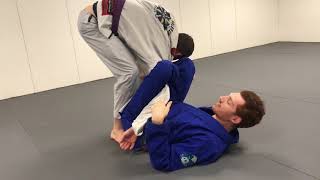
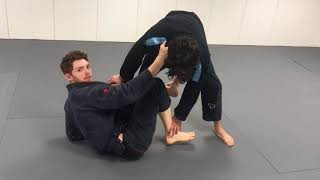
The initial position places the foot on the opponent's hip bone (anterior superior iliac spine) to prevent them from walking their hips forward into the guard player. This placement controls distance and prevents the opponent from using their posture to close their elbow back to their body. The hip bone serves as the primary anchor point for establishing outside control.
Transitioning the Wedge to the Ribs
As the opponent naturally attempts to close their elbow to their waist, the practitioner shifts their foot higher onto the opponent's ribs. This repositioning creates a new wedge that prevents elbow closure and sets up knee pressure on the opponent's elbow. The transition from hip to rib placement follows the opponent's defensive reactions.
Elbow Misalignment and Arm Weakness
Moving the opponent's elbow out of vertical alignment with their shoulder significantly weakens their arm's structural integrity. When the elbow is displaced laterally away from the shoulder line, the opponent loses mechanical leverage and strength. This principle underlies the effectiveness of using the knee to drive the elbow outward during the guard setup.
The Hip as Ultimate Wedge
Once the opponent's elbow lands in the guard player's hip, it becomes impossible for them to retract the elbow back to their body. This position, where the opponent's elbow rests completely in the lap, represents the optimal setup for submission attacks. From this configuration, the guard player can transition to triangle or omoplata submissions depending on the opponent's head position.
Submission Transition Based on Positioning
The choice between triangle and omoplata submissions depends on the opponent's head orientation relative to the guard player. If the opponent's head faces the guard player, a triangle choke becomes the appropriate finish. The two submissions are mechanically similar, with directional adjustments being the only significant variation.
How To Do The Perfect Collar Sleeve Guard by Mikey Musumeci
Key Takeaways
- •Foundation and Guard Structure
- •The Wedge Concept
- •Foot Placement on the Hip
- •Transitioning the Wedge to the Ribs
Learn here how to do the perfect Collar Sleeve Guard by Mikey Musumeci - Click Here To Check Out Mikey Musumeci's Instructional Videos - https://bjjfanatics.com/collections/all/fighter_MIKEY-MUSUMECI - "Bernardo Faria is a 5x World Champion. Bernardo started training Brazilian Jiu-Jitsu in Juiz de Fora - MG, Brazil at the age of 14 in 2001. After receiving the Black Belt from his first instructor Ricardo Marques in 2008, He moved to Sao Paulo to join BJJ legend Fabio Gurgel and his Alliance team. After many years of training and winning many major titles, Bernardo moved to NYC in 2013 to train and teach at Marcelo Garcia Academy. In 2015 Bernardo achieved his dream of winning the IBJJF World Championship Open class title and his division, doing the double Gold and becoming the 1st in the IBJJF Ranking and also chosen as the best athlete of 2015. Bernardo Faria has now taken on the mission to share some of the lessons, techniques, experiences and more that he has learned along in his 16 years and counting as a BJJ student, teacher and world class competitor. Subscribe to his channel, and join him in this amazing BJJ Journey. We promise that you will also improve your BJJ with his awesome Video Lessons, Episodes of his "5 Minutes BJJ Talk" and more... www.fujisports.com - 15% OFF Coupon Code: FARIA15 www.bjjfanatics.com - 10% OFF Coupon Code: YOUTUBEFARIA www.fujimats.com - 10% OFF Coupon Code: FARIAMAT10 http://bernardofaria.com https://www.facebook.com/bernardofariabjj/ https://www.instagram.com/bernardofariabjj/ https://twitter.com/bernardofariajj . For the best fightwear, check out https://www.kojofightwear.com/ and use code " YTD15 " to get 15% off your first order.
Related Techniques
Frequently Asked Questions
What does this video teach about collar-sleeve guard?
This video covers foundation and guard structure, the wedge concept, foot placement on the hip. It provides detailed instruction from Bernardo Faria BJJ Fanatics.
How long does it take to learn collar-sleeve guard?
The basic mechanics can be understood in a single session, but developing reliable execution requires consistent drilling over weeks of practice. This 7-part breakdown helps structure your training by isolating each phase of the technique.
What are the key details for finishing collar-sleeve guard?
Once the opponent's elbow lands in the guard player's hip, it becomes impossible for them to retract the elbow back to their body. This position, where the opponent's elbow rests completely in the lap, represents the optimal setup for submission attacks. From this configuration, the guard player can transition to triangle or omoplata submissions depending on the opponent's head position.