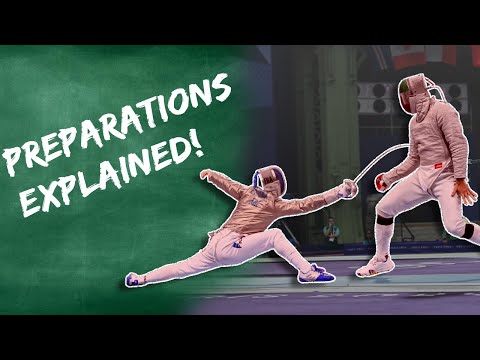
Preparations in Sabre | Fencing Explained 🤺
0
Sabre — Sport·Slicer Sabre
0:00 Intro 0:50 "physical chess" 1:43 go forwards 2:16 rock paper scissors 2:50 two kinds of preps 3:08 Reactive 4:31 Pr…
Translation: sabre — sport
The Sabre (Sport) family covers all techniques specific to the sabre discipline, the only fencing weapon that scores with both the edge and the point, targeting the entire body above the waist including the head and arms. [1] Sabre is the fastest and most aggressive of the three fencing weapons, characterised by explosive simultaneous attacks, rapid exchanges, and a right-of-way system that rewards the fencer who seizes the initiative through forward movement and blade speed. [1],[2] The combination of cutting and thrusting attacks, the large target area (everything above the waist), and the aggressive tempo creates a dramatically different tactical environment from the patient, precise combat of foil and epee. [2],[3] Sabre bouts are typically decided by the fencer who controls the initiative and the middle of the strip, as the weapon's speed and right-of-way rules punish hesitation and reward explosive offensive action. [3]
Sport sabre evolved from military sabre cavalry traditions, where mounted soldiers used curved cutting swords from horseback, which is why the target area is the upper body only (representing the part of a mounted soldier visible above the horse). [1] Hungarian, Italian, and Russian schools dominated sabre fencing for much of the 20th century, producing legendary champions like Aladar Gerevich (Hungary, seven Olympic gold medals) and Stanislav Pozdnyakov (Russia). [2],[3] Electronic scoring for sabre was introduced in 1988, the last of the three weapons to be electrified, and the modern sabre game — characterised by explosive simultaneous attacks — has been refined in the decades since. [3]
Sabre is the fastest of the three fencing weapons, with bouts frequently decided in under four seconds of blade time. [1] The combination of cutting and thrusting actions, plus the large upper-body target area, makes sabre the most aggressive and explosive fencing weapon. [2] The right-of-way convention rewards the fencer who attacks first with commitment, creating a high-tempo tactical environment that develops explosive speed and decision-making. [2]
Modern sport sabre descends from military sabre traditions, particularly the Hungarian school of Italo Santelli (who trained in Italy and established a dynasty in Hungary) and the Italian Radaelli system. [1] The Hungarian school produced the greatest sabre dynasty in fencing history, dominating Olympic competition from 1908 to 1960. [2] The Soviet sabre school, developed by David Tyshler and Mark Rakita, introduced systematic point-based attacks and tactical innovations that challenged Hungarian dominance from the 1960s onward. [3]
Hungary's sabre team won Olympic gold at every Games from 1908 to 1960 (except 1920). [1] Aladár Gerevich competed in six consecutive Olympics (1932–1960), winning seven gold medals — the most by any fencer in Olympic history. [2] Aron Szilagyi of Hungary won three consecutive individual sabre gold medals (2012, 2016, 2021), a feat unprecedented in individual fencing. [3]
No images yet for this technique.
Sign in to suggest an image.
0:00 Intro 0:50 "physical chess" 1:43 go forwards 2:16 rock paper scissors 2:50 two kinds of preps 3:08 Reactive 4:31 Pr…
No instructional courses yet for this technique.
Sign in to suggest a course.
Risk of injury to the person this technique is applied to
Modern sport fencing uses blunted weapons and full protective gear; injury rate ~2.5 per 1000 exposures (Harmer 2008)
Skill level needed to execute this technique reliably
Whether this technique is allowed under major competition rule sets
The Art of Fencing (Luigi Barbasetti, 1932)
Alias sources — [1] FIE Fencing Rules [2] FIE Fencing Rules
Effectiveness sources — [1] Czajkowski, Z., Understanding Fencing (SKA Swordplay Books, 2005) [2] Evangelista, N., The Inner Game of Fencing (McGraw-Hill, 2000)
Mixed Japanese-Western terminology — combines traditional Japanese terms with katakana loanwords
Alias sources — [1] FIE Fencing Rules [2] FIE Fencing Rules
Effectiveness sources — [1] Czajkowski, Z., Understanding Fencing (SKA Swordplay Books, 2005) [2] Evangelista, N., The Inner Game of Fencing (McGraw-Hill, 2000)
explosive lunge speed, finger/wrist dexterity, cardiovascular endurance
long reach (tall, long arms), fast-twitch legs
quadriceps (lunge), calves, forearm/finger flexors, core
Every move, in any martial art, shares a few universal traits. Mix and match below to pinpoint the right tool — or compare equivalents across styles.
The Attack On Preparation subfamily covers offensive actions timed to land during the opponent's preparatory movements — before the opponent's attack is fully launched — thereby seizing right-of-way priority by hitting during the opponent's vulnerable preparation phase. [1] In sabre's high-speed tactical game, the attack on preparation is one of the most important techniques because it counters an opponent who is building momentum for their own attack by striking during the wind-up. [1,2] The technique requires reading the opponent's preparation cues (forward lean, arm draw-back, step forward) and launching the attack at the precise moment when the opponent has committed to their preparation but has not yet established their own attack. [2,3]
The Sabre Cut subfamily covers all cutting (slashing) attacks in sabre, where the fencer scores by striking the opponent's valid target area (above the waist) with the edge of the blade rather than the point. [1] Cutting attacks are the defining characteristic of sabre fencing — they make sabre the only Olympic fencing weapon where the edge scores, and they produce the explosive, sweeping attack actions that give sabre its distinctive visual character. [1,2] Sabre cuts are classified by their target: head cut (to the top of the head), chest cut (to the torso), flank cut (to the side), and cheek cut (to the side of the mask), with each requiring different blade angles and arm mechanics. [2,3]
The Sabre Parry subfamily covers all defensive blade actions in sabre where the fencer deflects an incoming cut or thrust with their own blade, transferring right-of-way and earning the right to riposte. [1] Sabre parries must defend a larger and more varied set of attacks than foil or epee parries because sabre attacks can come as cuts from any angle (head, chest, flank, cheek) in addition to thrusts. [1,2] The primary sabre parries are quarte (inside defence, protecting the chest), tierce (outside defence), quinte (head defence, blade held horizontally above the head), and prime/seconde (low-line defences). [2,3]
The sabre is the only cutting weapon in sport fencing — both cuts and thrusts score. Target area is above the waist. The fastest-paced fencing discipline due to the cutting action. Olympic sport since 1896 (men) and 2004 (women). (FIE fencing rules; Olympic records)
A preparation is something you do before launching an attack or other action to get yourself and your opponent in the right position for that action to work. It's the foundational step that sets up your offensive or defensive moves.
You want your preparation to leave plenty of different possibilities open so you can react to whatever your opponent does, but sometimes you may sacrifice some possibilities to elicit a particular response. The key is having purpose behind your preparations rather than varying them randomly.
Avoid going too big and fast, as this makes it hard to change direction and gives you less time to react. Stay balanced and able to move in either direction, and avoid tells or twitches that reveal what action you're about to perform—ideally your preparations should look identical regardless of what you'll do next.
While footwork is important, you should also think about what you do with your hand. The position of your blade determines both what targets you can hit and where your opponent is likely to attack, and hand feints can be useful for drawing responses from your opponent.
The Sabre (Sport) family covers all techniques specific to the sabre discipline, the only fencing weapon that scores with both the edge and the point, targeting the entire body above the waist including the head and arms. Sabre is the fastest and most aggressive of the three fencing weapons, characterised by explosive simultaneous attacks, rapid exchanges, and a right-of-way system that rewards the fencer who seizes the initiative through forward movement and blade speed.
Sport sabre evolved from military sabre cavalry traditions, where mounted soldiers used curved cutting swords from horseback, which is why the target area is the upper body only (representing the part of a mounted soldier visible above the horse). Hungarian, Italian, and Russian schools dominated sabre fencing for much of the 20th century, producing legendary champions like Aladar Gerevich (Hungary, seven Olympic gold medals) and Stanislav Pozdnyakov (Russia).
FIE: legal — Legal fencing technique — governed by FIE rules for foil, épée, and sabre; HEMA: legal — Legal in historical fencing competition
Danger rating 2/10. Low — modern sport fencing uses blunted weapons and full protective gear; injury rate ~2.5 per 1000 exposures (Harmer 2008)
The standard setup chain: En Garde → Advance/Lunge Preparation → Attack → Recovery.
Standard counters include: Parry (Absetzen) — deflect the incoming blade with a counter-displacement / Void (Step Back) — withdraw from measure to avoid the cutting arc / Counter-Cut (Nachreisen) — strike into the opponent's opening during their attack.
Common variants: Simple attack (single blade action (disengage, beat, or direct) to score); Compound attack (multiple blade actions (feint then disengage) to create a…); Riposte (immediate counter after a successful parry); Counter-attack (attacking into the opponent's attack with priority or rig…).
Hungary's sabre team won Olympic gold at every Games from 1908 to 1960 (except 1920). Aladár Gerevich competed in six consecutive Olympics (1932–1960), winning seven gold medals — the most by any fencer in Olympic history.
Top errors to watch for: Using epee tactics (waiting to counter) in sabre — sabre right of way rewards attacking first; passivity is penalized / Attacking with the point only — sabre allows cuts; the cut is faster than the thrust for most targets / Not understanding right of way in sabre — the first to attack with arm and foot forward has priority / Retreating excessively — sabre favours aggressive forward movement; excessive retreat concedes the attack.
The Sabre — Sport is also known as Sāburu Kyōgi, Sabre Fencing, Sport Sabre.