Direct Attack: What is it, why use it, and how?
0
Attack On Preparation·OSM Fencing
The Direct Attack is an explosive, fast, yet simplistic action that enables the foilist to initiate an attack that trave…
Translation: attack on preparation
The Attack On Preparation subfamily covers offensive actions timed to land during the opponent's preparatory movements — before the opponent's attack is fully launched — thereby seizing right-of-way priority by hitting during the opponent's vulnerable preparation phase. [1] In sabre's high-speed tactical game, the attack on preparation is one of the most important techniques because it counters an opponent who is building momentum for their own attack by striking during the wind-up. [1],[2] The technique requires reading the opponent's preparation cues (forward lean, arm draw-back, step forward) and launching the attack at the precise moment when the opponent has committed to their preparation but has not yet established their own attack. [2],[3]
The attack on preparation is a classical fencing concept that gained particular importance in modern sabre, where the explosive simultaneous game created frequent situations where both fencers were preparing attacks simultaneously. [1] The ability to time attacks on the opponent's preparation became a distinguishing skill of elite sabre fencers. [2],[3]
Attack on preparation was described by Italian fencing masters as a tempo action, exploiting the opponent's movement to create an opening. [1]
Attack on preparation is a common scoring action at World Championship and Olympic level, particularly in sabre and foil where right-of-way creates opportunities during the opponent's preparation. [1]
No images yet for this technique.
Sign in to suggest an image.
The Direct Attack is an explosive, fast, yet simplistic action that enables the foilist to initiate an attack that trave…
ProTips4U athlete page: "Like" us on Facebook: https://www.facebook.com/ProTips4U Follow us on Twitter: https://twitter…
No instructional courses yet for this technique.
Sign in to suggest a course.
Risk of injury to the person this technique is applied to
Modern sport fencing uses blunted weapons and full protective gear; injury rate ~2.5 per 1000 exposures (Harmer 2008)
Skill level needed to execute this technique reliably
Whether this technique is allowed under major competition rule sets
The Art of Fencing (Luigi Barbasetti, 1932)
Alias sources — [1] FIE Rules of Competition [2] Classical Fencing (Rogers, 2014)
Effectiveness sources — [1] The Art and Science of Fencing (Evangelista, 1996) [2] FIE technical guidelines
Mixed Japanese-Western terminology — combines traditional Japanese terms with katakana loanwords
Alias sources — [1] FIE Rules of Competition [2] Classical Fencing (Rogers, 2014)
Effectiveness sources — [1] The Art and Science of Fencing (Evangelista, 1996) [2] FIE technical guidelines
explosive lunge speed, finger/wrist dexterity, cardiovascular endurance
long reach (tall, long arms), fast-twitch legs
quadriceps (lunge), calves, forearm/finger flexors, core
Every move, in any martial art, shares a few universal traits. Mix and match below to pinpoint the right tool — or compare equivalents across styles.
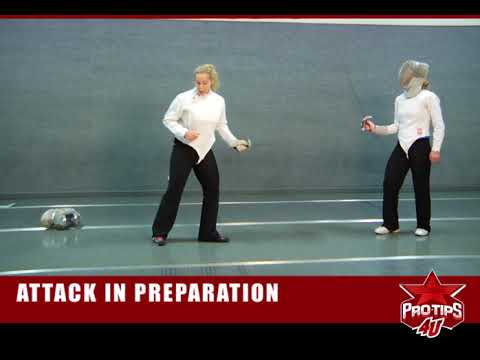
Attack in preparation works best when your opponent is committing to a fast attack toward you. Mariel Zagunis emphasizes using this technique when your opponent does a big step and is coming at you aggressively; if they're patient and not attacking, you should attack normally instead.
Keep your body forward and use a very tiny final step to close distance. Mariel Zagunis stresses that this is a technique requiring significant practice during footwork drills, and that proper positioning matters more than pure speed.
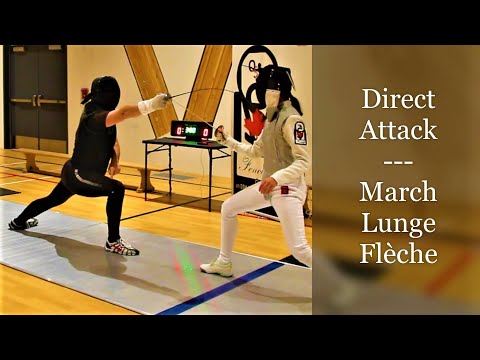
A direct attack travels the shortest distance possible in a single line from point A to point B with no feints or disengagements, which aligns with the efficiency needed in attack in preparation. OSM Fencing notes that this explosive action travels blade-first without changing the line of attack.
The Attack On Preparation subfamily covers offensive actions timed to land during the opponent's preparatory movements — before the opponent's attack is fully launched — thereby seizing right-of-way priority by hitting during the opponent's vulnerable preparation phase. In sabre's high-speed tactical game, the attack on preparation is one of the most important techniques because it counters an opponent who is building momentum for their own attack by striking during the wind-up.
The attack on preparation is a classical fencing concept that gained particular importance in modern sabre, where the explosive simultaneous game created frequent situations where both fencers were preparing attacks simultaneously. The ability to time attacks on the opponent's preparation became a distinguishing skill of elite sabre fencers.
FIE: legal — Legal fencing technique — governed by FIE rules for foil, épée, and sabre; HEMA: legal — Legal in historical fencing competition
Danger rating 2/10. Low — modern sport fencing uses blunted weapons and full protective gear; injury rate ~2.5 per 1000 exposures (Harmer 2008)
The standard setup chain: En Garde → Advance/Lunge Preparation → Attack → Recovery.
Standard counters include: Guard Position — return to a defensive ready stance / Distance Management — control the measure to avoid being in range / Counter-Attack — strike during the opponent's recovery or between movements.
Common variants: Simple attack (single blade action (disengage, beat, or direct) to score); Compound attack (multiple blade actions (feint then disengage) to create a…); Riposte (immediate counter after a successful parry); Counter-attack (attacking into the opponent's attack with priority or rig…).
Attack on preparation is a common scoring action at World Championship and Olympic level, particularly in sabre and foil where right-of-way creates opportunities during the opponent's preparation.
Top errors to watch for: Timing the attack on preparation too late — it must arrive before the opponent establishes their attack / Attempting attack on preparation without reading the opponent's rhythm — the timing depends on recognizing their prep… / Using attack on preparation against a patient opponent — it only works when the opponent is actively preparing / Not maintaining right of way during the attack on preparation — the arm must extend and the blade must threaten.
The Attack On Preparation is also known as Pureparashion Kōgeki, Attaque sur Preparation, Attack into Preparation.