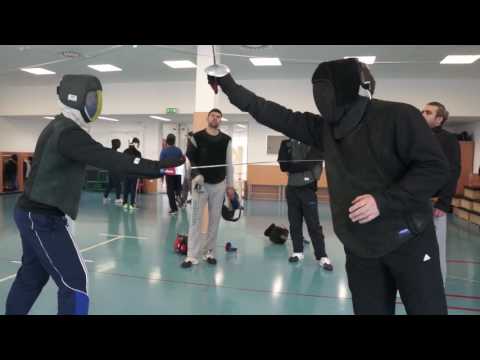
Sabre Quinte parry development
0
Sabre Parry·Beth Speedy
FIE Coaching course 2017
Translation: sabre parry
The Sabre Parry subfamily covers all defensive blade actions in sabre where the fencer deflects an incoming cut or thrust with their own blade, transferring right-of-way and earning the right to riposte. [1] Sabre parries must defend a larger and more varied set of attacks than foil or epee parries because sabre attacks can come as cuts from any angle (head, chest, flank, cheek) in addition to thrusts. [1],[2] The primary sabre parries are quarte (inside defence, protecting the chest), tierce (outside defence), quinte (head defence, blade held horizontally above the head), and prime/seconde (low-line defences). [2],[3]
Sabre parry technique was developed through the Hungarian, Italian, and Russian schools of sabre fencing, each contributing refinements to the defensive system. [1] The quinte parry (head parry) is unique to sabre fencing and does not exist in foil or epee, reflecting sabre's distinct target area and cutting attacks. [2],[3]
Sabre parry positions evolved from military cavalry defence and were systematised for competition by Hungarian and Italian masters. [1]
In Olympic sabre, parry-riposte is a key scoring pattern, though the speed of the weapon means many touches come from attack-counterattack exchanges. [1]
No images yet for this technique.
Sign in to suggest an image.
FIE Coaching course 2017
No instructional courses yet for this technique.
Sign in to suggest a course.
Risk of injury to the person this technique is applied to
Modern sport fencing uses blunted weapons and full protective gear; injury rate ~2.5 per 1000 exposures (Harmer 2008)
Skill level needed to execute this technique reliably
Whether this technique is allowed under major competition rule sets
The Art of Fencing (Luigi Barbasetti, 1932)
Alias sources — [1] FIE Rules of Competition [2] Classical Fencing (Rogers, 2014)
Effectiveness sources — [1] The Art and Science of Fencing (Evangelista, 1996) [2] FIE coaching manuals
Mixed Japanese-Western terminology — combines traditional Japanese terms with katakana loanwords
Alias sources — [1] FIE Rules of Competition [2] Classical Fencing (Rogers, 2014)
Effectiveness sources — [1] The Art and Science of Fencing (Evangelista, 1996) [2] FIE coaching manuals
explosive lunge speed, finger/wrist dexterity, cardiovascular endurance
long reach (tall, long arms), fast-twitch legs
quadriceps (lunge), calves, forearm/finger flexors, core
Every move, in any martial art, shares a few universal traits. Mix and match below to pinpoint the right tool — or compare equivalents across styles.
Overexaggerating the movement by moving too far in all directions. Beth Speedy emphasizes keeping the parry to the shortest critical movement necessary to block the incoming blade.
The Sabre Parry subfamily covers all defensive blade actions in sabre where the fencer deflects an incoming cut or thrust with their own blade, transferring right-of-way and earning the right to riposte. Sabre parries must defend a larger and more varied set of attacks than foil or epee parries because sabre attacks can come as cuts from any angle (head, chest, flank, cheek) in addition to thrusts.
Sabre parry technique was developed through the Hungarian, Italian, and Russian schools of sabre fencing, each contributing refinements to the defensive system. The quinte parry (head parry) is unique to sabre fencing and does not exist in foil or epee, reflecting sabre's distinct target area and cutting attacks.
FIE: legal — Legal fencing technique — governed by FIE rules for foil, épée, and sabre; HEMA: legal — Legal in historical fencing competition
Danger rating 2/10. Low — modern sport fencing uses blunted weapons and full protective gear; injury rate ~2.5 per 1000 exposures (Harmer 2008)
The standard setup chain: En Garde → Advance/Lunge Preparation → Attack → Recovery.
Standard counters include: Parry (Absetzen) — deflect the incoming blade with a counter-displacement / Void (Step Back) — withdraw from measure to avoid the cutting arc / Counter-Cut (Nachreisen) — strike into the opponent's opening during their attack.
Common variants: Simple attack (single blade action (disengage, beat, or direct) to score); Compound attack (multiple blade actions (feint then disengage) to create a…); Riposte (immediate counter after a successful parry); Counter-attack (attacking into the opponent's attack with priority or rig…).
In Olympic sabre, parry-riposte is a key scoring pattern, though the speed of the weapon means many touches come from attack-counterattack exchanges.
Top errors to watch for: Making parries too slow — sabre attacks are extremely fast; the parry must match their speed / Not riposting immediately after the parry — the right of way advantage is brief in sabre / Using the wrong parry for the attack — quinte for head, tierce for outside, quarte for inside / Making the parry too large — the parry should be just sufficient to deflect the attack.
The Sabre Parry is also known as Sāburu Uke, Parade au Sabre, Sabre Defence.