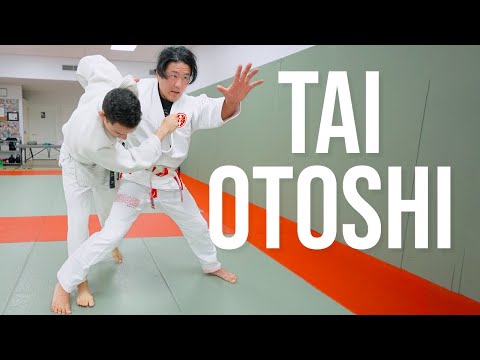
Tai Otoshi: Full Instructional
0
Standard Tai Otoshi·Shintaro Higashi·Added by Admin
Enjoy this full tai otoshi instructional! Soto Makikomi Instructional Available for Streaming and Download for only $2…
Translation: body drop
Standard Tai Otoshi executes the classical body drop where the thrower pivots and turns the back to the opponent, extends one leg across and in front of the opponent's lead shin, and pulls strongly with both hands to rotate the opponent forward and over the blocking leg. [1] The tsurite (lapel hand) lifts and turns while the hikite (sleeve hand) pulls sharply across the body, creating the rotational force that wheels the opponent over. [1],[2] The technique requires explosive rotation and precise leg placement to ensure the opponent's momentum carries them over the blocking leg. [2],[3]
Tai otoshi is one of the most effective forward throws in judo, combining hand technique with a leg barrier that blocks the opponent's retreat. [1] Inokuma and Sato describe it as one of the 'big three' competition throws alongside uchi mata and seoi nage. [2] The technique's effectiveness derives from the fact that the thrower's outstretched leg creates a fixed barrier while the hand action wheels the opponent over it, producing high-impact landings. [3]
No images yet for this technique.
Sign in to suggest an image.
Enjoy this full tai otoshi instructional! Soto Makikomi Instructional Available for Streaming and Download for only $2…
No instructional courses yet for this technique.
Sign in to suggest a course.
Risk of injury to the person this technique is applied to
Tai-Otoshi uses body as fulcrum; controlled but high-velocity landing
Skill level needed to execute this technique reliably
Whether this technique is allowed under major competition rule sets
Kodokan Judo — Official Nage-waza Classification
Traditional Judo throwing technique terminology (Kodokan Institute)
Official Kodokan ground technique classification system
Standard Japanese martial arts terminology (kanji/hiragana)
Established Japanese martial arts naming convention — native Japanese term (和語/漢語)
Traditional Judo throwing technique terminology (Kodokan Institute)
coordination, grip strength, hip and core power, balance
athletic build with strong hips and good proprioception
core, hips, legs, grip/forearms
Keep your elbow tucked in your armpit and maintain a strong position; this is the preferred setup for the technique rather than turning your knee down.
Take a back step from your position while angled off at a 90 degrees, with your back foot in alignment across to create proper positioning for the throw.
Pin your elbow down by staying tight to your opponent's side; this prevents your body from closing and maintains control throughout the technique.
Standard Tai Otoshi executes the classical body drop where the thrower pivots and turns the back to the opponent, extends one leg across and in front of the opponent's lead shin, and pulls strongly with both hands to rotate the opponent forward and over the blocking leg. The tsurite (lapel hand) lifts and turns while the hikite (sleeve hand) pulls sharply across the body, creating the rotational force that wheels the opponent over.
The standard form of tai otoshi is one of the foundational techniques of Kodokan judo, included in the gokyo since 1895 and taught in every judo school worldwide. Its effectiveness in competition is well documented across decades of international judo statistics.
IJF: legal — Legal throwing technique; IBJJF: legal — Legal at all belt levels; UWW: legal — Legal in both freestyle and Greco-Roman; Unified MMA: legal — Legal throwing technique; ADCC: legal — Legal; FIAS Sport Sambo: legal — Legal; FIAS Combat Sambo: legal — Legal
Danger rating 5/10. High — Tai-Otoshi uses body as fulcrum; controlled but high-velocity landing
The standard setup chain: Grip Setup (Kumi-kata) → Off-Balance (Kuzushi) → Entry (Tsukuri) → Execution (Kake).
Standard counters include: Lower Centre of Gravity — bend knees and drop hips to make the throw harder to execute / Grip Break — deny the thrower their preferred gripping configuration / Stiff-Arm — maintain distance with straight arms to prevent the entry.
Common variants: Standard technique (primary execution from standard grip and positioning); No-gi adaptation (modified without gi grips for submission grappling or MMA); Combination entry (entering from a failed attack or chain of techniques); Counter throw (applied as a direct counter to the opponent's throw or at…).
Tai otoshi is regularly scored at IJF World Championships and Olympic Games across all weight categories. Hidetoshi Nakanishi (JPN) used tai otoshi as his primary technique to win the 2003 World Championship at 90 kg.
Top errors to watch for: Stepping the lead foot too close to the opponent, jamming the turn / Not extending the rear leg far enough across — the block must reach the opponent's shin / Pulling only with the sleeve hand and forgetting the collar hand's lifting role / Bending at the waist and falling forward during the throw.
The Standard Tai Otoshi is also known as Tai Otoshi, Classical Body Drop, Standard Body Drop Throw, Kihon Tai Otoshi.