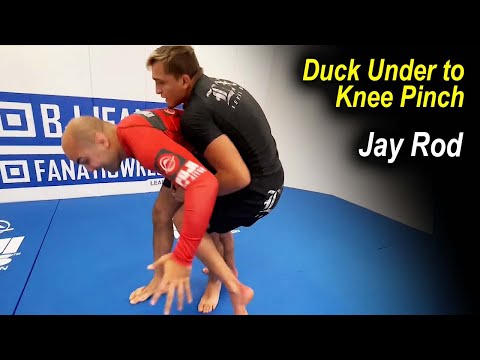
Duck Under to Knee Pinch - Jay Rod
0
Standard Duck Under·Bernardo Faria BJJ Fanatics
Duck Under To Knee Pinch Takedown - In this BJJ Training video, Jay Rodriguez teaches the Duck Under to Knee Pinch taked…
Translation: standard duck under (katakana)
The Standard Duck Under subfamily represents the basic duck under technique used as a general offensive tool, where the attacker ducks under the opponent's arm to achieve any advantageous position — side, behind, or angle — for a takedown. [1] The standard duck under prioritises creating an angular advantage over specifically achieving the back, giving the attacker flexibility to chain into whichever takedown is most available. [1],[2] The technique works from various tie-up positions including collar tie, underhook, and overhook, making it one of the most versatile positional-advantage techniques in wrestling. [2],[3]
The standard duck under is the fundamental version of the technique, using a level change to duck beneath the opponent's arm while maintaining contact. [1]
This is the baseline duck under taught in wrestling programmes at all levels. [1]
The standard duck under is a regular technique in NCAA and freestyle competition. [1]
No images yet for this technique.
Sign in to suggest an image.
Duck Under To Knee Pinch Takedown - In this BJJ Training video, Jay Rodriguez teaches the Duck Under to Knee Pinch taked…
No instructional courses yet for this technique.
Sign in to suggest a course.
Risk of injury to the person this technique is applied to
Duck under to rear; minimal impact, position-based
Skill level needed to execute this technique reliably
Whether this technique is allowed under major competition rule sets
Japanese amateur wrestling terminology
Japanese amateur wrestling terminology
Standard katakana transliteration of Western martial arts terminology (外来語) — used in Japanese MMA, boxing, and BJJ communities
Standard katakana transliteration used in Japanese wrestling (レスリング)
level change speed, agility, flexibility to duck under the arm
shorter stature for easier level change
quadriceps, core, neck, hip flexors
Every move, in any martial art, shares a few universal traits. Mix and match below to pinpoint the right tool — or compare equivalents across styles.
When you drop to a knee and go outside, it keeps your opponent's weight going past you rather than right into you, which prevents them from fighting your movement. This positional awareness helps you maintain control of the exchange.
You want to go slightly around your opponent rather than directly into them, which sets you up for follow-up controls like a knee pinch.
The Standard Duck Under subfamily represents the basic duck under technique used as a general offensive tool, where the attacker ducks under the opponent's arm to achieve any advantageous position — side, behind, or angle — for a takedown. The standard duck under prioritises creating an angular advantage over specifically achieving the back, giving the attacker flexibility to chain into whichever takedown is most available.
The standard duck under has been a staple of wrestling instruction and competition across multiple styles for generations. Its versatility and low energy cost ensure its continued relevance in modern wrestling, grappling, and MMA.
IJF: legal — Legal takedown technique; IBJJF: legal — Legal at all belt levels, scored as takedown (2 points); UWW: legal — Legal in both freestyle and Greco-Roman; Unified MMA: legal — Legal takedown technique; ADCC: legal — Legal, scored 2-4 points in second half of match; FIAS Sport Sambo: legal — Legal — all takedowns permitted; FIAS Combat Sambo: legal — Legal; NCAA Folkstyle: legal — Legal, scored as takedown (2 points)
Danger rating 3/10. Moderate — duck under to rear; minimal impact, position-based
The standard setup chain: Establish Contact → Create Off-Balance → Execute the Takedown → Follow to Ground.
Standard counters include: Sprawl — drop hips back and drive weight down to stuff the takedown attempt / Underhook — establish inside position to control distance and prevent the takedown entry / Post and Circle — post on the attacker's head and circle away to break their angle / Level Change Defence — recognize the shot early and react with appropriate hip defence.
Common variants: Standard duck under (level changing under the opponent's arm to take the back); Duck under to single leg (using the duck under to transition to a single-leg attack); Duck under from overhook (ducking under when the opponent holds an overhook).
The standard duck under is a regular technique in NCAA and freestyle competition.
Top errors to watch for: Ducking straight down instead of laterally through to the other side / Not pushing the arm up first, so it drops onto your neck as you try to duck / Moving slowly enough that the opponent simply re-squares their stance / Looking at the floor during the duck, losing track of the opponent's position.
The Standard Duck Under is also known as Dakku Andā, Duck Under, Dip Under, Moguri.