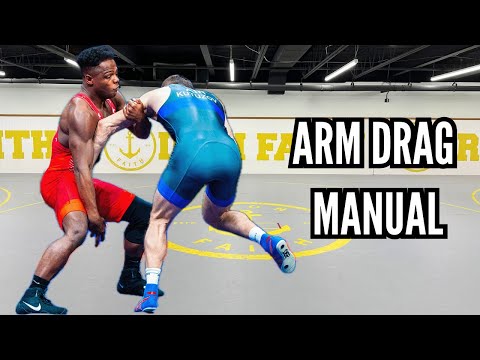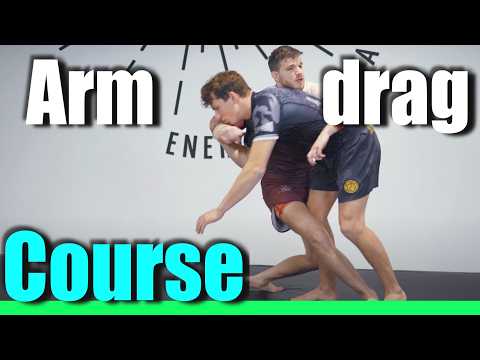
Armdrag TAKEDOWNS | Grappling BJJ
0
Standard Standing Arm Drag·Energia Martial Arts
Armdrag TAKEDOWNS | Grappling BJJ Back on our feet today to share you some more takedowns! This time we take a step by s…
Translation: standard standing arm drag
The Standard Standing Arm Drag executes the fundamental standing arm drag where the attacker grabs the opponent's wrist and tricep, pulls the arm sharply across the body, and steps behind the opponent to achieve an angle or back position. [1] The pulling action rotates the opponent's body and exposes their side or back, creating openings for single-leg, double-leg, or back-take finishes. [1],[2] The attacker must step off the line simultaneously with the pull to avoid being dragged back into a neutral position. [2] The standing arm drag is one of the most commonly used offensive setups in wrestling and grappling. [2],[3]
The standing arm drag is a high-percentage technique because it creates an immediate angular advantage from a standard clinch position. [1] By pulling the opponent's arm across their body, the attacker creates a clear path to the opponent's side or back. [1] The technique is low-risk and low-energy, making it effective across full matches. [2]
The standard standing arm drag is a regular setup technique in NCAA and freestyle competition. [1]
No images yet for this technique.
Sign in to suggest an image.
Armdrag TAKEDOWNS | Grappling BJJ Back on our feet today to share you some more takedowns! This time we take a step by s…
Iron Faith Merch ➡️ https://amptstudio.chipply.com/ifwc/ Join the #1 Online Wrestling Academy in the world ➡️ https://w…
On this week’s Technique Tuesday, rising Mizzou star Aeoden Sinclair shows how he chains together clean head outside att…
The standard standing arm drag is a fundamental upper-body takedown entry executed by controlling the opponent's arm and using footwork to establish positioning for follow-up attacks. Energia Martial Arts emphasizes gripping deep into the armpit rather than at the elbow, allowing control of the torso through the arm, and stepping chest-to-chest on the inside rather than circling widely around the opponent. Iron Faith Wrestling identifies two primary footwork patterns: stepping with the outside leg while pivoting to hug the shoulder, or stepping through with the inside foot. Both sources agree that arm drags are set up using push-pull-fake combinations and serve to generate opponent movement, making subsequent shots easier to execute. FloWrestling's Aiden Sinclair focuses on the head-outside variant, prioritizing elbow depth at the knee pit and toe alignment, with particular attention to beating the opponent's defensive arm when they turn inward. All three instructors recommend transitioning from the arm drag into diverse takedowns—double legs, single legs, high crotches, and go-behinds—though Energia emphasizes judo trips and Sinclair highlights the slide-by variation used against heavy collar-tie pressure. Common defensive chain drills across sources include handling the opponent's second-arm defense and adjusting when the opponent steps back or circles.
Synthesized from 3 instructors
No instructional courses yet for this technique.
Sign in to suggest a course.
Risk of injury to the person this technique is applied to
Arm drag creates angle for safe takedown entry
Skill level needed to execute this technique reliably
Whether this technique is allowed under major competition rule sets
Japanese amateur wrestling terminology
Japanese amateur wrestling terminology
Standard katakana transliteration of Western martial arts terminology (外来語) — used in Japanese MMA, boxing, and BJJ communities
Standard katakana transliteration used in Japanese wrestling (レスリング)
hand speed, lateral agility, quick level change
quick hands and explosive hips
biceps, deltoids, core rotators, hip flexors
When your opponent turns into you, make sure you have the elbow beat with your head outside—this gives you control. According to Aeoden Sinclair, you can then bring your arm inside to maintain the elbow beat as he turns, preventing him from escaping.
Aeoden Sinclair emphasizes that if your opponent's elbow gets back, the finish becomes much more difficult because they'll pull their leg back and sprawl, leaving you chasing the leg and stuck underneath.
According to Energia Martial Arts instruction, you should grab deep inside the armpit with your wrist, going all the way behind the shoulder. This allows you to control your opponent's torso through their arm rather than just moving the arm itself, and prevents you from slipping if they step back.
Iron Faith Wrestling teaches that you drag the arm to make your opponent circle into you, which puts them in a position where you can shoot a double leg with your hips in and drive through.
The Standard Standing Arm Drag executes the fundamental standing arm drag where the attacker grabs the opponent's wrist and tricep, pulls the arm sharply across the body, and steps behind the opponent to achieve an angle or back position. The pulling action rotates the opponent's body and exposes their side or back, creating openings for single-leg, double-leg, or back-take finishes.
The standing arm drag has been a core wrestling technique for generations, fundamental to the offensive systems of both freestyle and folkstyle wrestling. Its versatility ensures its continued use across all grappling and combat sports.
IJF: legal — Legal takedown technique; IBJJF: legal — Legal at all belt levels, scored as takedown (2 points); UWW: legal — Legal in both freestyle and Greco-Roman; Unified MMA: legal — Legal takedown technique; ADCC: legal — Legal, scored 2-4 points in second half of match; FIAS Sport Sambo: legal — Legal — all takedowns permitted; FIAS Combat Sambo: legal — Legal; NCAA Folkstyle: legal — Legal, scored as takedown (2 points)
Danger rating 3/10. Moderate — arm drag creates angle for safe takedown entry
The standard setup chain: Establish Contact → Create Off-Balance → Execute the Takedown → Follow to Ground.
Standard counters include: Sprawl — drop hips back and drive weight down to stuff the takedown attempt / Underhook — establish inside position to control distance and prevent the takedown entry / Post and Circle — post on the attacker's head and circle away to break their angle / Level Change Defence — recognize the shot early and react with appropriate hip defence.
Common variants: Standing arm drag (pulling the arm across from collar tie to take an angle b…); Seated arm drag (executing from a seated guard pull position); Arm drag to back take (dragging to circle fully behind the opponent).
The standard standing arm drag is a regular setup technique in NCAA and freestyle competition.
Top errors to watch for: Pulling the arm in front of you instead of past your hip — the arm needs to clear your body / Stepping with the wrong foot first (inside foot instead of outside foot) / Getting the angle but standing too far away to attack — stay hip-to-hip / Not pulling sharply enough — a gradual pull lets the opponent retract and re-square.
The Standard Standing Arm Drag is also known as Sutandingu Āmu Doraggu, Standing Arm Drag Takedown, Arm Pull to Angle, Tricep Drag.