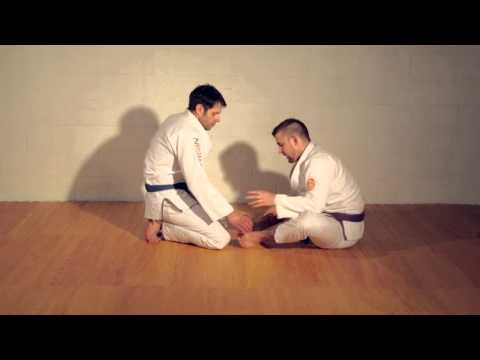
2-02 Seated Arm Drag (3-D Jiu-Jitsu)
0
Seated Arm Drag·Artechoke Media
This video is from 3-D Jiu-Jitsu, a free e-book written by Marshal D. Carper and published by Artechoke Media. 3-D Jiu-J…
Translation: seated arm drag (katakana)
The Seated Arm Drag subfamily covers arm drag takedowns initiated from a seated position, commonly from butterfly guard or seated guard in BJJ and submission grappling. [1] The seated attacker grabs the opponent's wrist or tricep and pulls the arm across their body while simultaneously scooting the hips behind the opponent, achieving a back-take or angle that enables a takedown or sweep. [1],[2] Seated arm drags are a cornerstone of modern no-gi grappling and are frequently used as the primary offensive tool from seated guard positions. [2],[3]
Seated arm drags were popularised in BJJ and no-gi grappling through competitors like Marcelo Garcia, who made the butterfly guard arm drag one of the most effective techniques in competition. [1] The seated application adapted standing wrestling arm drag mechanics to the ground-based guard positions central to BJJ. [2],[3]
Marcelo Garcia's seated arm drag was a primary entry to back takes in his ADCC gold medal performances (2003, 2005, 2007, 2009). [1]
No images yet for this technique.
Sign in to suggest an image.
This video is from 3-D Jiu-Jitsu, a free e-book written by Marshal D. Carper and published by Artechoke Media. 3-D Jiu-J…
No instructional courses yet for this technique.
Sign in to suggest a course.
Risk of injury to the person this technique is applied to
Arm drag creates angle for safe takedown entry
Skill level needed to execute this technique reliably
Whether this technique is allowed under major competition rule sets
Japanese BJJ community standard terminology
Japanese BJJ community standard terminology
Standard katakana transliteration of Western martial arts terminology (外来語) — used in Japanese MMA, boxing, and BJJ communities
Katakana transliteration used in Japanese BJJ community
precise timing, ankle flexibility, upper body pulling coordination
quick feet and excellent sense of balance
tibialis anterior, calf muscles, hip rotators, grip
Every move, in any martial art, shares a few universal traits. Mix and match below to pinpoint the right tool — or compare equivalents across styles.
No. According to Artechoke Media's 3-D Jiu-Jitsu instruction, you should avoid going directly between the legs if you want to successfully execute a takedown. Instead, move around the legs while working to pass the guard.
Keep your head forward and move your whole body away rather than leaning too far back, using a spring-like push to quickly pop the grip. Artechoke Media emphasizes moving your entire body as a unit to break the connection.
Opening your feet makes it easier to move forward during the technique, which helps you generate momentum and pop up into position, according to Artechoke Media's instruction.
The Seated Arm Drag subfamily covers arm drag takedowns initiated from a seated position, commonly from butterfly guard or seated guard in BJJ and submission grappling. The seated attacker grabs the opponent's wrist or tricep and pulls the arm across their body while simultaneously scooting the hips behind the opponent, achieving a back-take or angle that enables a takedown or sweep.
Seated arm drags were popularised in BJJ and no-gi grappling through competitors like Marcelo Garcia, who made the butterfly guard arm drag one of the most effective techniques in competition. The seated application adapted standing wrestling arm drag mechanics to the ground-based guard positions central to BJJ.
IJF: legal — Legal takedown technique; IBJJF: legal — Legal at all belt levels, scored as takedown (2 points); UWW: legal — Legal in both freestyle and Greco-Roman; Unified MMA: legal — Legal takedown technique; ADCC: legal — Legal, scored 2-4 points in second half of match; FIAS Sport Sambo: legal — Legal — all takedowns permitted; FIAS Combat Sambo: legal — Legal; NCAA Folkstyle: legal — Legal, scored as takedown (2 points)
Danger rating 3/10. Moderate — arm drag creates angle for safe takedown entry
The standard setup chain: Establish Contact → Create Off-Balance → Execute the Takedown → Follow to Ground.
Standard counters include: Sprawl — drop hips back and drive weight down to stuff the takedown attempt / Underhook — establish inside position to control distance and prevent the takedown entry / Post and Circle — post on the attacker's head and circle away to break their angle / Level Change Defence — recognize the shot early and react with appropriate hip defence.
Common variants: Timing sweep (catching the opponent as they step, sweeping the foot at …); Combination sweep (chaining sweeps to both sides to catch the opponent's adj…); Counter sweep (sweeping as the opponent initiates their own attack or step).
Marcelo Garcia's seated arm drag was a primary entry to back takes in his ADCC gold medal performances (2003, 2005, 2007, 2009).
Top errors to watch for: Pulling the arm without hip-escaping to the side — you end up in the same position / Staying seated after the drag instead of immediately coming up to attack / Dragging from too far away, unable to get past the opponent's shoulder line / Forgetting the butterfly hook control that keeps the opponent in range.
The Seated Arm Drag is also known as Shīteddo Āmu Doraggu, Sitting Arm Drag, Butterfly Arm Drag, Guard Arm Drag.