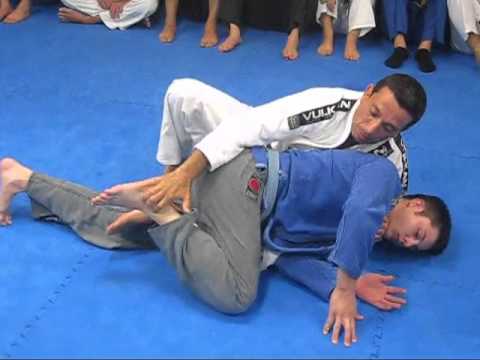
arm drag to side control and submissions
0
Standard Seated Arm Drag·FIT Jiu Jitsu Jordan/ Samy Aljamal·Added by Admin
Translation: standard seated arm drag
The Standard Seated Arm Drag executes the fundamental seated arm drag where the attacker, sitting with butterfly hooks or in seated guard, grabs the opponent's wrist with one hand and the tricep with the other, then pulls the arm across the body while simultaneously scooting the hips to the outside. [1] The drag creates an angle that exposes the opponent's back, and the hip scoot positions the attacker behind the opponent for a back take or single-leg finish. [1],[2] The key is simultaneous arm pull and hip movement — the drag alone is insufficient without the hip repositioning. [2] The standard seated arm drag is one of the most frequently drilled and applied techniques in modern no-gi competition. [2],[3]
The seated arm drag is effective in no-gi grappling because it allows the bottom fighter to create an angle and take the back from a seated guard position. [1] The technique was revolutionised in competitive grappling by Marcelo Garcia, who demonstrated its effectiveness against much larger opponents. [1]
No images yet for this technique.
Sign in to suggest an image.
No instructional courses yet for this technique.
Sign in to suggest a course.
Risk of injury to the person this technique is applied to
Arm drag creates angle for safe takedown entry
Skill level needed to execute this technique reliably
Whether this technique is allowed under major competition rule sets
Japanese BJJ community standard terminology
Japanese BJJ community standard terminology
Standard katakana transliteration of Western martial arts terminology (外来語) — used in Japanese MMA, boxing, and BJJ communities
Katakana transliteration used in Japanese BJJ community
hand speed, lateral agility, quick level change
quick hands and explosive hips
biceps, deltoids, core rotators, hip flexors
Instead of relying on strength, cup their leg with your hand and lift their foot up while bringing them toward you—this mechanical advantage allows you to progress the technique when raw power won't work. Samy Aljamal demonstrates this approach in his arm drag to side control sequence.
Place your ankle on their thigh as they defend with their arm, then grab their arm from either the top or bottom position to control it—this way you maintain control even if you can't insert your leg where you originally intended. Samy Aljamal emphasizes knowing how to control the arm is essential when the leg placement is blocked.
The Standard Seated Arm Drag executes the fundamental seated arm drag where the attacker, sitting with butterfly hooks or in seated guard, grabs the opponent's wrist with one hand and the tricep with the other, then pulls the arm across the body while simultaneously scooting the hips to the outside. The drag creates an angle that exposes the opponent's back, and the hip scoot positions the attacker behind the opponent for a back take or single-leg finish.
The standard seated arm drag became a foundational no-gi technique through Marcelo Garcia's dominance in ADCC competition during the 2000s–2010s. His systematic approach to the seated arm drag transformed it from an occasional technique to a primary offensive system.
IJF: legal — Legal takedown technique; IBJJF: legal — Legal at all belt levels, scored as takedown (2 points); UWW: legal — Legal in both freestyle and Greco-Roman; Unified MMA: legal — Legal takedown technique; ADCC: legal — Legal, scored 2-4 points in second half of match; FIAS Sport Sambo: legal — Legal — all takedowns permitted; FIAS Combat Sambo: legal — Legal; NCAA Folkstyle: legal — Legal, scored as takedown (2 points)
Danger rating 3/10. Moderate — arm drag creates angle for safe takedown entry
The standard setup chain: Establish Contact → Create Off-Balance → Execute the Takedown → Follow to Ground.
Standard counters include: Sprawl — drop hips back and drive weight down to stuff the takedown attempt / Underhook — establish inside position to control distance and prevent the takedown entry / Post and Circle — post on the attacker's head and circle away to break their angle / Level Change Defence — recognize the shot early and react with appropriate hip defence.
Common variants: Standing arm drag (pulling the arm across from collar tie to take an angle b…); Seated arm drag (executing from a seated guard pull position); Arm drag to back take (dragging to circle fully behind the opponent).
Marcelo Garcia's arm drag became one of the most studied techniques in competitive submission grappling after his four ADCC titles. His seated arm drag to back take sequence produced numerous submissions in ADCC and other major tournaments.
Top errors to watch for: Dragging without the hip escape, ending up chest-to-chest with the opponent still facing you / Releasing the tricep grip after the drag, losing control of the arm / Not using the butterfly hook to assist the off-balance during the drag / Coming up behind the opponent but not securing the seatbelt quickly enough — they turn to face you.
The Standard Seated Arm Drag is also known as Shīteddo Āmu Doraggu, Seated Arm Drag Takedown, Marcelo Garcia Arm Drag, Butterfly Drag.