Introduction to Arm Drag Mechanics
The arm drag is presented as an efficient technique applicable across multiple positions. The instructor emphasizes that the technique's power derives from moving oneself rather than forcefully moving the opponent, a principle that reduces energy expenditure and increases effectiveness regardless of size differential.
Conceptual Framework: Standing and Seated Positions
The arm drag operates on the same fundamental principles whether executed from standing or seated positions. The instructor frames standing posture as analogous to guard positioning, where maintaining proper leg placement relative to the opponent remains the priority rather than attempting direct takedowns.
Butt Scoot Posture Fundamentals
Proper butt scoot setup requires specific body positioning: chest forward with an arched back, feet placed with outside edges digging into the mat, and elbows positioned between knees and ankles. This configuration creates a stable structure that resists forward pressure and enables quick multidirectional movement.
Defense Against Head and Collar Pressure
The arched-back posture functions as a structural anchor, distributing downward pressure through the hips to the mat rather than compromising neck safety. When the opponent grabs the collar, the practitioner can rapidly load and spring backward by moving the entire body rather than just extending the arms.
Grip Mechanics and Forward Movement
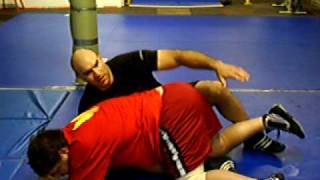
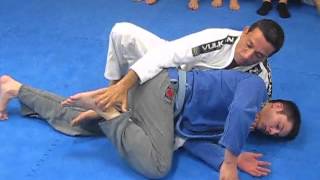
The arm drag begins with a wrist grip combined with an elbow drag toward the body. The instructor exploits the opponent's natural resistance by using their backward pull as momentum to drive forward and upward, effectively converting defensive energy into offensive positioning.
Execution from Seated Position
From the seated position, the practitioner pulls the opponent's wrist while using that grip to rise upward. The forward momentum allows the practitioner to swing a leg upward for additional momentum, then drive it downward to complete the standing position transition.
Integration with Standing Game
Understanding the arm drag's application in both seated and standing contexts accelerates development of the standing game. Recognizing positional parallels between guard work and standing posture allows practitioners from a defensive background to systematically develop their takedown and control mechanics.
2-02 Seated Arm Drag (3-D Jiu-Jitsu)
Key Takeaways
- •Introduction to Arm Drag Mechanics
- •Conceptual Framework: Standing and Seated Positions
- •Butt Scoot Posture Fundamentals
- •Defense Against Head and Collar Pressure
This video is from 3-D Jiu-Jitsu, a free e-book written by Marshal D. Carper and published by Artechoke Media. 3-D Jiu-Jitsu is a demonstration of the Artechoke instructional model, which we plan to apply to Matt "Aesopian" Kirtley's Mastering the Crucifix and Reverse Omoplata. To support Matt's book, please visit ArtechokeMedia.com and pre-order the book via our Indiegogo fundraiser. To access your free copy of 3-D Jiu-Jitsu, visit www.ArtechokeMedia.com/3DBJJ Follow us on Facebook: https://www.facebook.com/ArtechokeMedia Follow us on Twitter: https://twitter.com/ArtechokeMedia
Related Techniques
Frequently Asked Questions
What does this video teach about seated arm drag?
This video covers introduction to arm drag mechanics, conceptual framework: standing and seated positions, butt scoot posture fundamentals. It provides detailed instruction from Artechoke Media.
How long does it take to learn seated arm drag?
The basic mechanics can be understood in a single session, but developing reliable execution requires consistent drilling over weeks of practice. This 7-part breakdown helps structure your training by isolating each phase of the technique.
What are the key details for finishing seated arm drag?
From the seated position, the practitioner pulls the opponent's wrist while using that grip to rise upward. The forward momentum allows the practitioner to swing a leg upward for additional momentum, then drive it downward to complete the standing position transition.