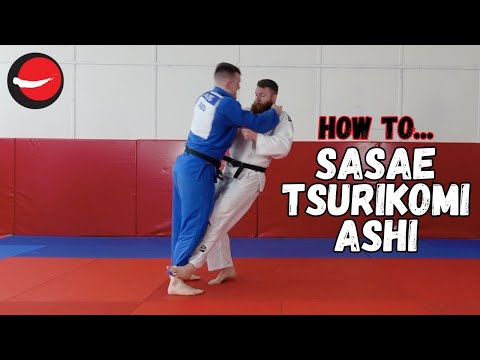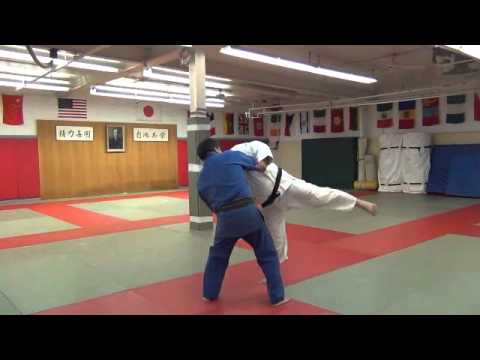
Sasae Tsurikomi Ashi
0
Sasae Tsurikomi Ashi·WINNING
Fundamentals of Sasae Tsurikomi Ashi (Proping Ankle) Throw as demonstrated by Sensei's Felix & Jim @ the Tohkon Judo Aca…
Translation: propping drawing ankle throw
Sasae Tsurikomi Ashi (lifting-pulling propping ankle block) is a foot sweep subfamily where the attacker blocks the opponent's advancing foot with the sole of their own foot while using a lifting-pulling hand action to direct the opponent's body over the blocked foot. [1] Unlike sweeping techniques that remove the foot, sasae blocks the foot in place and rotates the opponent's upper body over this fixed point, creating a rotational fall. [1],[2] The technique requires the attacker to time the block with the opponent's forward step and simultaneously create a strong circular pulling action with the hands. [2] Sasae tsurikomi ashi is one of judo's most elegant techniques, demonstrating the principle of using the opponent's force against them. [2],[3]
Sasae tsurikomi ashi is one of the original judo techniques classified in the Kodokan gokyo-no-waza and has been a fundamental part of judo training since the art's founding by Jigoro Kano. [1] The technique exemplifies kuzushi (off-balancing) and tsukuri (fitting) principles central to judo philosophy. [2],[3]
Sasae tsurikomi ashi is a common scoring technique in IJF judo competition and is frequently used as a setup for other throws. [1]
No images yet for this technique.
Sign in to suggest an image.
Fundamentals of Sasae Tsurikomi Ashi (Proping Ankle) Throw as demonstrated by Sensei's Felix & Jim @ the Tohkon Judo Aca…
How To Sasae Tsurikomi Ashi is taken from the Judo Way of Life online learning program!! Sasae Tsurikomi Ashi is a trem…
No instructional courses yet for this technique.
Sign in to suggest a course.
Risk of injury to the person this technique is applied to
Timing-based sweep; lower force than trips
Skill level needed to execute this technique reliably
Whether this technique is allowed under major competition rule sets
Kodokan Judo — Official Nage-waza Classification
Traditional Judo throwing/takedown terminology (Kodokan Institute)
Official Kodokan ground technique classification system
Standard Japanese martial arts terminology (kanji/hiragana)
Established Japanese martial arts naming convention — native Japanese term (和語/漢語)
Traditional Judo throwing/takedown terminology (Kodokan Institute)
timing, balance, upper body control for push-pull
good coordination and sense of opponent's weight distribution
core stabilisers, hip adductors/abductors, calves
Every move, in any martial art, shares a few universal traits. Mix and match below to pinpoint the right tool — or compare equivalents across styles.
Sasae tsurikomi ashi (propping drawing ankle throw) appears referenced in 22 books under 'sasae' — one of the most widely documented foot techniques. The attacker blocks the opponent's advancing foot while pulling them forward over the block. First throw in the Kodokan's gokyo no waza (first group). (Kano, Kodokan Judo)
The Judo Way of Life emphasizes that sasae tsurikomi ashi involves more complexity than just where you stick the leg—it requires understanding the principles of foot placement, body positioning, and how to break your opponent's balance before executing the throw.
WINNING recommends throwing toward the top of the triangle between their feet, as this is the easiest direction for you and the hardest for them to defend; if you throw to the side, they can bridge with their leg to block.
WINNING clarifies that it is a foot block, not a kick—you control your uke with good posture and place your foot to block their step as they overreach.
The Judo Way of Life confirms that you don't have to use the traditional same-side sleeve and leg grip; you can attack with alternative grips like a lapel or top grip while maintaining the same underlying principles of the throw.
Sasae Tsurikomi Ashi (lifting-pulling propping ankle block) is a foot sweep subfamily where the attacker blocks the opponent's advancing foot with the sole of their own foot while using a lifting-pulling hand action to direct the opponent's body over the blocked foot. Unlike sweeping techniques that remove the foot, sasae blocks the foot in place and rotates the opponent's upper body over this fixed point, creating a rotational fall.
Sasae tsurikomi ashi is one of the original judo techniques classified in the Kodokan gokyo-no-waza and has been a fundamental part of judo training since the art's founding by Jigoro Kano. The technique exemplifies kuzushi (off-balancing) and tsukuri (fitting) principles central to judo philosophy.
IJF: legal — Legal (ashi-waza) — trips executed without grabbing opponent's legs are permi…; IBJJF: legal — Legal at all belt levels, scored as takedown (2 points); UWW: restricted — Legal in freestyle, restricted in Greco-Roman (leg-to-leg contact prohibited); Unified MMA: legal — Legal takedown technique; ADCC: legal — Legal, scored 2-4 points in second half of match; FIAS Sport Sambo: legal — Legal — all takedowns permitted; FIAS Combat Sambo: legal — Legal; NCAA Folkstyle: legal — Legal, scored as takedown (2 points)
Danger rating 4/10. Moderate — timing-based sweep; lower force than trips
The standard setup chain: Establish Contact → Create Off-Balance → Execute the Takedown → Follow to Ground.
Standard counters include: Sprawl — drop hips back and drive weight down to stuff the takedown attempt / Underhook — establish inside position to control distance and prevent the takedown entry / Post and Circle — post on the attacker's head and circle away to break their angle / Level Change Defence — recognize the shot early and react with appropriate hip defence.
Common variants: Standard trip (blocking or sweeping the support leg while driving the up…); Combination trip (chaining an inside trip with an outside trip when the opp…); Counter trip (using the trip as a counter when the opponent attacks); Clinch trip (executing the trip from a tight clinch position).
Sasae tsurikomi ashi is a common scoring technique in IJF judo competition and is frequently used as a setup for other throws.
Top errors to watch for: Sweeping instead of blocking — sasae is a prop, not a sweep / Blocking too early when no weight has committed to the foot / Not applying the lifting-pulling hand action, relying only on the foot block / Blocking too high on the shin instead of at the ankle.
The Sasae Tsurikomi Ashi is also known as Sasae Tsurikomi Ashi, Propping Drawing Ankle Throw, Lifting Pulling Foot Block.